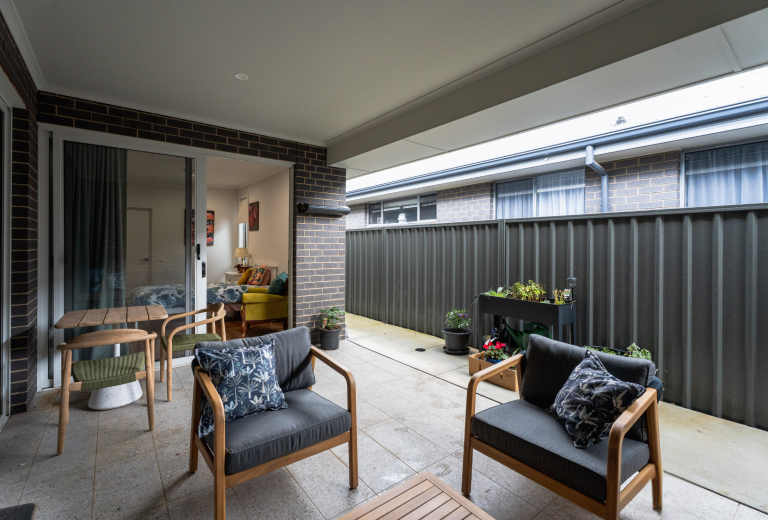
ID: Photo of an alfresco area that has been intentionally designed for a client who has dementia. Featuring sturdy seating areas and easy access to the bedroom.
Good design is about more than creating beautiful spaces. At its best, it helps people feel comfortable, safe and independent in their everyday lives.
When interior designer Steve Angel, from Décor Made Easy, looks at a room, he sees more than furniture, colours and floorplans. He sees opportunity: an opportunity to create a space where someone can continue doing the things they enjoy, feel connected to the people around them and maintain independence in a home that supports their needs.
Recently, Steve worked alongside My Ability Pathway to transform a small north-facing alfresco area into a practical outdoor retreat for a client living with dementia. The client loved gardening and wanted somewhere she could enjoy the sunshine, spend time with family and friends, and continue doing something she was passionate about.
What emerged was much more than an outdoor sitting area. It became a space that supported connection, routine and independence.
Starting with the Person
For Steve, successful design starts by understanding the individual.
“The client loves gardening, so what we looked to achieve was an extra space for her to have a little bit of autonomy,” Steve explains. “Somewhere where she could sit and have a cup of tea, enjoy the northern sun, have family and friends visit, and create a little bit of space for gardening because that’s what she loves.”
Positioned just outside the client’s bedroom, the outdoor area naturally extends her living space, making it easy to access throughout the day while offering a peaceful place to relax.
“It’s literally off the client’s bedroom… and it’s a great use of the space.” Steve says.
Small Design Choices Make a Big Difference
Inclusive design is often about details that many people may not immediately notice, but that can have a significant impact on someone’s confidence, comfort and safety.
For this project, furniture was carefully selected to provide stability and reassurance. Steve chose solid timber seating that would not move unexpectedly when someone sat down, while dining chairs were fitted with rubber stoppers to prevent them from sliding away.
“We wanted fairly generous seating, quite solid, so it’s not something too flimsy if someone isn’t too stable on their feet,” Steve says. “You can sort of flop into it and it won’t slide away.”
Rather than creating a space filled with busy patterns or overwhelming colours, the design remains calm and inviting. As Steve puts it, “It’s just simplistic, with a bit of colour in the cushions. Nothing too demanding or dramatic.”
What Designing for Dementia Has Taught Steve
Through previous work designing dementia-specific environments in aged care spaces, Steve has seen firsthand how thoughtful design can improve quality of life. One of the biggest lessons was understanding that people living with dementia may experience their surroundings differently.
Something as simple as a patterned floor can create confusion. Steve recalls learning that flooring with strong borders or contrasting lines could sometimes be perceived as an obstacle that residents felt they needed to step over.
“People thought patterned floors or border lines were something they had to step over, so we learned we couldn’t have those sorts of designs because they affected people’s confidence to move freely.”
Those observations also revealed creative ways to gently guide movement without using physical barriers. In one aged care setting, a wallpaper border placed at eye level helped guide a resident through a space where she had previously become stuck, preserving her freedom while reducing frustration and confusion.
“We discovered we could use visual cues to encourage people through spaces or away from certain areas without putting up barriers. It worked extremely well.”
Colour and contrast also play an important role, particularly for people experiencing vision changes. Steve learned that artwork, patterns and decorative elements work best when they feature clear edges and strong contrast.
“We learned that artwork needed nice sharp edges and good contrast. Anything blurry or soft could become difficult to interpret, so we were very mindful of choosing crisp patterns and images.”
Designing for Independence, Not Just Appearance
For Steve, inclusive design is about helping people maintain control over their daily lives and continue doing the things that matter to them.
He recalls working with an older woman who had severe arthritis and struggled to use the chain-operated blinds installed in her room. The blinds may have looked modern, but they were not functional for the person using them.
“She used to have to call staff just to put the blind up or down.”
By replacing them with motorised blinds and an accessible wall-mounted remote, she was able to manage them independently and no longer needed to ask staff for help.
“She became so much more independent because she was in control of that.”
For Steve, this is what inclusive design is all about: thinking first, rather than simply following design trends.
“It’s a little bit more thinking first, and not just saying, ‘Well, that’s the fashion in design.’ Let’s think about whether that’s suitable.”
Creating Spaces That Empower
Inclusive design does not require creating clinical spaces or removing personality from a home. Instead, it means understanding how people experience their environment and making thoughtful choices that support safety, confidence and independence.
Whether it is selecting stable furniture, creating clearer visual cues, improving accessibility or enabling people to continue pursuing the hobbies they love, thoughtful design can have a lasting impact on quality of life.
As Steve’s work shows, the most successful spaces are not necessarily the most stylish or the most expensive. They are the spaces that help people keep doing what matters most.
“If design can help people become independent – whatever that means for them – that’s a fantastic thing.”