We value your privacy
This website uses technical, functional and analytical cookies that do not infringe on your privacy.
General purpose platform session cookies are usually used to maintain an anonymised user session by the server.

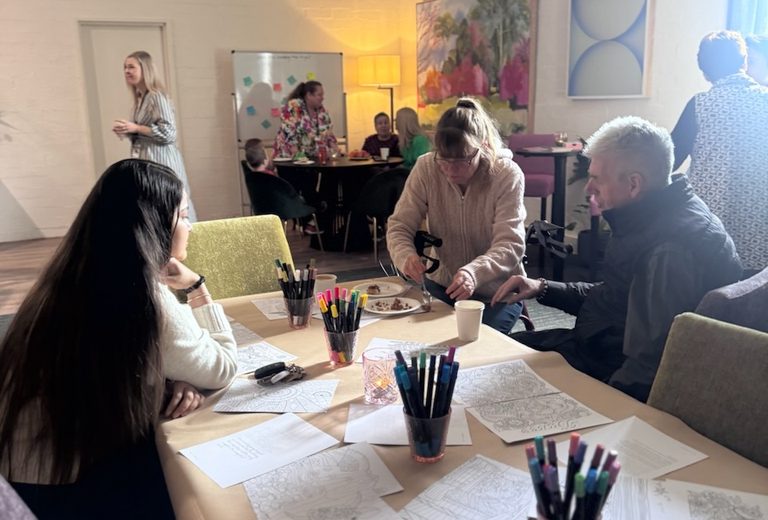
ID: Group of people sitting around a table with colouring in pages.
At My Ability Pathway, wellbeing is something we talk about often, but it is also something we need to make time for intentionally. In the disability sector, so much of the work is centred on supporting others – often through complex, emotional and physically demanding days. For frontline team members in particular, the rhythm of care can mean giving a lot of yourself, day after day.
Recently, we held our Wellbeing Together event at MAP HQ. It was planned around the time of R U OK? Day, but with a slightly different focus. While awareness days can be important reminders to check in, we wanted to create something that felt practical, gentle and ongoing – a space where people could pause, connect and be reminded that wellbeing is not a one-day conversation.
The morning itself was simple, but in many ways that was what made it meaningful. Around the room were small wellbeing stations designed to give people different ways to slow down. Some team members sat together colouring in, enjoying the quiet focus and conversation that can come from doing something with your hands. Others took time to reflect, sitting with prompts that invited them to notice what was happening in their internal world. There was also a massage chair for a much-needed neck and back massage, along with good food, drinks and time to talk.
Nothing about it was complicated. And perhaps that was the point. Sometimes wellbeing begins with permission – permission to step away from the pace of the day, to sit beside someone you may not usually work with, to take a breath, or to notice that you are carrying more than you realised.
Wellbeing Together was primarily created for our team, while also being open to clients. It gave us an opportunity to come together in a way that was relaxed and human, away from tasks, rosters, emails and routines. It was also a chance to bridge the perceived gap that can sometimes exist between frontline and administration teams.
In an organisation like MAP, every role contributes to the same purpose. Some people provide direct support in homes and communities. Others coordinate services, manage systems, communicate with families and stakeholders, or help keep the organisation moving behind the scenes. Events like this remind us that we are not separate groups doing separate work – we are one team, supporting people in different but connected ways.
For people working in the disability sector, wellbeing cannot be an afterthought. Supporting people with significant disabilities can be deeply rewarding, but it can also be exhausting. The emotional labour, the responsibility, the unpredictability and the physical demands can add up quietly over time.
That is why checking in matters – not just with the people around us, but with ourselves. Am I actually doing okay? What do I need right now? Who can I talk to if I am not coping? These questions are not signs of weakness. They are part of staying well enough to keep showing up with care, patience and compassion.
We also used the event as an opportunity to connect our team with local wellbeing resources. Lifeline has recently opened at the Barossa Community Centre on Second Street in Nuriootpa, making support more accessible within our community. While Lifeline is well known for suicide prevention, its services extend beyond crisis support. They offer free, confidential counselling, unlimited support sessions, mental health and emotional wellbeing support, and a safe space to talk through life’s challenges – big or small.
You do not need to be in crisis to reach out. Support can be for stress, anxiety, grief, relationship challenges, work pressures or the everyday weight of life. Knowing where to turn before things become overwhelming is an important part of looking after ourselves and each other.
We also encourage our male team members to explore Good Better Best Men, a volunteer-run organisation offering open men’s groups and workshops focused on connection, wellbeing and supporting one another. Sometimes the hardest step is starting the conversation, and community spaces like these can make that step feel a little easier.
Wellbeing Together was never about replacing formal supports or suggesting that one morning could meet every need. It was about reminding our team that support exists, that connection matters, and that caring for yourself is part of caring well for others.
Our hope is that events like this help create a culture where wellbeing is not only spoken about when things are difficult, but woven into the everyday. A culture where people feel safe to say they need a moment, where reaching out is encouraged, and where no one feels they have to carry things alone.
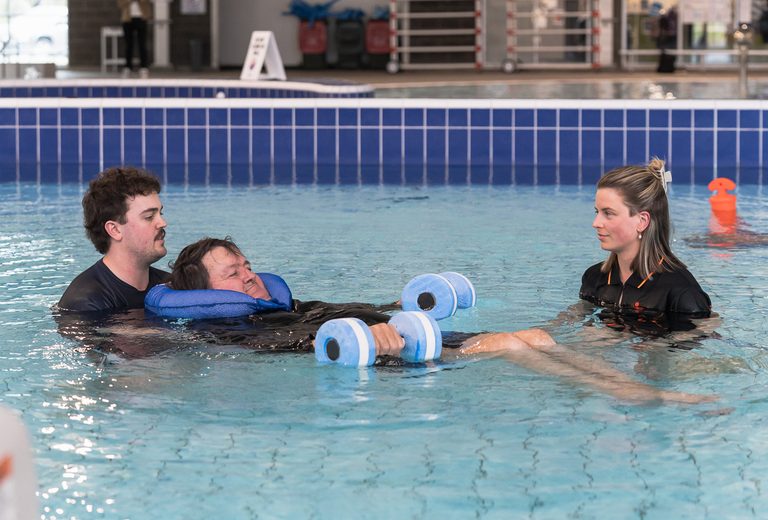
ID: A photo of Ian at The Rex Barossa Aquatic Fitness with Physiotherapist Aaron (left) and My Ability Pathway Service Delivery Lead Brooke (right).
For Ian, hydrotherapy is about more than exercise. It is time out of the house, time away from the routines of everyday life, and an opportunity to move in a way that feels more possible.
Supported by his My Ability Pathway team and guided by Aaron from Tanunda Physiotherapy, Ian has been attending hydrotherapy as part of his broader therapy routine. Together, they are working toward a goal that holds deep meaning for him: walking.
When asked what walking again would mean to him, Ian’s answer was simple: “A lot. I used to do a lot of it.”
Hydrotherapy uses the warmth, buoyancy and support of water to help people move with less pressure on their joints. For Ian, the water provides a space where exercise can feel more achievable than it does on land.
“When the water’s fairly warm it’s beautiful,” Ian said. While he is still working toward getting more movement and strength back in his legs, hydrotherapy has become an important part of that process.
Ian’s support worker Ryan has seen the difference that consistent therapy is making. “Since I’ve started working with you, you’ve definitely got more flexibility in your legs,” Ryan said. “You can straighten up a lot more than you used to.”
That progress matters. For many people, therapy is not about one big moment of change. It is about small improvements over time: a little more movement, a little more confidence, a little more comfort, and the support to keep going.
Ryan supports Ian to get to and from hydrotherapy, helping make the routine possible. For Ian, this practical support means he can continue accessing therapy, stay connected to his goals and take part in something he enjoys.
“It gets me out of the house,” Ian said. “It’s much easier to do the exercises in the water than it is on dry land.”
That sense of enjoyment is just as important as the exercises themselves. When supports are built around a person’s goals, interests and daily life, therapy can become something meaningful rather than just another appointment.
Aaron, Ian’s physiotherapist from Tanunda Physiotherapy, has been supporting Ian through a mix of hydrotherapy and land-based therapy. He has seen how the water can create opportunities that may not be available in other environments.
“The hydrotherapy is definitely fantastic for Ian,” Aaron said. “He’s allowed to do a lot more things in the water than he might not be able to do on land, and it’s an opportunity to just relax a little bit as well, just get out of the chair and move a little bit more freely in the water.”
For Ian, this combination of movement, relaxation and support is helping him continue working toward his goals. Each session is another step in building flexibility, confidence and capacity.
At My Ability Pathway, support looks different for every person. For some people, it might be building independence at home. For others, it might be reconnecting with community, learning new skills or working toward mobility goals. For Ian, hydrotherapy is one part of a bigger journey – one guided by patience, encouragement and the belief that every step forward matters.
And while Ian is clear that he is still working toward where he wants to be, he is also clear about what keeps him going: the chance to move, to get out, and to keep working toward walking again.
Progress can take time, but with the right team and the right supports around him, Ian is continuing to move forward – in the water, on land, and toward the goals that matter most to him.

ID: Two men walking forward, looking at the camera. The man on the left is supporting the man on the right.
Michael’s story is one of resilience, dignity, and the power of consistent, thoughtful care. Living with Parkinson’s disease and dementia, his journey has brought challenges – but it has also highlighted how the right support can help preserve independence, mobility, and wellbeing.
As his daughter Carmen reflects, “Dad’s journey hasn’t been easy… from being a fit, working man to not knowing what his future held… was a challenging time for our family.”
Despite these challenges, Michael remains, first and foremost, a person who enjoys movement, thrives on routine, and values connection.
Conditions like Parkinson’s disease and dementia can significantly affect mobility, coordination, and overall physical wellbeing over time. Maintaining movement is not just about physical health – it’s about preserving confidence, comfort, and a sense of self.
Consistency plays a powerful role here. Familiar routines and repeated activities help reduce confusion and anxiety, creating a sense of safety and predictability. As Michael’s team explains, “A consistent approach allows Michael to feel more comfortable, safe, and confident during activities.”
This consistency also reinforces movement patterns, supporting independence and helping to maintain mobility for as long as possible.
Michael receives personalised exercise physiology support in his home environment – an approach that allows his therapy to fit seamlessly into his daily life.
His sessions include a variety of engaging, purposeful activities such as:
Each activity is carefully adapted to suit Michael’s needs, abilities, and even how he is feeling on the day. Importantly, the program is built around what he enjoys – particularly walking – helping him stay motivated and engaged. Alongside this, Michael attends regular physiotherapy sessions, with both disciplines working together to support his mobility, safety, and independence.
Over time, the impact of familiar faces and regular routines has been significant. Trusted support workers and structured sessions not only encourage participation but also build confidence.
As his care team notes, “Having familiar support workers, repeated exercise routines, and structured sessions helps him better understand what is expected and encourages participation.”
Consistency also plays a key role in physical outcomes – supporting balance, stability, and strength through regular practice.
While Parkinson’s disease and dementia are progressive conditions, the results of Michael’s ongoing support highlight the difference consistent care can make.
Since beginning his program:
His team reflects positively on these outcomes: “Overall… the ongoing exercise support has played an important role in maintaining his mobility, preventing falls and keeping him engaged and active in a safe environment.”
For Carmen, the changes go beyond physical health:
“Dad’s mobility has increased and he has been happier, more well and his mental health has improved.”
And the impact on daily life is meaningful:
“Dad’s mobility means he can move with comfort and ease, get out to the community more often… and live more independently.”
Michael’s story is a reminder that even in the face of progressive conditions, thoughtful and tailored support can make a profound difference.
Through consistent care, personalised therapy, and familiar routines, it is possible to preserve not just physical ability – but dignity, confidence, and quality of life.
At My Ability Pathway (MAP), there is a deep commitment to providing high-quality Supported Independent Living (SIL) supports that are centred around each individual. This means working alongside people like Michael to understand what matters most to them – whether that’s maintaining mobility, staying connected to community, or simply feeling comfortable in their daily routines.

ID: Photo of people in a work meeting
Growing up, I knew I was flexible.
I could do the cool party trick of clasping my hands together and somehow getting my arms all the way around my body without letting go. I could do the splits without practice. I could place my hands flat on the floor without bending my knees. My fingers are all double-jointed, which made for some pretty freaky-looking hand tricks.
At first, it felt fun. Different. Almost like a talent.
What I didn’t realise at the time was that my body was quietly trying to tell me something.
May is globally recognised as Ehlers-Danlos Syndrome and Hypermobility Spectrum Disorder awareness month – a time to shine a light on conditions that are often invisible, misunderstood, and difficult to diagnose.
For me, the signs were there long before I had a name for any of it.
In high school, I started getting migraines. In Year 12, I developed a shin splint. I was constantly finding bruises in random places with no memory of how they got there. Joints would dislocate easily – and by easily, I mean sometimes I’d simply sit down and my knee would pop out of place. Rolled ankles were practically guaranteed during PE.
And then there was the fatigue.
Not “I stayed up too late” tired. A deep, relentless exhaustion that followed me everywhere.
If I was sitting still for too long, staying awake became a battle. Uni lectures were especially difficult. I lost count of how many times I fell asleep in my seat – not because I wasn’t interested, and not because I hadn’t slept, but because my body simply shut down when stationary for too long. Snacks during lectures became a survival strategy. The hour-plus drive home afterwards was awful. I used to keep my mum on speed dial because talking to someone was often the only thing that helped me stay awake.
There were other symptoms I couldn’t explain, too – like air hunger, that unsettling feeling of not being able to take a full breath no matter how deeply you inhale. For many people with HSD, connective tissue differences can affect the way the ribcage expands and moves, making something as automatic as breathing suddenly feel like work.
The strange thing is, for years I thought this was normal.
I thought everyone’s joints hurt. I thought everyone felt exhausted all the time. I thought everyone bruised easily, rolled their ankles constantly, or felt breathless for no obvious reason.
Then I was rear-ended at a traffic light and experienced whiplash.
What followed were months of appointments with different healthcare professionals. Physiotherapists. Chiropractors. Osteopaths. I’d get temporary relief, but nothing lasted. One chiropractor would realign my spine only for it to shift again almost immediately.
Eventually, I was diagnosed with HSD.
The diagnosis itself was strangely anticlimactic. I was handed an A4 piece of paper with a little bit of information and sent on my way. No real explanation. No roadmap. No support network. Just a label for something I barely understood.
But at the same time, it finally made sense.
The joint pain. The instability. The bruising. The fatigue.
Unfortunately, my experience of waiting years for answers isn’t unusual.
Recent global research involving almost 4,000 people found that, despite affecting as many as one in 500 people, those living with HSD wait an average of 17 years from symptom onset to diagnosis, while people with hypermobile EDS wait even longer – 22 years on average. Most reported experiencing symptoms in childhood or adolescence but were often misdiagnosed or dismissed before finally receiving answers.
That statistic stopped me in my tracks when I first read it, because it reflects what so many of us already know: the symptoms are real, but recognition often comes far too late.
Later in life, I spent years seeing specialists trying to work out ongoing gut issues, only to eventually learn that this too can be connected to HSD.
That’s one of the hardest parts about invisible disabilities and conditions like HSD and EDS – symptoms don’t fit neatly into one box. They affect multiple systems throughout the body, not just joints. Research now confirms what many people with lived experience have known all along: HSD is far more than simply being “double-jointed.”
Most of what I’ve learned since my diagnosis hasn’t come from the healthcare system. It’s come from lived experience, online communities, and social media – from other people with HSD and EDS sharing what has helped them navigate daily life.
And along the way, I’ve also learned how frustrating misconceptions can be.
“Just exercise more.”
“Just stretch.”
These comments are usually well-intentioned, but they completely miss the reality of living with hypermobility.
If you’re hypermobile, exercising the wrong muscles or moving in the wrong way can cause more injuries. I was constantly pulling or pinching muscles because my body was compensating in ways it shouldn’t have to.
And stretching? My muscles are already overworked. They’re tight for a reason. They’re trying to hold my body together.
I used to explain hypermobility to people by saying, “My muscles do the job my ligaments are supposed to do.”
Even though I know it’s a lot more complicated than that, it’s still the simplest way I know how to describe it.
The reality of invisible disability is that people often only see what’s on the surface.
I “look fine”.
But what people don’t see are the joints slipping out of place, the constant fatigue, the pain, the muscle tension, the migraines, the air hunger, the digestive issues, or the way everyday tasks can take more energy than they should.
That’s why awareness matters.
Not for sympathy, but for understanding.
Because there are so many people living with conditions like HSD and EDS who are still searching for answers, still trying to explain symptoms nobody else can see, or still questioning whether what they experience is “normal”.
Invisible disabilities need the same recognition, compassion, and support as visible ones.
You really can’t judge a body by the way it looks.

ID: photo of a person sitting in a wheelchair facing away from the camera.
At My Ability Pathway (MAP), meaningful outcomes often begin with listening – really listening – to a person’s history, preferences, and what brings them comfort.
For one of our clients – who lives with Down Syndrome and Dementia and is non-verbal – this approach led to the introduction of a simulated pet through Dementia Support Australia, championed by MAP’s Support Coordination team.
The idea was sparked during a visit from a Behaviour Practitioner, who took the time to understand the client’s background. A simple but important detail stood out: she had always had dogs. Building on this, the practitioner arranged for a simulated pet to be introduced – something familiar, comforting, and aligned with her lived experience.
The introduction itself was calm and intentional. While seated at the dining table, staff gently placed the simulated pet in front of the client, modelling interaction by softly stroking it and speaking to it. What followed was a natural progression – initial observation, then curiosity, and soon, active engagement.
Since then, the impact has been clear.
The client presents with a noticeably happier and more positive mood, regularly engaging with the pet through touch and exploration. She strokes it, activates its sounds, and spends time interacting with its different textures – from its ears to its paws – often smiling throughout. These moments of sensory engagement have become meaningful parts of her day.
For a client who communicates non-verbally, connection looks different – but no less powerful. She now points to the simulated pet to gain staff attention, inviting shared interaction and creating opportunities for connection. What may seem like a small gesture is, in reality, a significant form of communication and choice.
This outcome is a strong reflection of what person-centred practice looks like in action. By exploring creative, tailored supports, the team has enabled greater emotional expression, engagement, and enjoyment – supporting the client to connect with the world around her in a way that feels natural and meaningful.
Behind this outcome is proactive and thoughtful Support Coordination. Recognising an opportunity to better support the client, the Support Coordinator reached out to Dementia Australia for guidance. This led to a referral to Dementia Support Australia, with consent from the client’s nominee – ultimately opening the door to a tailored intervention that has made a real difference.
Simulated pets are therapeutic tools – often robotic or plush animals – designed to replicate the look, feel, and responsiveness of real pets. Commonly used in dementia care, they provide comfort and emotional connection without the responsibilities or risks associated with live animals.
They can help reduce anxiety, agitation, and social isolation, while encouraging sensory engagement and nurturing behaviours such as holding, stroking, or interacting with the pet. For individuals with limited verbal communication, simulated pets offer a powerful non-verbal way to express emotion and build connection – supporting wellbeing in a way that is both gentle and deeply personal.
For more information on virtual simulated pets visit: https://www.dementia.com.au/resource-hub/the-use-of-simulated-pets-in-dementia-care
Photo by Steven HWG on Unsplash

ID: Three girls walking with their backs to the camera.
Home life is busy. For a family of six – Mum, Dad, three girls and their dog, Freckles – most days start like any other family: getting ready for school and preparing for what lies ahead. But woven into their daily routine are therapy sessions with occupational therapists, speech pathologists and psychologists.
This family is one of many living with autism.
And they thrive! With three children with ASD, they have found a rhythm and joy in the everyday. Their lives are built on understanding, resilience and celebrating wins.
For Emily*, the first signs came at age five. What initially seemed like childhood quirks gradually formed a clearer picture—particularly a moment at a friend’s house when she covered her ears after flushing the toilet. It prompted a deeper look at patterns: sensitivities to noise and fabrics, challenges with sleep, and a preference for order (like keeping foods separate on her plate).
“We had always attributed her quirky behaviours as just being due to being little,” Mum says. “But when we spoke to the doctor, it was the first time we looked at all those little quirks and saw the bigger picture.”
“Lucy* was a little easier to see, once we understood Emily,” she continues. “But she had some of her own special traits.” Lucy’s differences included toe walking, sensory-seeking behaviours, and a love of movement—like swinging high on the swings—as well as selective eating habits.
“The main barrier we faced was getting a referral for an assessment – and then there was the waiting list!” Mum recalls. “For our youngest daughter, we paid for her to be assessed privately. It was so much faster, but it was an expensive process.”
Despite the challenges, having a diagnosis proved to be a turning point. It opened doors to funding and support through the NDIS, along with access to therapies and resources that have helped the family better understand and meet each child’s needs.
Ask the girls what they’re most proud of, and their answers come quickly.
“My biggest strength is swimming,” Emily says. “And I’m really proud of my swimming. I’m working hard to become an Olympic swimmer.”
Lucy shares that love of the water – and also shines in the kitchen: “I am really proud of learning how to bake and being able to make things in the kitchen on my own, with mum or dad just supervising.”
They find great joy in their passions.
“Spending time in the kitchen and the pool makes me happy,” Lucy says.
Emily agrees. She takes great pleasure in “spending time in the pool with my swimming friends.”
For Mum and Dad, an evening reflection proves the perfect way to focus on joy and the everyday wins. “At dinner we share the best part of our day, to find something that made us happy, even on a tricky day.”
“The word spectrum can be confusing. It makes people think that autistic people are somewhere along a continuum, whereas it’s more complicated than that,” Mum says. “Every child is unique with their own set of skills and challenges. For our girls, we have heard quite a lot about how they make eye contact, so they can’t have autism. We have three autistic girls, and they are all so very different.”
What people don’t always see is the effort it takes.
“Something [our girls] do have in common is working very hard at school, to focus and do their best – and then the struggles at home to regulate after a long day,” Mum shares. “I think more people need to be aware of just how hard some autistic children work to stay regulated and focused all day.”
Emily’s advice is simple but powerful: “Don’t let being autistic make you give up on your dreams.”
For Mum and Dad, connection is key. Seeking out support, accessing available services, and finding other families who understand the journey has made a meaningful difference. “There is lots of help and support out there, so make the most of it. Finding other families who have autistic children has been helpful for us as they understand our girls.”
*Names have been changed to protect the privacy of the children.
Photo by Steve Lieman on Unsplash
