We value your privacy
This website uses technical, functional and analytical cookies that do not infringe on your privacy.
General purpose platform session cookies are usually used to maintain an anonymised user session by the server.

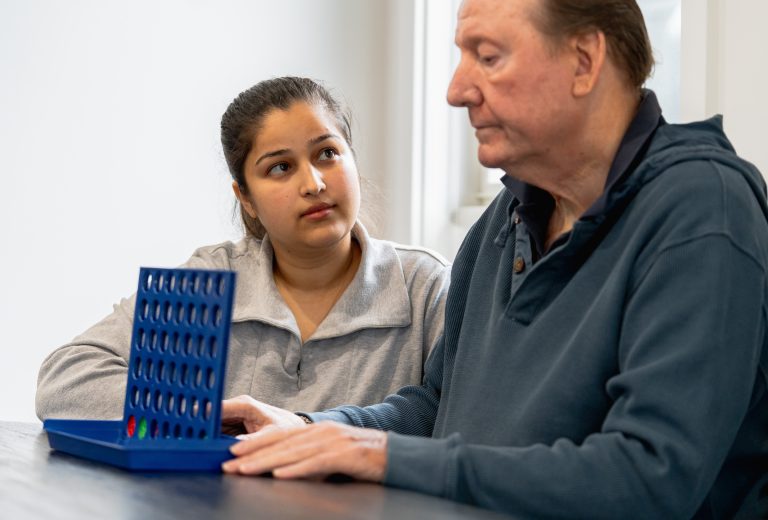
ID: A women carer sitting at a table with a man playing connect four.
At My Ability Pathway, every team member brings a unique story, shaped by experiences that fuel their passion for supporting others. For Smriti, her journey into the disability sector is rooted deeply in compassion, family, and a desire to make a meaningful difference.
Before joining MAP, Smriti worked in the aged care sector, where she developed a strong commitment to supporting vulnerable communities. Her connection to care, however, began much earlier.
“I used to live with my grandparents because my Mum & Dad were both abroad, so that has pushed me to this point,” she shares.
That early experience instilled a natural sense of empathy and responsibility – qualities that continue to shape the way she supports participants today. Transitioning into her role at MAP felt like a natural step, allowing her to expand her impact while continuing to grow personally and professionally.
“Especially joining MAP, it has helped me with personal growth… it’s been really empowering.”
For Smriti, one of the most rewarding aspects of working in the disability sector is the constant sense of variety and progress. No two days are the same – and that’s exactly what keeps her motivated.
“Every day is different, that’s for sure,” she says.
But it’s the small, meaningful milestones that leave the biggest impression. Watching participants build confidence and independence over time is what makes the work truly fulfilling.
“I like seeing how the clients are more confident in what they are doing… it’s nice to see them build their confidence over time.”
Smriti describes her role not as being at the forefront, but as standing just behind participants – supporting, encouraging, and celebrating their achievements.
“It’s nice to just be in the background and look at them reach those goals.”
Working in the disability sector isn’t just about supporting others – it’s also a journey of self-growth. Smriti believes the impact goes both ways, leaving lasting changes not only in the lives of participants but also in those who support them.
“If you want something that’s really, really rewarding and fulfilling and you want to make changes in lives, including your own, then I’d say that the disability sector is that.”
Smriti’s story reflects what so many MAP team members experience – purpose-driven work that empowers both participants and support workers alike. Through compassion, consistency, and connection, meaningful change becomes possible every day.
Her journey is a powerful reminder that growth doesn’t always happen in big, dramatic moments. Often, it’s found in the quiet progress, the steady confidence-building, and the shared wins along the way.

ID: Two men walking towards the camera. The man on the left has Down Syndrome.
For Dave, working in the disability sector was never just about finding a job – it was about finding something that meant more.
Like many, his journey started with study. While completing a Certificate III in Individual Support (Ageing and Disability) through TAFE, Dave was introduced to My Ability Pathway (MAP) during a presentation. What stood out wasn’t just the information – it was the feeling he got about the organisation itself.
“I thought they seemed very, very professional,” Dave says. “So I thought, I’ll give them a buzz and see if there is the possibility of a job.”
That one decision turned into the beginning of a career.
Dave joined MAP as a Support Worker while still studying – an opportunity that gave him immediate, real-world experience in a role built around people, not just tasks.
What drew him in initially still holds true today.
“Their professionalism and their 1:1 care really appealed,” he says. “And they had friendly staff.”
It’s a simple observation, but one that reflects something deeper about the work – the importance of genuine connection and consistency in support.
Because at its core, this industry isn’t about ticking boxes. It’s about showing up for someone else.
Within just six months, Dave transitioned into a Key Worker position – a natural progression that reflects both his commitment and the opportunities available within the sector.
His role has since expanded beyond direct support into leadership and coordination.
“I’ve had a little bit more hands on with administration… helping teach other workers and running the house day to day,” he explains. “A lot of paperwork – it’s a good challenge.”
It’s a shift that highlights something often overlooked: growth in this sector doesn’t mean stepping away from people – it means finding new ways to support them, while also supporting your team.
Ask Dave what he enjoys most about his role, and his answer is immediate.
“Probably a bit of the teaching and making a difference to other people’s lives.”
There’s a quiet honesty in that response. It speaks to the heart of disability support – that the reward isn’t about recognition, but about impact.
It’s about what you can give.
And that perspective shapes how Dave sees the work as a whole.
“Any of us could be in that position at any time,” he says. “It’s nice to know that there are caring people out there.”
For anyone considering a career in the sector, Dave’s advice is simple:
“Definitely jump at it – because it’s very rewarding. Not just for yourself, but for the clients as well.”
It’s a reminder that this kind of work asks something of you – your time, your patience, your empathy – but it also gives something back that’s hard to find elsewhere.
A sense of purpose.
A chance to grow.
And the opportunity to make a real difference in someone’s everyday life.
Because in the end, it’s not about the job title.
It’s about the impact you leave behind.
If you have experience as a Support Worker in aged care or disability and are looking for the stability of a rostered line of 38+ hours per week, we’d love to hear from you. Explore current opportunities and apply via My Ability Pathway Careers.

ID: A photo of a women and a man smiling.
Across three very different journeys, a common thread emerges: sometimes the most meaningful careers begin in unexpected places. For three of the MAP team, the path into disability support didn’t start in healthcare or community services—it started in the fast-paced, high-pressure world of commercial kitchens.
As chefs, Subi, Lana and Chris mastered long hours, intense environments, and the art of staying calm when everything around them demanded urgency. Over time, each of them was pulled toward something more sustainable, more balanced, and ultimately, more purposeful.
Drawn to disability support by a deep motivation to connect, to care, and to make a tangible difference in people’s lives, the diversity of career experience amongst MAP’s team showcases how transferable skills like resilience, organisation, and empathy opens doors to an entirely new career.
As chefs, Subi, Lana and Chris were accustomed to long hours, and busy weeks. “I used to be working sixteen-hour shifts,” Subi says. “It was very intense.”
Transitioning into disability support offered not just a change of role, but a shift in lifestyle. “I used to be a chef for seven years,” Chris reflects. “But then three years ago I got married … and I couldn’t balance my work/life.” Being able to prioritise time with family, the transition to the disability industry offered increased flexibility and structure. This has led to a renewed sense of balance and wellbeing, Importantly, this balance didn’t come at the cost of fulfilment—quite the opposite.
“I decided to pursue opportunities that would provide a better work-life balance,” Lana says. “And I find the work highly rewarding. Seeing the smiles on the clients’ faces brings me daily joy and a real sense of fulfillment in my work.
Subi agrees. “To see people smiling, a smile on their face is all we want. That’s the most satisfying thing in this role.”
“Being a chef was a very demanding job,” Subi remembers. “Disability is not an easy industry either. But it’s a very fulfilling job. You can make a difference in people’s lives.”
Despite leaving the kitchen behind, none of our team started from scratch. In fact, their hospitality experience became a strong foundation for success in support work. Working under pressure is a critical strength, as Chris highlights: “It’s pretty demanding working in the kitchen. I moved to a pub in Melbourne; in the first weekend we did 4000 meals. But I was calm and focused. That’s one thing that I bring into this sphere. Then I started as a support worker. For the first time, I was greeted when I walked into a job. By the client. That felt different for me. It’s very rewarding.”
“I can handle pressure and be calm,” Subi agrees. “I’m very good at dealing with people.”
Organisational skills and time management are other key things our team attribute to their time in the kitchen. As Lana shares, “My strong organisational and time management abilities enable me to stay on task and ensure that all responsibilities are completed efficiently for my clients.”
For Subi, Lana and Chris, the move into disability support work initially seemed like natural stopping point. However, all three describe their experiences with MAP opening doors to leadership opportunities and career progression—an often overlooked avenue in support work.
“I never thought of being in a leadership role of being a Key Worker,” Chris says. “I took it because working with different clients changed my mind. I’m almost a year into the leadership role and now I believe that I’m the perfect fit.”
“I did not initially see myself progressing into more senior roles,” Lana agrees. “However, my commitment to my clients grew and I developed a strong desire to do more. As a result, stepping into a higher-level role became a natural progression in my career.”
Subi shared a similar experience, and adds, “If you have the right team around you, it gives you confidence, it helps you to see the things that you have not discovered by yourself.”
The strongest theme shared is the emotional impact of support work. These moments capture what makes disability support unique—the ability to see, feel, and be part of meaningful change in someone’s life.
While deeply fulfilling, all three acknowledged that the work comes with challenges and requires the right mindset. “If you’ve got … a good attitude and you feel empathy and you want to do something rewarding, I would definitely recommend disability support work,” Chris says.
“Stepping into disability support work is both a meaningful and rewarding journey,” Lana agrees, while Subi says, “If you do the right thing, it can make an impact on people. There was a client with us, we had a very hard beginning with him. The whole team could see the difference in his life, the positive impact our support had on him. That hit me hard.”
Chris, too, shares a highlight moment in his journey so far. “I have my client who doesn’t speak at all, speak for about two minutes. Twice! I just laughed and cried, I was so over the moon, it was very rewarding.”
For Lana, this experience comes often. “Since joining MAP, I have experienced this feeling many times. The growth I have seen in our clients—their increased confidence and capacity building—is truly remarkable.”
From the intensity of the kitchen to the impact of disability support, Subi, Lana and Chris’s stories celebrate change and finding meaningful work that supports not just their clients, but also themselves. They’re united by where they came from, as well as where they’ve arrived: roles grounded in empathy, purpose, and connection.
For anyone considering a similar move, their experiences offer a simple but powerful message—your skills are more transferable than you think, and the right opportunity can lead to professional growth and a deeper sense of fulfilment in both work and life.
If you have experience as a Support Worker in aged care or disability and are looking for the stability of a rostered line of 38+ hours per week, we’d love to hear from you. Explore current opportunities and apply via My Ability Pathway Careers.

ID: A smiling woman with dark hair wearing a green top.
Career changes can often feel daunting, especially when moving into a completely different industry. But as Skye has discovered since joining My Ability Pathway (MAP) as Workforce Planner, the skills you develop throughout your career can be more transferable than you might think.
As MAP’s Workforce Planner, Skye plays a key role in ensuring the organisation’s services run smoothly.
“As MAP’s Workforce Planner, I coordinate client support schedules and support operational planning,” Skye explains. “My role focuses on streamlining processes, analysing data, and providing behind-the-scenes support so teams can deliver consistent, high-quality outcomes for our clients.”
While much of the work happens behind the scenes, it plays an important part in ensuring teams have the structure and support they need to deliver the best possible outcomes.
Before joining MAP, Skye spent more than 25 years working in the franchising industry in roles spanning legal and compliance, finance, debt recovery and administration. Those experiences provided a strong foundation in organisation, planning and operational systems.
Today, she’s applying those skills in a new environment.
“My goal at MAP is to continue strengthening workforce planning and operational systems while supporting the team to work efficiently and confidently,” she says. “I’m rapidly learning about the disability sector while contributing to MAP’s ongoing growth and improvement.”
Skye’s journey to MAP began in an unexpected way.
“In late 2025, MAP identified a need for stronger workforce planning and operational support,” she explains. “Through a school-pick up conversation with Charlotte, I was introduced to the opportunity – it quickly became clear the role aligned well with my skills and experience.”
Not long after, Skye stepped into the newly created Workforce Planner role and began applying her experience to a sector focused on supporting people and communities.
Transitioning into disability services brought some new perspectives and learning opportunities.
“The biggest adjustment has been shifting from a process-driven environment to one where participant outcomes come first,” Skye says.
“While systems and structure remain important, flexibility is essential in disability services. Learning to balance efficiency with care-focused decision-making has been a rewarding challenge.”
For anyone considering a career change into the disability sector, Skye believes transferable skills are incredibly valuable.
“Don’t underestimate the value of your transferable skills!” she says. “Skills like organisation, planning, communication, and problem-solving are highly relevant.”
She also encourages people to approach the change with curiosity and patience.
“Be open to learning, ask questions (I’ve asked plenty!) and give yourself time to adjust. MAP is very supportive and encourages people to grow into their roles.”
These skills don’t just help individuals transition into new roles – they also strengthen organisations.
“Transferable skills bring fresh perspectives and practical solutions,” Skye explains. “They help improve processes, support teams, and ensure services run smoothly.”
“At MAP, these skills directly contribute to better coordination, stronger operations, and improved outcomes for our clients.”
Like any role, workforce planning comes with both rewarding moments and challenges.
“A highlight is seeing schedules, systems, and processes working well and knowing the team feels supported,” Skye says.
At the same time, the role requires strong organisation and adaptability.
“A challenge is managing multiple moving parts across the organisation – but staying organised, adaptable, and calm helps.”
What makes a difference, she says, is the supportive culture at MAP.
“The collaborative culture at MAP makes a big difference.”
For Skye, one of the most important things people should know about working at MAP is that diverse experiences are valued.
“MAP values diverse experience and supports people to succeed, regardless of their background,” she says.
“Even if you come from a different industry, your skills can make a real and meaningful impact here – for both the team and the people we support.”
