We value your privacy
This website uses technical, functional and analytical cookies that do not infringe on your privacy.
General purpose platform session cookies are usually used to maintain an anonymised user session by the server.

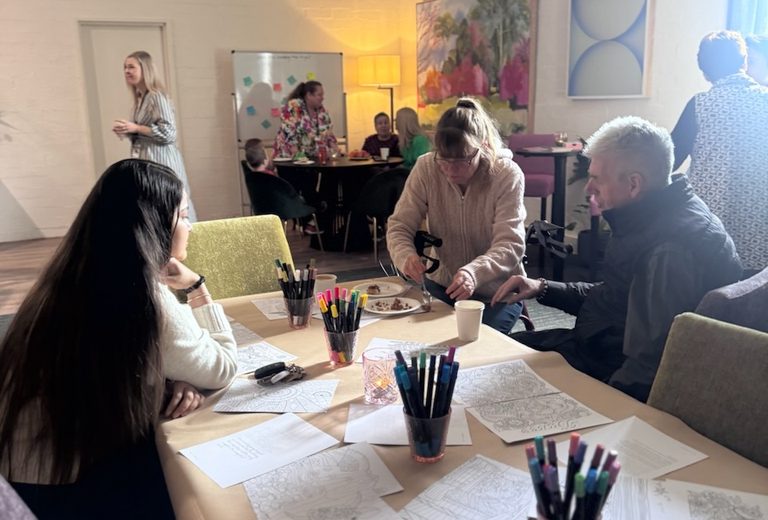
ID: Group of people sitting around a table with colouring in pages.
At My Ability Pathway, wellbeing is something we talk about often, but it is also something we need to make time for intentionally. In the disability sector, so much of the work is centred on supporting others – often through complex, emotional and physically demanding days. For frontline team members in particular, the rhythm of care can mean giving a lot of yourself, day after day.
Recently, we held our Wellbeing Together event at MAP HQ. It was planned around the time of R U OK? Day, but with a slightly different focus. While awareness days can be important reminders to check in, we wanted to create something that felt practical, gentle and ongoing – a space where people could pause, connect and be reminded that wellbeing is not a one-day conversation.
The morning itself was simple, but in many ways that was what made it meaningful. Around the room were small wellbeing stations designed to give people different ways to slow down. Some team members sat together colouring in, enjoying the quiet focus and conversation that can come from doing something with your hands. Others took time to reflect, sitting with prompts that invited them to notice what was happening in their internal world. There was also a massage chair for a much-needed neck and back massage, along with good food, drinks and time to talk.
Nothing about it was complicated. And perhaps that was the point. Sometimes wellbeing begins with permission – permission to step away from the pace of the day, to sit beside someone you may not usually work with, to take a breath, or to notice that you are carrying more than you realised.
Wellbeing Together was primarily created for our team, while also being open to clients. It gave us an opportunity to come together in a way that was relaxed and human, away from tasks, rosters, emails and routines. It was also a chance to bridge the perceived gap that can sometimes exist between frontline and administration teams.
In an organisation like MAP, every role contributes to the same purpose. Some people provide direct support in homes and communities. Others coordinate services, manage systems, communicate with families and stakeholders, or help keep the organisation moving behind the scenes. Events like this remind us that we are not separate groups doing separate work – we are one team, supporting people in different but connected ways.
For people working in the disability sector, wellbeing cannot be an afterthought. Supporting people with significant disabilities can be deeply rewarding, but it can also be exhausting. The emotional labour, the responsibility, the unpredictability and the physical demands can add up quietly over time.
That is why checking in matters – not just with the people around us, but with ourselves. Am I actually doing okay? What do I need right now? Who can I talk to if I am not coping? These questions are not signs of weakness. They are part of staying well enough to keep showing up with care, patience and compassion.
We also used the event as an opportunity to connect our team with local wellbeing resources. Lifeline has recently opened at the Barossa Community Centre on Second Street in Nuriootpa, making support more accessible within our community. While Lifeline is well known for suicide prevention, its services extend beyond crisis support. They offer free, confidential counselling, unlimited support sessions, mental health and emotional wellbeing support, and a safe space to talk through life’s challenges – big or small.
You do not need to be in crisis to reach out. Support can be for stress, anxiety, grief, relationship challenges, work pressures or the everyday weight of life. Knowing where to turn before things become overwhelming is an important part of looking after ourselves and each other.
We also encourage our male team members to explore Good Better Best Men, a volunteer-run organisation offering open men’s groups and workshops focused on connection, wellbeing and supporting one another. Sometimes the hardest step is starting the conversation, and community spaces like these can make that step feel a little easier.
Wellbeing Together was never about replacing formal supports or suggesting that one morning could meet every need. It was about reminding our team that support exists, that connection matters, and that caring for yourself is part of caring well for others.
Our hope is that events like this help create a culture where wellbeing is not only spoken about when things are difficult, but woven into the everyday. A culture where people feel safe to say they need a moment, where reaching out is encouraged, and where no one feels they have to carry things alone.
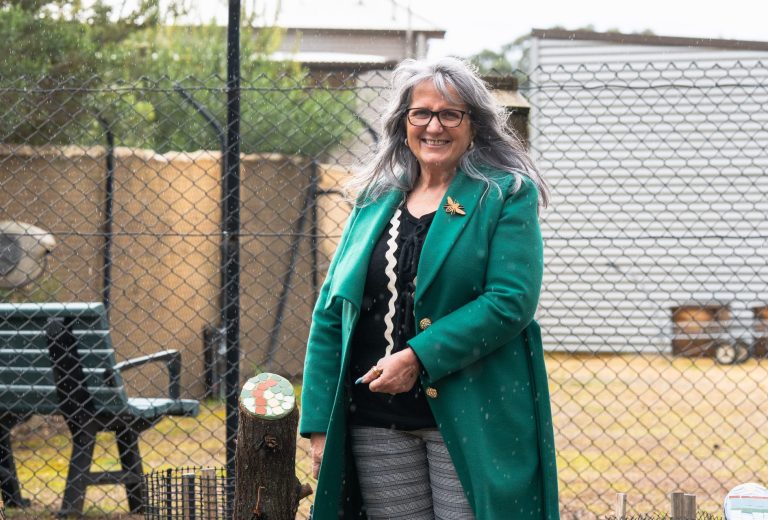
ID: Reta standing next to her mosaic which is part of the Reconciliation Mosaic Project at Barossa Bushgardens.
Sometimes, the people who have the greatest impact are the ones who never set out looking for recognition.
For those who know Reta, it will come as no surprise that after decades spent supporting others, advocating for the disadvantaged and championing equality, she still speaks about her work with the same passion and conviction that first drew her into the sector.
In fact, she was preparing to retire.
“I was 60 years old and I was going to retire,” she laughs.
Instead, an opportunity arose at My Ability Pathway. Although administration was completely new territory, Barbara and Charlotte recognised the incredible depth of knowledge and experience Reta could bring to the organisation. Today, she continues to support the team, mentor colleagues and share her wisdom whenever needed.
“I feel very privileged that they value my opinion when it comes to community,” she says.
And what an opinion it is.
Reta’s journey began with a childhood dream of becoming a nurse. After moving to the Barossa in her late twenties, she met Sophie, then Director of Nursing at Barossa Village, who offered her a shift that would change the course of her life.
“The rest is history,” she says.
Following a decade in aged care and some significant personal experiences, Reta discovered a calling that would shape the rest of her career.
“I came to the realisation that there were people who didn’t have a voice and weren’t being heard,” she explains.
“That’s what led me to become an advocate.”
Over the years, Reta has worked across disability, homelessness, domestic violence and child protection, but she always finds herself returning to disability support.
For Reta, advocacy has never been about speaking for people. It has been about ensuring people are heard and supported to live the lives they choose.
“I come from the belief that everybody is equal and that we all have the right, given the opportunity, to live our life to our full potential and be treated with dignity, irrespective of where we come from and who we are.”
It is a philosophy that has guided her both personally and professionally.
Anyone who has worked alongside Reta knows that her knowledge is immense, but what stands out even more is her unwavering passion for people.
She describes herself as “quite assertive” when advocating for others, although those around her would simply call it dedication.
At MAP, we are incredibly fortunate to have someone with Reta’s lived experience, compassion and wisdom. Her ability to mentor others, provide perspective and remind us of the importance of community is invaluable.
Quite simply, Reta is one of those people who makes everyone around her better.
During National Reconciliation Week, we are reminded that reconciliation is about relationships, respect and opportunities.
At My Ability Pathway, these values underpin everything we do. We recognise that reconciliation is not a destination but an ongoing journey – one that requires listening, learning and walking together.
This year, we were excited to see Reta contribute to the Reconciliation Mosaic Project at the Barossa Bushgardens. Bringing together children from Nuriootpa Kindergarten, an OSHC group and members of the community, the project was guided by an Indigenous artist and explored our connections to land and to one another.
Reta’s piece featured two intertwining trees.
“It’s about standing together against any problems in the past and standing together moving forward and supporting each other, irrespective of where we come from or who we are,” she says.
It’s a beautiful reflection of the values she has embodied throughout her entire life.
And perhaps that’s what makes Reta so special.
Not just her decades of experience, her advocacy, or her wealth of knowledge – but her enduring belief that everyone deserves dignity, respect and the opportunity to thrive.
At My Ability Pathway, we are grateful every day that she chose not to retire.
Because our team, and our community, are stronger because of it.
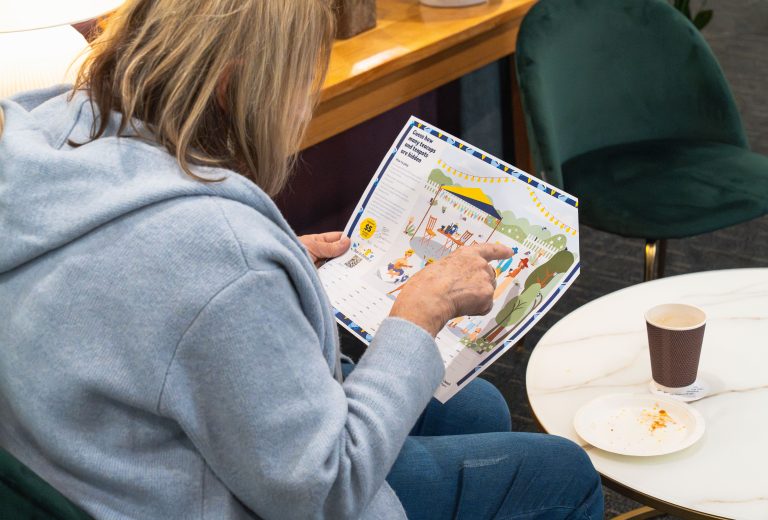
ID: A women playing the Biggest Morning Tea ‘Guess how many teacups’ game to raise funds for Cancer Council.
More than 30 people came together recently for My Ability Pathway’s third and final Australia’s Biggest Morning Tea, raising an incredible $1,108 for Cancer Council and surpassing our fundraising goal of $1,000.
It was lovely to see so many familiar faces, with clients, support workers, team members, families and local supporters gathering to enjoy good food, great company and the chance to support a cause that touches so many lives.
Like many Australians, we all know someone who has been affected by cancer. Over the past three years, these events have given us the opportunity to come together, show our support and give back in a meaningful way. Thanks to the generosity of everyone involved, we have now raised over $3,500 for Cancer Council since hosting our first Biggest Morning Tea.
This year’s event was particularly special. Not only did we exceed our fundraising target, but we were also heartened by the strong turnout and the sense of connection that filled the room. From delicious treats and coffee to raffle prizes and plenty of laughter, the morning was a reminder of what we can achieve when we come together.
As we close the chapter on our Biggest Morning Tea tradition, we do so with immense gratitude to everyone who has supported us over the past three years. While this marks the end of our involvement with this particular fundraiser, it certainly won’t be the end of our commitment to supporting meaningful causes.
We look forward to turning our attention to other worthwhile initiatives in the future and continuing to create opportunities for our community to make a difference.
Thank you to everyone who attended, donated, purchased raffle tickets, contributed prizes and helped make our final Biggest Morning Tea such a memorable success. Together, we have made a real difference.
Special thanks to the businesses and individuals who supported this event through donated goods:

ID: Picture of two men on a motorbike.
At My Ability Pathway, our Support Coordination team often talks about goals, plans and progress. But sometimes, the most powerful outcomes aren’t written in a plan – they’re felt in the wind on your face, the sound of an engine starting, and the spark of recognition in someone’s eyes.
Today, 5 March 2026, we saw exactly that with John, one of MAP’s Support Coordination clients.
John lives with Frontal Lobe Dementia, also known as Frontotemporal Dementia (FTD). FTD is a progressive neurodegenerative disease that causes shrinkage (atrophy) in the brain’s frontal and temporal lobes. It most commonly affects people between the ages of 45 and 65.
Unlike other forms of dementia that begin with memory loss, FTD often first presents as dramatic changes in personality, behaviour and language.
Common impacts include:
There are two main subtypes:
FTD is caused by abnormal protein build-up in the brain. In around 30–40% of cases, there is a genetic link. There is currently no cure, and diagnosis relies on neurological assessments, behavioural evaluations and brain imaging that shows atrophy.
In recent years, public awareness of FTD has increased following the diagnosis of actor Bruce Willis, helping many families better understand the condition and its impact.
While life expectancy varies widely, supportive care, routine, therapies and medication can help manage symptoms such as agitation, depression and sleep changes.
But beyond the clinical description is something equally important: identity. And that’s where John’s story comes in.
For many people living with FTD, it’s not only abilities that change – it’s interests and motivation too. Activities that once brought joy can feel distant, confusing or overwhelming.
John used to ride motorcycles. It wasn’t just a hobby; it was part of who he was.
As dementia progressed, riding became difficult. John shared that it wasn’t only about forgetting how to ride – it was about losing confidence. People would tell him he was doing it wrong. His balance worried him. Gradually, the bikes stopped.
And with that, something else quietened too.
His wife Terri has watched these changes unfold. Over the years, John has shown less interest in many of the things that once energised him. So when something sparks engagement, it matters.
After talking with John, Support Coordinator Beth started thinking differently. What if this wasn’t about what John could no longer do – but about how we could safely reconnect him with what he loved?
Beth reached out to Keith from the Long Riders Motorcycle Club Adelaide. Without hesitation, Keith offered to come to John’s home and spend time talking bikes.
That visit alone made a difference.
They sat together – John, Terri and Keith – swapping stories. They talked about John’s first bike, a Suzuki. They reminisced about runs, rides and the open road.
John worried about his balance. Keith reassured him.
And then John’s humour surfaced:
“I’ve got some bungee straps out the back if you need to strap me down.”
The room filled with laughter.
It was a glimpse of the John Terri knows so well.
Soon enough, they stepped outside to Keith’s bike.
John was asked, “How are you feeling?”
“Nervous. It’s been a long time.”
The first ride was just around the block – a gentle reintroduction to the sensation. A quick stop back home. A moment to regroup.
Then they headed out for a longer ride around town.
This was something different for Terri. John rarely leaves the house without her now, which makes us acutely aware of the pressures carried by carers – the constant responsibility, the fatigue, the hypervigilance, the quiet mental load. Moments like this highlight an important question in disability and dementia support: who’s caring for the carer?
Creating space for John to safely reconnect with something meaningful also created space – even briefly – for Terri to breathe.
There is no cure for Frontal Lobe Dementia. We cannot stop the progression.
But we can support identity.
We can create moments of connection.
We can work creatively around challenges.
Today wasn’t about motorcycles alone. It was about dignity. Confidence. Laughter. Community.
It was about remembering that even when the brain changes, the person is still there.
At MAP, Support Coordination is not just about navigating systems – it’s about listening deeply enough to ask: What still matters?
For John, it turns out, it’s still the rumble of a bike beneath him and the freedom of the road ahead.
