We value your privacy
This website uses technical, functional and analytical cookies that do not infringe on your privacy.
General purpose platform session cookies are usually used to maintain an anonymised user session by the server.

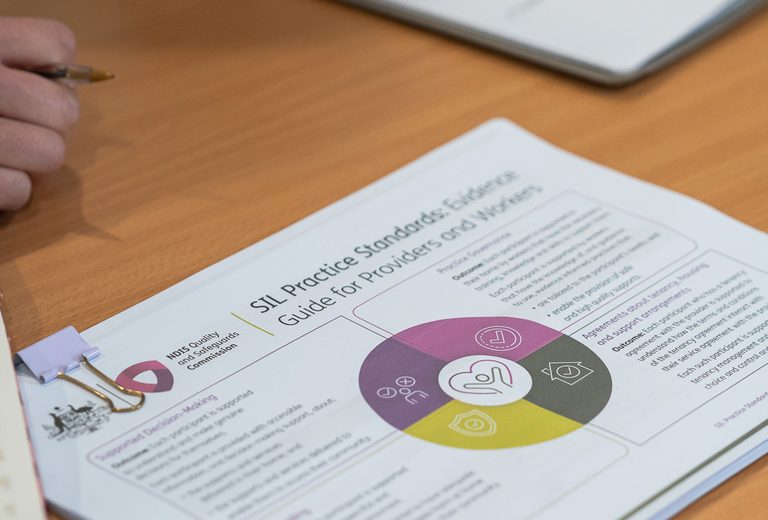
ID: Photo of a print out of the new SIL Practice Standards.
There has been a lot of conversation recently about the newly released Supported Independent Living (SIL) Practice Standards.
Introduced by the NDIS Quality and Safeguards Commission, the standards are designed to uphold the rights, safety and wellbeing of participants who receive SIL supports. People with SIL funding often receive support for most, or all, of the day, including overnight support.
The introduction of these standards also sits alongside new registration requirements for NDIS providers offering SIL supports. The standards came into effect on 1 July 2026, with providers needing to have mandatory NDIS registration in place, or have applied for it, by 1 October 2026.
The SIL Practice Standards are made up of four key areas: Supported Decision-making, Safeguarding, Practice Governance, and Agreements about Tenancy, Housing and Support Arrangements. Together, these areas are designed to support:
While there is a compliance element to the standards, and providers will be audited against them, these areas go deeper than meeting requirements. They are about strengthening quality, consistency and person-centred outcomes for participants.
Each area includes a dedicated intent, individualised quality indicators, and statements around expectations and outcomes. These can be viewed on the NDIS Commission website.
For participants, families and support networks, these benchmarks can also help build a clearer understanding of what quality supports should look like in a SIL setting.
Supported Decision-making: Ensures participants are supported, where needed, to make decisions about their own lives, rather than having decisions made for them.
Safeguarding: Outlines how SIL providers work to keep participants safe from harm, abuse, violence and neglect, while respecting choice, dignity of risk and individual decision-making. It also ensures SIL workers have the skills to identify and respond to signs of harm using a person-centred, trauma-informed approach.
Practice Governance: Sets out how providers are responsible for creating and maintaining safe living environments, supported by practice leadership, clear processes and good governance.
Agreements about Tenancy, Housing and Support Arrangements: Ensures providers have clear agreements in place that distinguish SIL supports from tenancy or housing arrangements. It also outlines how participants are supported to make decisions about who they live with, how support is delivered, and how changes can be made.
The quality indicators for each area map out the key, measurable criteria needed to demonstrate the outcomes of the SIL Practice Standards.
The NDIS Commission has shared resources to help participants, families, support people, providers and teams understand the SIL Practice Standards. These can be found here.
At MAP, we will continue to share updates and take a deeper look into each area of the SIL Practice Standards over the coming months, so keep an eye out.

ID: Photo of Shaun outside, on a sunny day.
As we step into a new year, it’s a wonderful time to reflect on Shaun’s ongoing journey toward independence and the goals that continue to guide him forward. Last year, we shared Shaun’s story—his determination to live in his own home with Supported Independent Living (SIL) services, and the optimism he brings to every step of that journey. Since then, Shaun has continued to build on those foundations with enthusiasm, resilience and a clear focus on what he is working towards.
Reflecting on the year behind
Over the past year, Shaun has navigated change with perseverance. After returning to live with his mother, Coral, Shaun remained committed to his long-term goal of independent living. What could have feltlike a setback instead became a period of growth, reflection and skill-building. Together, Shaun and Coral continued to keep his goals front and centre, using this time to strengthen the skills and confidence needed for the next stage of his journey.
Shaun’s weekly SIL stays have continued to play an important role in maintaining momentum. These supports allow Shaun to practise independence in a supported environment, helping him bridge the gap between family life and living on his own again. During his stays, Shaun takes pride insetting up his space, organising groceries and planning his days. From swimming and shopping to cooking meals and attending concerts, Shaun remains actively engaged and motivated, using his NDIS supports to access meaningful activities while working steadily toward his goals.
Growth through skill-building
Looking back, Shaun has made notable progress in developing everyday living skills. With prompting and support, he continues to manage many daily tasks and safely approaches more complex activities alongside his support team. Each new skill—whether using household appliances or keeping up with chores—represents another step closer to the independent life he envisions.
Shaun’s confidence in decision-making has also continued to grow. Over the past year, he has become increasingly comfortable expressing his preferences and following through on his choices, from selecting clothes to planning outings. This growing self-confidence has been a key part of his progress and supports his ability to take ownership of his goals.
Shaun’s commitment to learning and self-improvement reminds us that progress is ongoing and goals are built one step at a time.
Looking ahead to the year to come
As the new year begins, Shaun continues to balance his love of family life with his desire for independence. Time spent at home with Coral and the comforting presence of his dog, Casper, remains important to him, while supported living continues to offer opportunities for growth and autonomy.
Looking forward, Shaun’s goals may continue to evolve, but his determination remains unchanged. With a positive outlook, strong support network and clear goals in mind, Shaun enters the new year ready to keep building toward a future where he can live independently, confidently and on his own terms.
