We value your privacy
This website uses technical, functional and analytical cookies that do not infringe on your privacy.
General purpose platform session cookies are usually used to maintain an anonymised user session by the server.

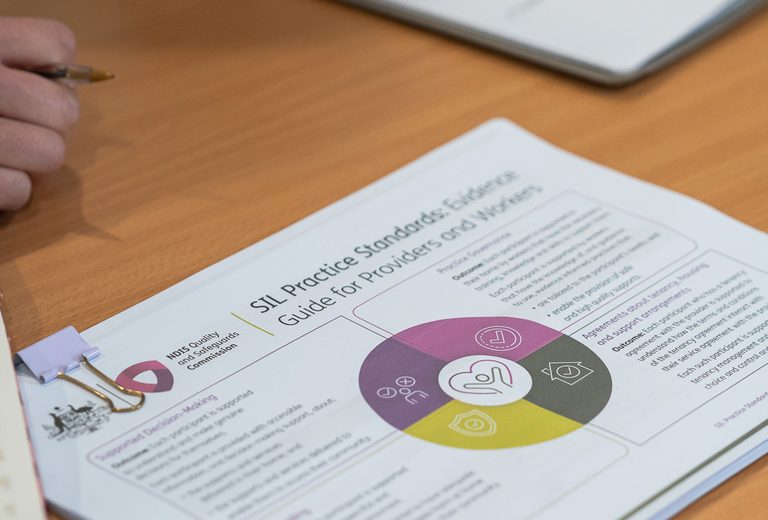
ID: Photo of a print out of the new SIL Practice Standards.
There has been a lot of conversation recently about the newly released Supported Independent Living (SIL) Practice Standards.
Introduced by the NDIS Quality and Safeguards Commission, the standards are designed to uphold the rights, safety and wellbeing of participants who receive SIL supports. People with SIL funding often receive support for most, or all, of the day, including overnight support.
The introduction of these standards also sits alongside new registration requirements for NDIS providers offering SIL supports. The standards came into effect on 1 July 2026, with providers needing to have mandatory NDIS registration in place, or have applied for it, by 1 October 2026.
The SIL Practice Standards are made up of four key areas: Supported Decision-making, Safeguarding, Practice Governance, and Agreements about Tenancy, Housing and Support Arrangements. Together, these areas are designed to support:
While there is a compliance element to the standards, and providers will be audited against them, these areas go deeper than meeting requirements. They are about strengthening quality, consistency and person-centred outcomes for participants.
Each area includes a dedicated intent, individualised quality indicators, and statements around expectations and outcomes. These can be viewed on the NDIS Commission website.
For participants, families and support networks, these benchmarks can also help build a clearer understanding of what quality supports should look like in a SIL setting.
Supported Decision-making: Ensures participants are supported, where needed, to make decisions about their own lives, rather than having decisions made for them.
Safeguarding: Outlines how SIL providers work to keep participants safe from harm, abuse, violence and neglect, while respecting choice, dignity of risk and individual decision-making. It also ensures SIL workers have the skills to identify and respond to signs of harm using a person-centred, trauma-informed approach.
Practice Governance: Sets out how providers are responsible for creating and maintaining safe living environments, supported by practice leadership, clear processes and good governance.
Agreements about Tenancy, Housing and Support Arrangements: Ensures providers have clear agreements in place that distinguish SIL supports from tenancy or housing arrangements. It also outlines how participants are supported to make decisions about who they live with, how support is delivered, and how changes can be made.
The quality indicators for each area map out the key, measurable criteria needed to demonstrate the outcomes of the SIL Practice Standards.
The NDIS Commission has shared resources to help participants, families, support people, providers and teams understand the SIL Practice Standards. These can be found here.
At MAP, we will continue to share updates and take a deeper look into each area of the SIL Practice Standards over the coming months, so keep an eye out.

ID: low angle photo of pink and orange balloons with sad and happy faces.
It can be hard to understand something we cannot see. Psychosocial disability is often hidden beneath the surface, which means its impacts can be overlooked, minimised or misunderstood. For people living with mental health conditions that affect daily life, relationships, work or study, that lack of understanding can lead to stigma, discrimination and sometimes, a painful absence of compassion.
Mental health conditions are, as the name indicates, health conditions. In Australia, they are treated by the healthcare system and supported by Medicare. Psychosocial disability exists when a person living with a mental health condition experiences functional difficulties or barriers directly related to the impacts of that condition.
Those impacts can show up in daily activities, social interactions, work, study and other parts of life. They don’t look the same for everyone. Some people may be able to work or study with support or clear boundaries, while others may go through periods where daily tasks, social connection or employment become very difficult – or even impossible – to manage, at least for a time.
One of the reasons psychosocial disability is so often misunderstood is that mental health conditions are not always visible. The disability impacts can be overlooked or misread. Someone might be labelled as lazy, difficult, messy, withdrawn or unwilling, when what’s really happening is that they are facing functional barriers connected to their mental health condition.
Comments like “be happy” or “run it off” don’t recognise how serious mental health conditions can be, or the very real disability impacts that can come with them. Those kinds of attitudes can add to stigma and make it harder for people to feel understood or supported.
The numbers show just how many people may be missing out on support. Figures from 2022–23 estimate that, across Australia, 230,500 people with severe psychosocial disability and 263,100 people with moderate psychosocial disability were not accessing either NDIS or mainstream support. That works out to more than 68% of people with severe psychosocial disability and more than 84% of people with moderate psychosocial disability not receiving support.
Those are significant numbers, especially when we think about the broader mental health picture. In any given year, an estimated one in five people will experience a mental illness. Not everyone who experiences mental health concerns will also experience psychosocial disability, but it does remind us that these conditions are common and widespread.
For some people, the cause of their psychosocial disability may be very treatable, and recovery from the functional impacts may be possible. For many others, mental health conditions can be chronic or episodic. This means they may flare up and then ease again with time or treatment. Relapses can happen, and treatments may need to be reviewed or adjusted along the way.
Recovery looks different for every person and every condition. It can depend on many things, including what recovery means to the person themselves. For some people, psychosocial disability may continue despite treatment. The NDIS calls this “permanence”. For others, treatment may resolve the functional impairments they experience because of their mental health condition.
Building skills to manage or overcome barriers can make a real difference, but it doesn’t always mean the underlying mental health condition has been “cured”. Many conditions are treatable but not curable, and depending on the person’s circumstances and goals, both mental health treatment and disability support may be needed.
Living with psychosocial disability can be incredibly difficult. It can affect things like housework, isolation, work, relationships, daily tasks, or even understanding what is happening. For some people, recovery is hard because they may not respond to traditional treatments, may be medication resistant, or may not be able to access treatment and therapies.
The good news is that support is available for both mental health conditions and the disability impacts that can come with them. In South Australia, Medicare may provide assistance, and the NDIS remains an option for people living with permanent psychosocial disability. Support phone lines, online chat options and walk-in support clinics are also available.
Progress in mental health is not always easy to see, and it is not always a straight line. Setbacks do not mean progress is not happening. When we understand psychosocial disability with compassion, accuracy and respect, we take an important step toward reducing stigma and helping people access the support they need.
Photo by Madison Oren on Unsplash
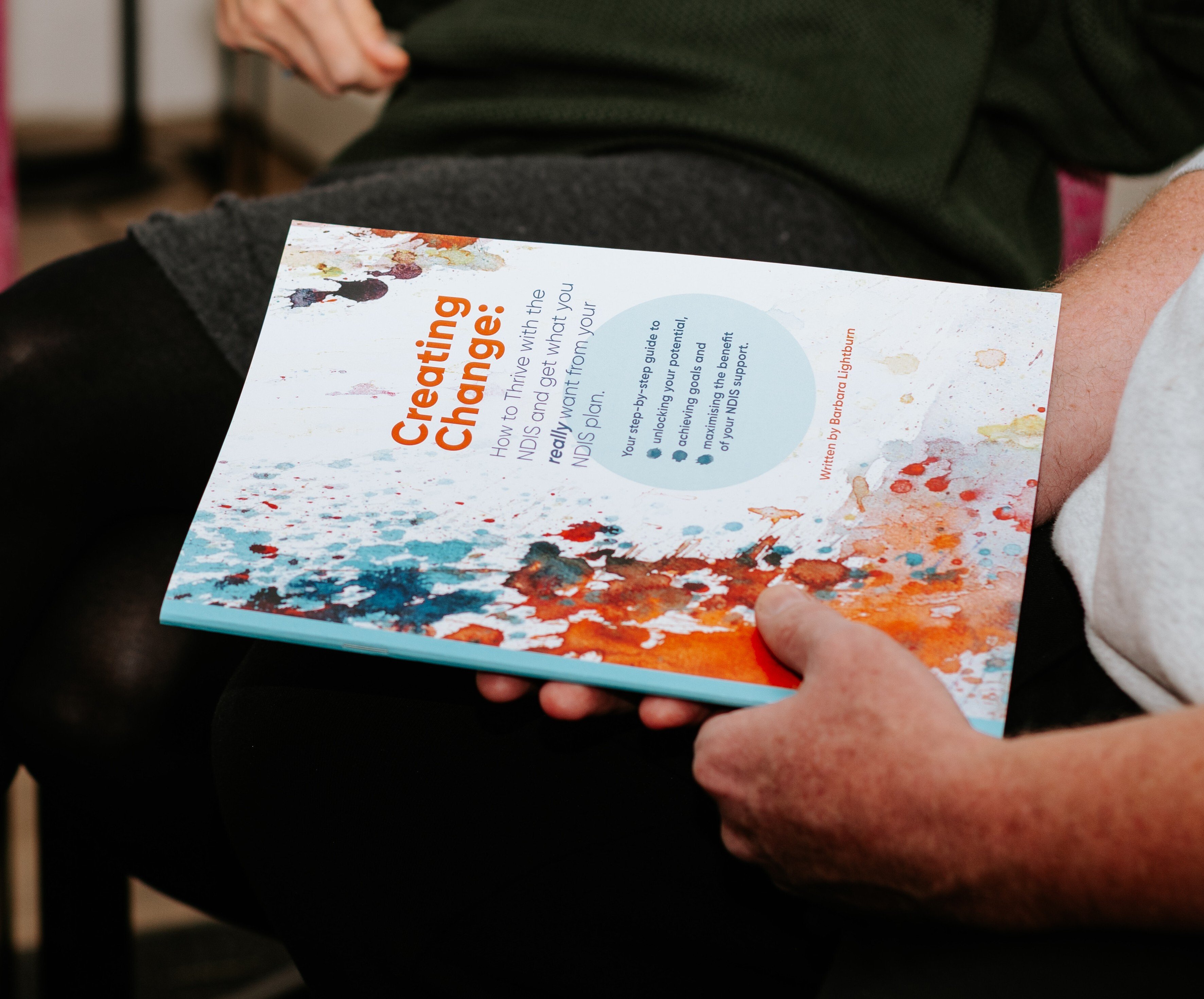
ID: A photo of a person holding the Creating Change book.

New year’s resolutions. A popular method of goal setting, but one that doesn’t tend to have the best success rate. Why?
Goals that fall by the wayside often have some things in common:
So, let’s explore creating goals.
Goal setting is something that gets talked about a lot in NDIS spaces. If you’re a participant, you’ll have been asked to set some goals for your NDIS plan. These can be anything you want, and sometimes it can be difficult to figure out what that might be.
If you work in the disability industry, or support a loved one with a disability, you’ll be looking to align outcomes with the goals of the participants you support – and you’ll have your own goals, whether they be work-based or personal.
Creating Change, written by Barbara Lightburn, is a resource to support anyone looking to hone their goal setting skills.
Top Tip – Write your goals down and monitor progress
Setting strong, personalised goals can be extremely beneficial in assisting you to achieve what you want to achieve. For many of us, having a written record and a way to track progress is very supportive. There are many ways to record your goals and monitor progress – from spreadsheets to apps to journalling, there is bound to be a method that will work for you.
At MAP, we’ve built a culture inspired by the importance of setting goals as a way to support all areas of life. Seeing our achievements gives us a sense of success, builds confidence, and empowers us to continue striving. No win is too small, and if you’re tracking your progress, you’ll get to see in real time just how far you’ve progressed, despite any setbacks or interruptions.
This is so important, because many of us notice shortcomings far more sharply than we recognise successes. Retraining your focus to be objective and positive helps you stay strong when times get tough.
Top Tip – Make your goals “SMART”
There are so many positives to learning to set goals – and beyond that, to adjust those goals when things change for you. Sometimes a goal no longer applies or may become unrealistic. Any number of things can change in the time we’re working to achieve the things we’re aiming for.
There’s a skill to strong goal setting, and it’s one that can be learned and honed. A popular method is “SMART” goals. SMART stands for:
Developed by George T. Doran, SMART goals help you be clear about what you want to do, support you to set a timeframe to keep you on track and accountable, ensuring it’s realistic and applicable to you, and assists with measuring your achievements.
On top of creating a SMART goal, you can break the goal down into manageable steps or actions. This will make it easier to monitor for those small wins and see your progress. Chapter 4 of Creating Change includes a helpful workbook section to guide you through this.
Check in and review your goals regularly – daily, weekly or monthly check ins work well for many goals, and allow you to adjust your focus, try new approaches and recognise what’s going well as you work towards your goals.
Top Tip – Develop a support network
Having support can help us towards our goals in a variety of ways. From encouragement to holding us accountable, a support network gives us people to rely on for help and perspective.
Different types of goals need different types of support. It’s important to consider who might be the best person, or group of people, to help out. From emotional support to professional guidance, there are options appropriate to every type of goal.
Online spaces are increasingly popular ways to connect with likeminded people, especially for those living rurally or regionally. Local clubs and groups might be an option too – for example, a book club or sports group could help with a goal around reading more, or learning a new fitness activity. Consider your budget and explore training or coaching options that may suit your needs.
Goals help us give our lives direction, supporting us to achieve and grow in the ways that we want. Consider your new year’s resolutions and think about how you might be able to refine and refocus them into strong, SMART goals. Have you made those small wins already? Celebrate them! Will you benefit from an accountability partner, or some guidance from someone with experience? Explore finding that support.
Most of all, remember your purpose. You set this goal for a reason. It’s yours to achieve.
