We value your privacy
This website uses technical, functional and analytical cookies that do not infringe on your privacy.
General purpose platform session cookies are usually used to maintain an anonymised user session by the server.

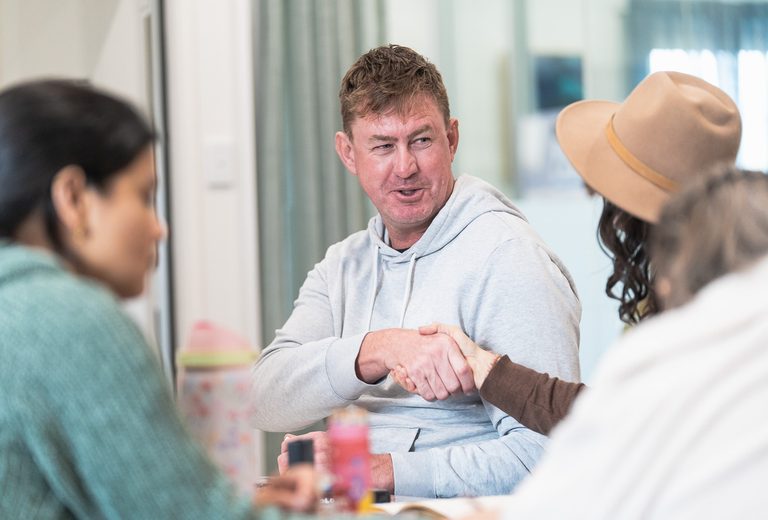
ID: Man sitting at a table and shaking hands with a women wearing a hat
When Ashley reflects on his journey, he doesn’t begin with what has been lost. He begins with gratitude, perspective and a steady belief that each day still holds the possibility of something good.
“It’s been a challenging journey, but I think it’s an exciting journey,” Ashley shares. “Every day I face my challenges, yet that is okay, my cup is half full. I’m thankful for what I have today and where I’ve come from if we looked at it from where I was to where I’m now.”
It is this sense of optimism that has carried Ashley through a period of enormous change. After becoming unwell, Ashley found himself in hospital in Adelaide, facing a future that suddenly looked very different from the life he had known. Independence, something he had once been able to rely on without much thought, was no longer guaranteed. Everyday tasks such as showering, getting dressed and moving through the day now required support.
“I no longer had independence anymore,” Ashley says. “I could no longer do what I used to be able to do and I needed help with my daily tasks.”
That adjustment was not only physical. For Ashley, coming to terms with the change also meant working through the emotional weight of uncertainty. He was trying to understand what life might look like, how he would manage, and how he could rebuild a sense of control. While the experience was difficult, Ashley was surrounded by family who helped him through those early stages.
At the time, Ashley and his family were living around two and a half hours from Adelaide. Being away from his wife and two boys during his hospital and rehabilitation journey was hard. As rehab continued, Ashley moved to the Barossa, where family support and local services helped make his recovery feel more possible.
A key part of that shift was discovering support close to home. Ashley was able to access hydrotherapy in Nuriootpa, continuing the rehabilitation he had begun in hospital. From there, more local supports became part of his life, including physiotherapy, occupational therapy, exercise physiology and community-based activities.
For Ashley, returning to the Barossa was more than a practical decision. It was a homecoming. A Barossa local, born and bred, he knew the area, the people and the sense of community that had shaped him. Moving back gave Ashley the chance to be closer to the supports, relationships and familiar places that could help him keep moving forward.
“The whole community piece is a huge part for me,” Ashley explains. Before becoming unwell, connection and supporting others had been a big part of his identity. When illness changed his daily life, that sense of involvement was something he deeply missed. Rebuilding those connections became an important part of his wellbeing.
Since moving back, Ashley has found strength not only in formal supports, but in the everyday power of community. He speaks about social outings, local groups and shared experiences with others who understand pain, fatigue and the challenges that are not always visible to the outside world.
“We’re all living through these similar things,” Ashley says. “Everyone has a very challenging journey and I think rolling this together, we need to support and be there for each other.”
That shared understanding matters. Ashley knows that not every disability, illness or ongoing health challenge is immediately visible. He has noticed that when people are not using a wheelchair or walking aid, others may assume they are okay. For Ashley, spaces where people can speak openly, feel understood and be met without judgement are essential.
Connection has also supported Ashley’s confidence, self-worth and passion for advocacy. His journey has helped him see how important it is for people to have someone to talk to, somewhere to belong, and access to the right supports in their own community. He believes there is value in more local opportunities where people can connect, share and support one another.
Acceptance has been a long process. Ashley is honest about that. There are days that are harder than others, and the journey has required him to get to know what he describes as “the new me”. But even within that reality, Ashley continues to choose hope.
“Some days are worse than others yet I’m thankful for every day,” he says. “There are good things to look forward to.”
Ashley’s story is a reminder that rehabilitation is not only about appointments, exercises or clinical progress. It is also about family, community, connection and having the right supports close enough to make daily life feel achievable. For Ashley, coming home to the Barossa has meant being surrounded by people and services that support his healing, independence and sense of purpose.
His cup-half-full outlook does not ignore the challenges he faces. Instead, it makes space for them while still recognising how far he has come. Ashley’s optimism, honesty and commitment to supporting others continue to shape his journey – one day, one connection and one step at a time.
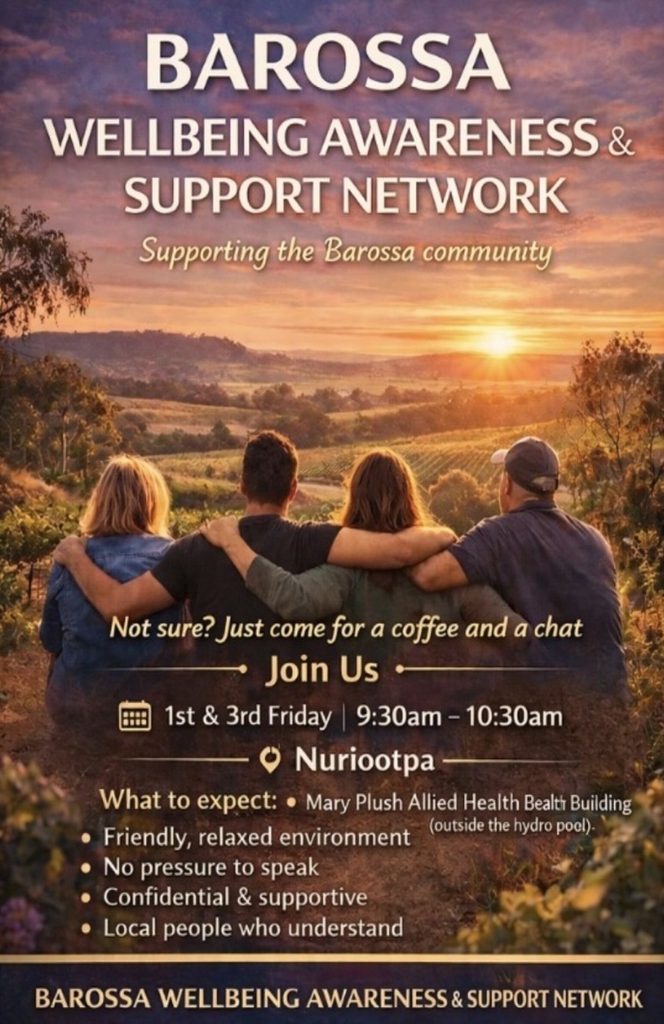
Ashley also helps run the Barossa Wellbeing Awareness & Support Network, held on the 1st and 3rd Friday of each month from 9:30am to 10:30am at the Mary Plush Allied Health Building. The group offers a friendly, relaxed and confidential space where there is no pressure to speak, just support from local people who understand. See the poster below for more information.

ID: Picture of two men on a motorbike.
At My Ability Pathway, our Support Coordination team often talks about goals, plans and progress. But sometimes, the most powerful outcomes aren’t written in a plan – they’re felt in the wind on your face, the sound of an engine starting, and the spark of recognition in someone’s eyes.
Today, 5 March 2026, we saw exactly that with John, one of MAP’s Support Coordination clients.
John lives with Frontal Lobe Dementia, also known as Frontotemporal Dementia (FTD). FTD is a progressive neurodegenerative disease that causes shrinkage (atrophy) in the brain’s frontal and temporal lobes. It most commonly affects people between the ages of 45 and 65.
Unlike other forms of dementia that begin with memory loss, FTD often first presents as dramatic changes in personality, behaviour and language.
Common impacts include:
There are two main subtypes:
FTD is caused by abnormal protein build-up in the brain. In around 30–40% of cases, there is a genetic link. There is currently no cure, and diagnosis relies on neurological assessments, behavioural evaluations and brain imaging that shows atrophy.
In recent years, public awareness of FTD has increased following the diagnosis of actor Bruce Willis, helping many families better understand the condition and its impact.
While life expectancy varies widely, supportive care, routine, therapies and medication can help manage symptoms such as agitation, depression and sleep changes.
But beyond the clinical description is something equally important: identity. And that’s where John’s story comes in.
For many people living with FTD, it’s not only abilities that change – it’s interests and motivation too. Activities that once brought joy can feel distant, confusing or overwhelming.
John used to ride motorcycles. It wasn’t just a hobby; it was part of who he was.
As dementia progressed, riding became difficult. John shared that it wasn’t only about forgetting how to ride – it was about losing confidence. People would tell him he was doing it wrong. His balance worried him. Gradually, the bikes stopped.
And with that, something else quietened too.
His wife Terri has watched these changes unfold. Over the years, John has shown less interest in many of the things that once energised him. So when something sparks engagement, it matters.
After talking with John, Support Coordinator Beth started thinking differently. What if this wasn’t about what John could no longer do – but about how we could safely reconnect him with what he loved?
Beth reached out to Keith from the Long Riders Motorcycle Club Adelaide. Without hesitation, Keith offered to come to John’s home and spend time talking bikes.
That visit alone made a difference.
They sat together – John, Terri and Keith – swapping stories. They talked about John’s first bike, a Suzuki. They reminisced about runs, rides and the open road.
John worried about his balance. Keith reassured him.
And then John’s humour surfaced:
“I’ve got some bungee straps out the back if you need to strap me down.”
The room filled with laughter.
It was a glimpse of the John Terri knows so well.
Soon enough, they stepped outside to Keith’s bike.
John was asked, “How are you feeling?”
“Nervous. It’s been a long time.”
The first ride was just around the block – a gentle reintroduction to the sensation. A quick stop back home. A moment to regroup.
Then they headed out for a longer ride around town.
This was something different for Terri. John rarely leaves the house without her now, which makes us acutely aware of the pressures carried by carers – the constant responsibility, the fatigue, the hypervigilance, the quiet mental load. Moments like this highlight an important question in disability and dementia support: who’s caring for the carer?
Creating space for John to safely reconnect with something meaningful also created space – even briefly – for Terri to breathe.
There is no cure for Frontal Lobe Dementia. We cannot stop the progression.
But we can support identity.
We can create moments of connection.
We can work creatively around challenges.
Today wasn’t about motorcycles alone. It was about dignity. Confidence. Laughter. Community.
It was about remembering that even when the brain changes, the person is still there.
At MAP, Support Coordination is not just about navigating systems – it’s about listening deeply enough to ask: What still matters?
For John, it turns out, it’s still the rumble of a bike beneath him and the freedom of the road ahead.
