We value your privacy
This website uses technical, functional and analytical cookies that do not infringe on your privacy.
General purpose platform session cookies are usually used to maintain an anonymised user session by the server.

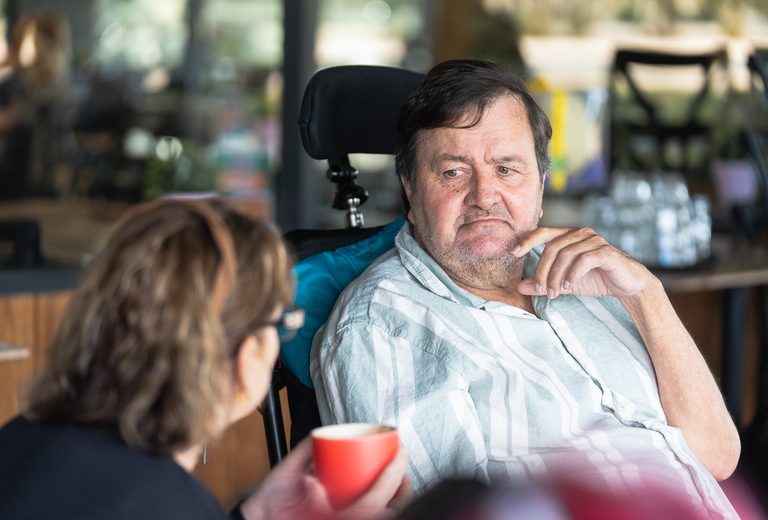
ID: Photo of Ian out at MAP’s Easter Morning Tea event.
For Ian and his family, moving into Specialist Disability Accommodation (SDA) in Nuriootpa has been about much more than finding an accessible house. It has been about creating a home that supports safety, independence, family connection and everyday choice.
After experiencing multiple strokes in 2023, Ian’s life changed significantly. Once a truck driver who had lived independently, Ian became wheelchair bound and needed a home designed around his physical support needs. His daughter, Regina, said the family knew that having access to an SDA home would be important for Ian’s future.
“Having access to an SDA house was what we were needing for his needs going forward,” Regina shared.
Specialist Disability Accommodation is purpose-built housing for NDIS participants with extreme functional impairment or very high support needs. For people like Ian, SDA can make daily routines safer, easier and more comfortable by removing barriers within the home and supporting greater independence.
For Ian, the difference is felt in the everyday details. Regina explained that his SDA home is “designed better” for him because it caters to his needs as a wheelchair user. Open spaces allow him to move through the home more freely, while accessible design features support the routines, interests and choices that continue to matter to him.
“He’s always enjoyed cooking,” Regina said, describing how adjustable kitchen benches allow Ian to remain involved in an activity he enjoys. “Having benches that can move up and down… cater for people who are in wheelchairs.”
Accessible housing is often spoken about in terms of equipment, floorplans and support ratios, but its real value is found in the way it helps people participate in their own lives. Ian’s Nuriootpa SDA home gives him room to move, space for safe transfers and the ability to do meaningful things for himself.
Regina shared that Ian can wheel himself to the front door and open it for her when she visits. It is a simple moment, but one that reflects the importance of independence, privacy and dignity within the home.
“He can wheel himself up,” Regina said. “The bathroom’s big enough so he can get in and out there… he’s got the big space to be able to be lifted to and from bed into wheelchair.”
One of the most important parts of Ian’s SDA journey has been location. Ian lives in the Barossa, close to Regina and his grandchildren. For their family, being near familiar places and people was an important part of finding the right long-term home.
Regina explained that Nuriootpa was a good fit because it kept Ian close to family routines and community connections. “It’s only 30 minutes away from where I live and my kids go to school here in the Barossa,” she said. “We’re always over here… the plan long term [was] to be able to have him as close to family as possible.”
This is why Specialist Disability Accommodation in regional communities like the Barossa matters. Purpose-built SDA homes can help people with disability remain connected to their families, local services, support networks and the communities they know, while receiving the daily support they need to live safely and well.
Ian’s story is a reminder that the right SDA home does more than meet physical access requirements. It supports confidence, comfort, connection and choice. It gives families reassurance that their loved one is living in a place designed around their needs, while also creating opportunities for the person to stay involved in everyday life.
At My Ability Pathway, we believe accessible housing should support people to live with dignity, independence and a strong sense of belonging. Through our Supported Independent Living services within SDA homes across the Barossa, we work alongside participants, families, support coordinators and housing providers to help people build a life that reflects their needs, preferences and goals.
We currently have a vacancy in a Nuriootpa Specialist Disability Accommodation home. If you are eligible for SDA, or know someone who may be looking for accessible housing in the Barossa, we encourage you to reach out to our team. More information about SDA can be found on our Barossa SDA page, and details about our current Nuriootpa vacancy are available on our Current Vacancies page.
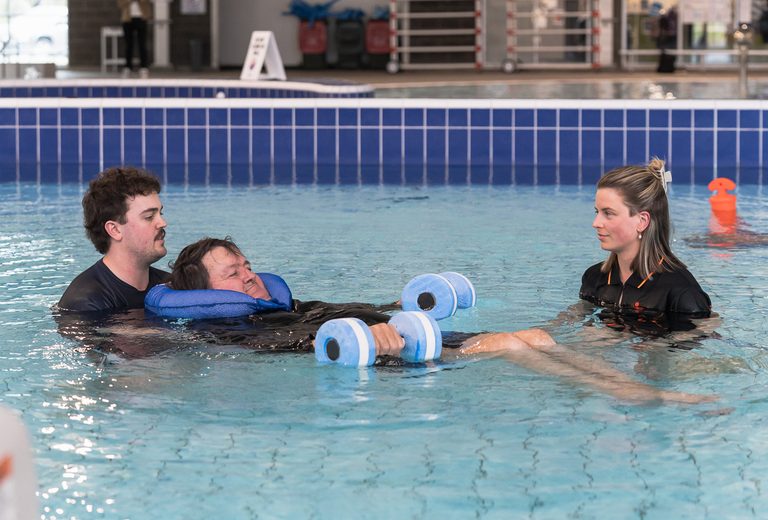
ID: A photo of Ian at The Rex Barossa Aquatic Fitness with Physiotherapist Aaron (left) and My Ability Pathway Service Delivery Lead Brooke (right).
For Ian, hydrotherapy is about more than exercise. It is time out of the house, time away from the routines of everyday life, and an opportunity to move in a way that feels more possible.
Supported by his My Ability Pathway team and guided by Aaron from Tanunda Physiotherapy, Ian has been attending hydrotherapy as part of his broader therapy routine. Together, they are working toward a goal that holds deep meaning for him: walking.
When asked what walking again would mean to him, Ian’s answer was simple: “A lot. I used to do a lot of it.”
Hydrotherapy uses the warmth, buoyancy and support of water to help people move with less pressure on their joints. For Ian, the water provides a space where exercise can feel more achievable than it does on land.
“When the water’s fairly warm it’s beautiful,” Ian said. While he is still working toward getting more movement and strength back in his legs, hydrotherapy has become an important part of that process.
Ian’s support worker Ryan has seen the difference that consistent therapy is making. “Since I’ve started working with you, you’ve definitely got more flexibility in your legs,” Ryan said. “You can straighten up a lot more than you used to.”
That progress matters. For many people, therapy is not about one big moment of change. It is about small improvements over time: a little more movement, a little more confidence, a little more comfort, and the support to keep going.
Ryan supports Ian to get to and from hydrotherapy, helping make the routine possible. For Ian, this practical support means he can continue accessing therapy, stay connected to his goals and take part in something he enjoys.
“It gets me out of the house,” Ian said. “It’s much easier to do the exercises in the water than it is on dry land.”
That sense of enjoyment is just as important as the exercises themselves. When supports are built around a person’s goals, interests and daily life, therapy can become something meaningful rather than just another appointment.
Aaron, Ian’s physiotherapist from Tanunda Physiotherapy, has been supporting Ian through a mix of hydrotherapy and land-based therapy. He has seen how the water can create opportunities that may not be available in other environments.
“The hydrotherapy is definitely fantastic for Ian,” Aaron said. “He’s allowed to do a lot more things in the water than he might not be able to do on land, and it’s an opportunity to just relax a little bit as well, just get out of the chair and move a little bit more freely in the water.”
For Ian, this combination of movement, relaxation and support is helping him continue working toward his goals. Each session is another step in building flexibility, confidence and capacity.
At My Ability Pathway, support looks different for every person. For some people, it might be building independence at home. For others, it might be reconnecting with community, learning new skills or working toward mobility goals. For Ian, hydrotherapy is one part of a bigger journey – one guided by patience, encouragement and the belief that every step forward matters.
And while Ian is clear that he is still working toward where he wants to be, he is also clear about what keeps him going: the chance to move, to get out, and to keep working toward walking again.
Progress can take time, but with the right team and the right supports around him, Ian is continuing to move forward – in the water, on land, and toward the goals that matter most to him.
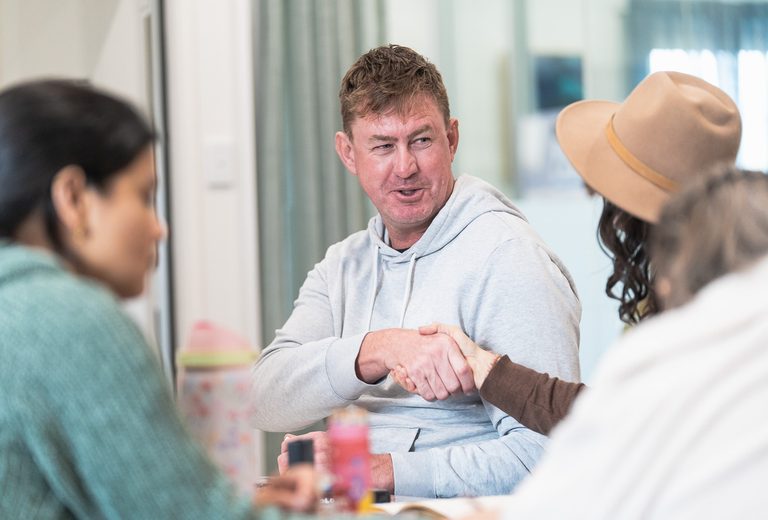
ID: Man sitting at a table and shaking hands with a women wearing a hat
When Ashley reflects on his journey, he doesn’t begin with what has been lost. He begins with gratitude, perspective and a steady belief that each day still holds the possibility of something good.
“It’s been a challenging journey, but I think it’s an exciting journey,” Ashley shares. “Every day I face my challenges, yet that is okay, my cup is half full. I’m thankful for what I have today and where I’ve come from if we looked at it from where I was to where I’m now.”
It is this sense of optimism that has carried Ashley through a period of enormous change. After becoming unwell, Ashley found himself in hospital in Adelaide, facing a future that suddenly looked very different from the life he had known. Independence, something he had once been able to rely on without much thought, was no longer guaranteed. Everyday tasks such as showering, getting dressed and moving through the day now required support.
“I no longer had independence anymore,” Ashley says. “I could no longer do what I used to be able to do and I needed help with my daily tasks.”
That adjustment was not only physical. For Ashley, coming to terms with the change also meant working through the emotional weight of uncertainty. He was trying to understand what life might look like, how he would manage, and how he could rebuild a sense of control. While the experience was difficult, Ashley was surrounded by family who helped him through those early stages.
At the time, Ashley and his family were living around two and a half hours from Adelaide. Being away from his wife and two boys during his hospital and rehabilitation journey was hard. As rehab continued, Ashley moved to the Barossa, where family support and local services helped make his recovery feel more possible.
A key part of that shift was discovering support close to home. Ashley was able to access hydrotherapy in Nuriootpa, continuing the rehabilitation he had begun in hospital. From there, more local supports became part of his life, including physiotherapy, occupational therapy, exercise physiology and community-based activities.
For Ashley, returning to the Barossa was more than a practical decision. It was a homecoming. A Barossa local, born and bred, he knew the area, the people and the sense of community that had shaped him. Moving back gave Ashley the chance to be closer to the supports, relationships and familiar places that could help him keep moving forward.
“The whole community piece is a huge part for me,” Ashley explains. Before becoming unwell, connection and supporting others had been a big part of his identity. When illness changed his daily life, that sense of involvement was something he deeply missed. Rebuilding those connections became an important part of his wellbeing.
Since moving back, Ashley has found strength not only in formal supports, but in the everyday power of community. He speaks about social outings, local groups and shared experiences with others who understand pain, fatigue and the challenges that are not always visible to the outside world.
“We’re all living through these similar things,” Ashley says. “Everyone has a very challenging journey and I think rolling this together, we need to support and be there for each other.”
That shared understanding matters. Ashley knows that not every disability, illness or ongoing health challenge is immediately visible. He has noticed that when people are not using a wheelchair or walking aid, others may assume they are okay. For Ashley, spaces where people can speak openly, feel understood and be met without judgement are essential.
Connection has also supported Ashley’s confidence, self-worth and passion for advocacy. His journey has helped him see how important it is for people to have someone to talk to, somewhere to belong, and access to the right supports in their own community. He believes there is value in more local opportunities where people can connect, share and support one another.
Acceptance has been a long process. Ashley is honest about that. There are days that are harder than others, and the journey has required him to get to know what he describes as “the new me”. But even within that reality, Ashley continues to choose hope.
“Some days are worse than others yet I’m thankful for every day,” he says. “There are good things to look forward to.”
Ashley’s story is a reminder that rehabilitation is not only about appointments, exercises or clinical progress. It is also about family, community, connection and having the right supports close enough to make daily life feel achievable. For Ashley, coming home to the Barossa has meant being surrounded by people and services that support his healing, independence and sense of purpose.
His cup-half-full outlook does not ignore the challenges he faces. Instead, it makes space for them while still recognising how far he has come. Ashley’s optimism, honesty and commitment to supporting others continue to shape his journey – one day, one connection and one step at a time.
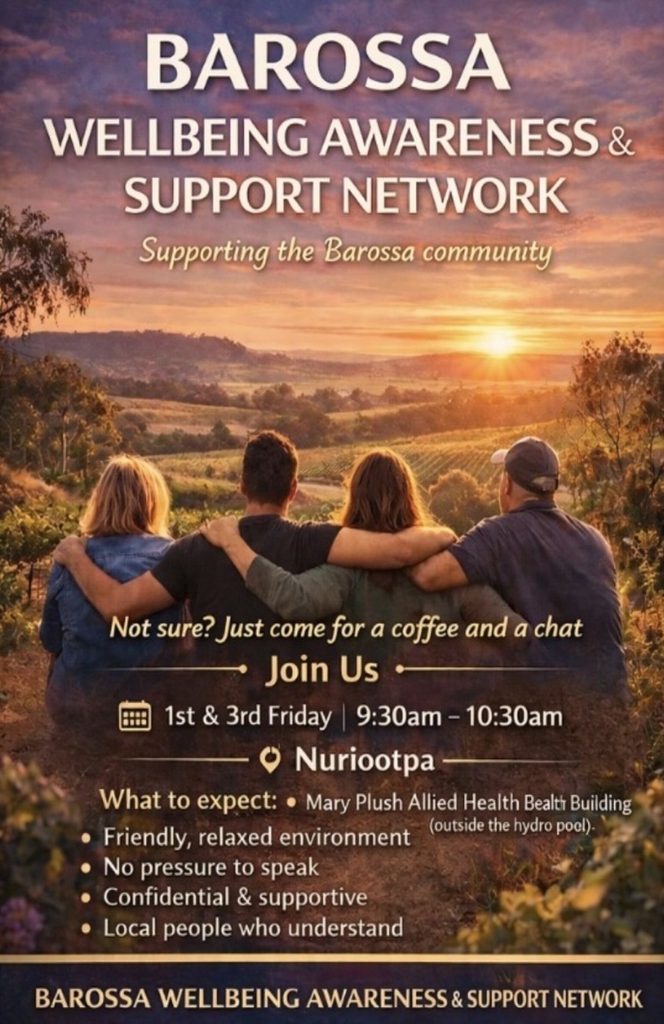
Ashley also helps run the Barossa Wellbeing Awareness & Support Network, held on the 1st and 3rd Friday of each month from 9:30am to 10:30am at the Mary Plush Allied Health Building. The group offers a friendly, relaxed and confidential space where there is no pressure to speak, just support from local people who understand. See the poster below for more information.
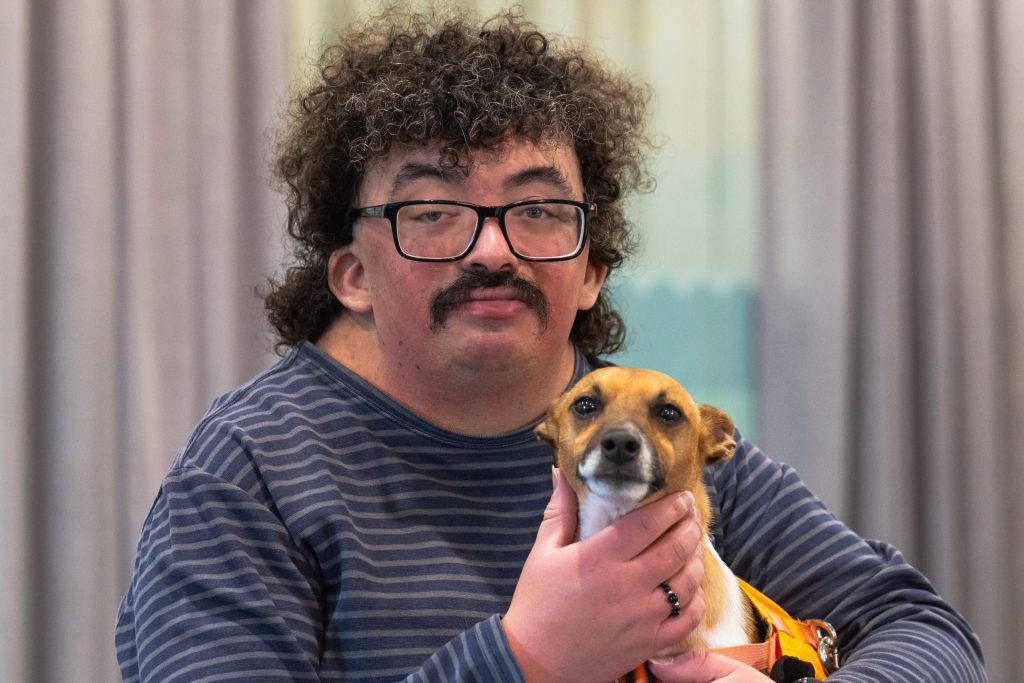
ID: Man sitting and facing the camera holding his pet dog.
For Malcolm Smith, independence doesn’t mean doing everything alone.
Instead, it means having the right support to live life on his own terms.
“There’s two types of independence,” Malcolm explains. ” Independence with help has been very much appreciated.”
Today, Malcolm lives independently with his dog, Bo, in a home that’s filled with routine, purpose and the confidence to enjoy everyday life. It’s a life that wasn’t possible before accessing support through the NDIS.
For Malcolm, support isn’t about someone taking over. It’s about having someone there when he needs it.
Whether it’s preparing healthy meals, attending medical appointments, getting out into the community or trying something new, having trusted support workers has helped Malcolm maintain his independence while building new skills and confidence.
“I’ve been able to cook better meals,” he says. “Just having someone with me when I need it to take me to doctor’s appointments and take me around if I want to go somewhere.”
His week is now full of activities that bring connection and enjoyment. Mondays are spent at an art group. Wednesdays are for cooking. Thursdays include water aerobics with one of his support workers, while Fridays are another opportunity to prepare a hearty meal. Monthly group dinners and social outings provide even more chances to connect with others, and weekends are often spent catching up with family.
These are things Malcolm says simply weren’t part of his life before.
“Yes,” he says. “I couldn’t do these things before.”
Before receiving NDIS supports, Malcolm spent many years living with chronic migraines that significantly impacted his daily life.
“For about 10 years I was mainly alone, very isolated,” he says. “Because of the pain… I wasn’t doing any of that. I wasn’t happy.”
The combination of physical health challenges and isolation meant everyday activities became difficult, and social connection was limited.
Today, life looks very different.
Support through the NDIS has helped Malcolm access community activities, maintain his home with the assistance of a cleaner, and receive equipment that has made a real difference to his independence.
A new mobility scooter has made shopping easier and given him the freedom to take Bo for walks.
“My new gopher has been extremely helpful with taking Bo on his walks,” Malcolm says. “And now I have something that helps me go to the shops better.”
It’s these practical supports that have opened the door to greater independence and a more connected life.
When asked what the right support means to him, Malcolm’s answer is simple.
“The right support is the ability to be yourself,” he says.
“To have someone help you be yourself and help you do your daily activities. And someone who pushes you – only a tiny little bit,” he says. “I don’t like to be pushed too much, only a tiny bit to do something different.”
That balance of encouragement and respect has helped Malcolm grow in confidence while remaining in control of his own life.
For Malcolm’s mum, Carolyn, watching her son’s confidence grow has been one of the greatest rewards.
“As a parent I am so relieved to have the supports in place through the NDIS because it has taken so much pressure off me,” she says.
After raising Malcolm and his sister on her own following the loss of Malcolm’s father when he was young, Carolyn spent many years as his primary support.
Today, she sees a very different Malcolm.
“It’s been fantastic as a parent to see Malcolm be able to grow through the NDIS and My Ability Pathway,” she says.
“The people who come in and support him are really caring and kind people, and I think that’s really important.”
Perhaps the biggest change has been Malcolm’s confidence.
“He was very scared in the beginning of having people coming into his home,” Carolyn recalls. “Now he’s really happy to have people come in. In the past he would never open the door, wouldn’t answer his telephone, and now to see his confidence grow… I’m just proud of the person he has become.”
Malcolm’s story is a reminder that independence looks different for everyone.
Sometimes, independence means asking for help. It means having people around who encourage you, respect your choices and provide the support you need to live the life you want.
With the right supports through the NDIS, Malcolm has gone from years of isolation to a life filled with connection, routine, confidence and choice.
And for Malcolm, that’s exactly what independence means.
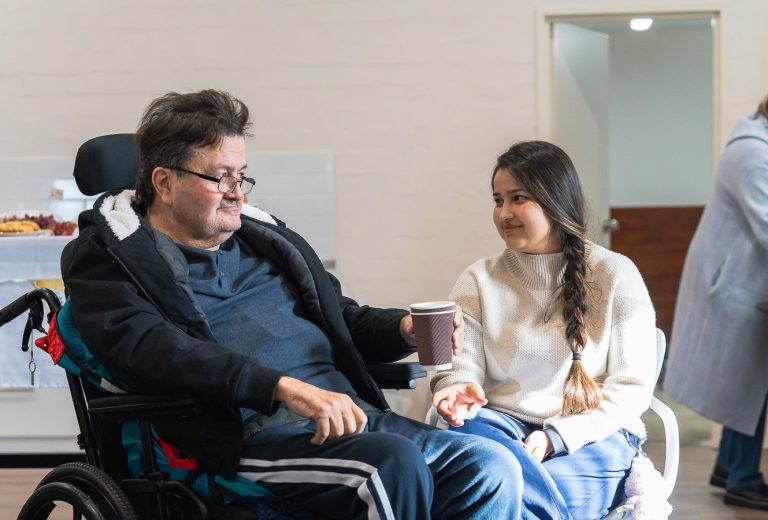
ID: Man in a wheelchair drinking a hot drink next to a female Support Worker at a Morning Tea.
For Ian and his family, the past few years have brought significant and unexpected challenges. Once an interstate truck driver who valued his independence, Ian’s life changed dramatically after experiencing multiple strokes in 2023. Today, he is settled in a Specialist Disability Accommodation (SDA) home in Nuriootpa, where he has the care, accessibility and support he needs to live safely and comfortably.
Before his strokes, Ian lived independently in Eudunda. Although he had already stopped interstate truck driving due to balance difficulties associated with normal pressure hydrocephalus, he continued to manage life on his own. His daughter, Regina, had noticed changes in his mobility, including a shuffling gait and increased periods of sitting or resting.
In September 2023, Ian suffered a haemorrhagic stroke and multiple lacunar strokes, beginning a lengthy and complex health journey. According to Regina, Ian experienced a total of 11 strokes. He had originally been admitted to hospital to receive treatment for his pre-existing hydrocephalus, but this treatment was ultimately deemed too risky due to the severity and frequency of the strokes.
Following his hospitalisation, Ian was unable to return home. Instead, he spent months moving between several hospitals and rehabilitation settings while his family and support team worked to identify the most appropriate long-term housing solution.
Ian entered the NDIS for the first time following his strokes. From the outset, it was clear that his support needs had changed significantly and that accessible housing would play a critical role in his future. During his initial NDIS planning meeting, Ian’s daughter and nominee, Regina, worked alongside his Support Coordinator to advocate for Specialist Disability Accommodation funding.
Given his high care needs, SDA funding was included in Ian’s plan, and he was also granted Medium Term Accommodation (MTA) while suitable long-term housing was identified.
Like many SDA journeys, Ian’s pathway involved a large team working together behind the scenes.
His Support Coordinator collaborated closely with My Ability Pathway’s leadership team, hospital social workers, the YIPRAC team and housing providers to ensure the necessary evidence and documentation were submitted correctly. The process required ongoing communication, frequent follow-up and coordination between multiple stakeholders.
While these administrative processes can often be complex, the goal was to minimise stress for Ian and his family and ensure a smooth transition into appropriate housing.
Location was one of the most important considerations for Ian and his family.
With strong ties to the Kapunda and Eudunda region, Ian wanted to remain as close as possible to his family, while also having access to specialised housing and support services. His Support Coordinator explored available SDA options through Housing Hub and by contacting SDA providers directly. Several properties were considered, but the priority remained finding a home within a reasonable distance of family and community connections.
Ian initially moved into an SDA home in Gawler East, providing him with an immediate solution when suitable accommodation became available. At the same time, plans were underway for new SDA homes to be developed in Nuriootpa, much closer to the area Ian and his family called home.
When the opportunity arose, Ian transitioned into one of the newly completed SDA homes in Nuriootpa, allowing him to be even closer to his support network and maintain stronger connections with family and community.
Today, Ian is enjoying the benefits of living in a purpose-built SDA home that meets his accessibility and support needs. His journey demonstrates the importance of early advocacy, collaborative planning and person-centred decision-making when navigating the SDA process.
Most importantly, it highlights how the right home can do much more than provide accommodation – it can restore connection, improve quality of life and create a foundation for greater independence and wellbeing.
For Ian and his family, finding the right SDA home was about more than a house. It was about finding a place where he could feel safe, supported and close to the people who matter most.
There are currently vacancies available in SDA homes in both Nuriootpa and Tanunda. These homes offer an opportunity for eligible participants to access purpose-built accommodation close to local services, community connections and support networks.

ID: Two men walking forward, looking at the camera. The man on the left is supporting the man on the right.
Michael’s story is one of resilience, dignity, and the power of consistent, thoughtful care. Living with Parkinson’s disease and dementia, his journey has brought challenges – but it has also highlighted how the right support can help preserve independence, mobility, and wellbeing.
As his daughter Carmen reflects, “Dad’s journey hasn’t been easy… from being a fit, working man to not knowing what his future held… was a challenging time for our family.”
Despite these challenges, Michael remains, first and foremost, a person who enjoys movement, thrives on routine, and values connection.
Conditions like Parkinson’s disease and dementia can significantly affect mobility, coordination, and overall physical wellbeing over time. Maintaining movement is not just about physical health – it’s about preserving confidence, comfort, and a sense of self.
Consistency plays a powerful role here. Familiar routines and repeated activities help reduce confusion and anxiety, creating a sense of safety and predictability. As Michael’s team explains, “A consistent approach allows Michael to feel more comfortable, safe, and confident during activities.”
This consistency also reinforces movement patterns, supporting independence and helping to maintain mobility for as long as possible.
Michael receives personalised exercise physiology support in his home environment – an approach that allows his therapy to fit seamlessly into his daily life.
His sessions include a variety of engaging, purposeful activities such as:
Each activity is carefully adapted to suit Michael’s needs, abilities, and even how he is feeling on the day. Importantly, the program is built around what he enjoys – particularly walking – helping him stay motivated and engaged. Alongside this, Michael attends regular physiotherapy sessions, with both disciplines working together to support his mobility, safety, and independence.
Over time, the impact of familiar faces and regular routines has been significant. Trusted support workers and structured sessions not only encourage participation but also build confidence.
As his care team notes, “Having familiar support workers, repeated exercise routines, and structured sessions helps him better understand what is expected and encourages participation.”
Consistency also plays a key role in physical outcomes – supporting balance, stability, and strength through regular practice.
While Parkinson’s disease and dementia are progressive conditions, the results of Michael’s ongoing support highlight the difference consistent care can make.
Since beginning his program:
His team reflects positively on these outcomes: “Overall… the ongoing exercise support has played an important role in maintaining his mobility, preventing falls and keeping him engaged and active in a safe environment.”
For Carmen, the changes go beyond physical health:
“Dad’s mobility has increased and he has been happier, more well and his mental health has improved.”
And the impact on daily life is meaningful:
“Dad’s mobility means he can move with comfort and ease, get out to the community more often… and live more independently.”
Michael’s story is a reminder that even in the face of progressive conditions, thoughtful and tailored support can make a profound difference.
Through consistent care, personalised therapy, and familiar routines, it is possible to preserve not just physical ability – but dignity, confidence, and quality of life.
At My Ability Pathway (MAP), there is a deep commitment to providing high-quality Supported Independent Living (SIL) supports that are centred around each individual. This means working alongside people like Michael to understand what matters most to them – whether that’s maintaining mobility, staying connected to community, or simply feeling comfortable in their daily routines.

ID: Three girls walking with their backs to the camera.
Home life is busy. For a family of six – Mum, Dad, three girls and their dog, Freckles – most days start like any other family: getting ready for school and preparing for what lies ahead. But woven into their daily routine are therapy sessions with occupational therapists, speech pathologists and psychologists.
This family is one of many living with autism.
And they thrive! With three children with ASD, they have found a rhythm and joy in the everyday. Their lives are built on understanding, resilience and celebrating wins.
For Emily*, the first signs came at age five. What initially seemed like childhood quirks gradually formed a clearer picture—particularly a moment at a friend’s house when she covered her ears after flushing the toilet. It prompted a deeper look at patterns: sensitivities to noise and fabrics, challenges with sleep, and a preference for order (like keeping foods separate on her plate).
“We had always attributed her quirky behaviours as just being due to being little,” Mum says. “But when we spoke to the doctor, it was the first time we looked at all those little quirks and saw the bigger picture.”
“Lucy* was a little easier to see, once we understood Emily,” she continues. “But she had some of her own special traits.” Lucy’s differences included toe walking, sensory-seeking behaviours, and a love of movement—like swinging high on the swings—as well as selective eating habits.
“The main barrier we faced was getting a referral for an assessment – and then there was the waiting list!” Mum recalls. “For our youngest daughter, we paid for her to be assessed privately. It was so much faster, but it was an expensive process.”
Despite the challenges, having a diagnosis proved to be a turning point. It opened doors to funding and support through the NDIS, along with access to therapies and resources that have helped the family better understand and meet each child’s needs.
Ask the girls what they’re most proud of, and their answers come quickly.
“My biggest strength is swimming,” Emily says. “And I’m really proud of my swimming. I’m working hard to become an Olympic swimmer.”
Lucy shares that love of the water – and also shines in the kitchen: “I am really proud of learning how to bake and being able to make things in the kitchen on my own, with mum or dad just supervising.”
They find great joy in their passions.
“Spending time in the kitchen and the pool makes me happy,” Lucy says.
Emily agrees. She takes great pleasure in “spending time in the pool with my swimming friends.”
For Mum and Dad, an evening reflection proves the perfect way to focus on joy and the everyday wins. “At dinner we share the best part of our day, to find something that made us happy, even on a tricky day.”
“The word spectrum can be confusing. It makes people think that autistic people are somewhere along a continuum, whereas it’s more complicated than that,” Mum says. “Every child is unique with their own set of skills and challenges. For our girls, we have heard quite a lot about how they make eye contact, so they can’t have autism. We have three autistic girls, and they are all so very different.”
What people don’t always see is the effort it takes.
“Something [our girls] do have in common is working very hard at school, to focus and do their best – and then the struggles at home to regulate after a long day,” Mum shares. “I think more people need to be aware of just how hard some autistic children work to stay regulated and focused all day.”
Emily’s advice is simple but powerful: “Don’t let being autistic make you give up on your dreams.”
For Mum and Dad, connection is key. Seeking out support, accessing available services, and finding other families who understand the journey has made a meaningful difference. “There is lots of help and support out there, so make the most of it. Finding other families who have autistic children has been helpful for us as they understand our girls.”
*Names have been changed to protect the privacy of the children.
Photo by Steve Lieman on Unsplash
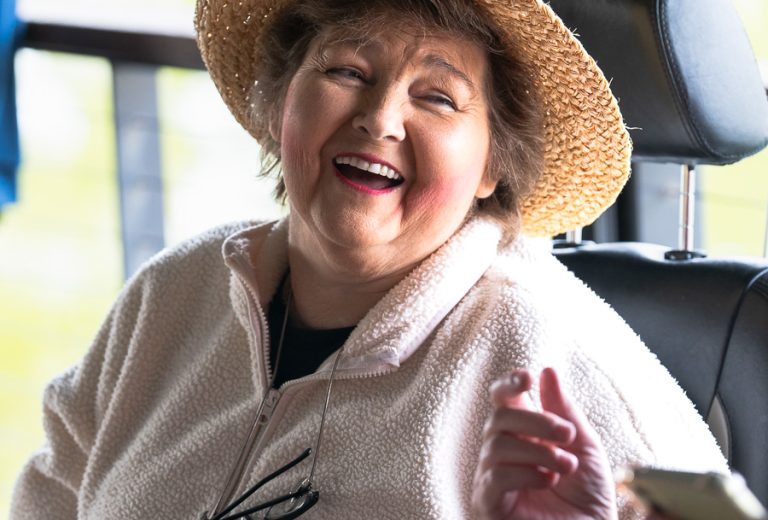
ID: A woman laughing wearing a broad brim straw hat.
Christine remembers the fear more than anything.
Not fear of the unknown – but fear of the everyday.
The simple, human moments most of us take for granted had become the hardest. Standing. Moving. Reaching. Even holding her grandchildren came with a quiet, constant worry in the back of her mind: What if I fall? What if I hurt them? What if I hurt my husband trying to manage on our own?
Before moving into Specialist Disability Accommodation (SDA), life had become a careful balancing act – one where the risks were growing and the support just wasn’t enough.
Her home, though filled with love and familiarity, wasn’t built for what she needed.
“My bathroom [was] very big,” Christine explains, “but it’s not big enough for my wheelchair or my lifter. My husband was able to help me, but not always. He’s getting older too… I had to come here so that I could get the help that I needed so that I didn’t hurt Tony.”
It’s a reality many people face quietly – where love and care alone can’t replace the right environment, the right design, and the right level of support.
Moving into SDA in Gawler changed things for Christine – but not in the way people sometimes assume.
It didn’t take away her independence.
It gave it back.
“I’m getting the help that I need and I’m so much more relaxed… I can concentrate on getting better and building my strength up.”
With the right supports in place, Christine’s focus shifted – from simply getting through the day, to actually living it.
There’s something powerful about feeling safe in your own home. It creates space for everything else – healing, confidence, connection.
And for Christine, something else returned too: hope.
“Oh definitely… I used to be frightened to pick up my grandchildren… but now I’m quite confident in having them come visit me and sit on my lap… I can cuddle them and I can do the things that I need to do to be a great granny.”
That confidence – the ability to be present with the people you love without fear – is what real support looks like.
One of the biggest misconceptions about SDA is that it feels clinical or restrictive.
Christine’s experience tells a very different story.
“It doesn’t stop you from living your life, it helps you.”
Her home isn’t defined by limitations – it’s shaped around possibility.
She bakes. She uses her computer. She hosts friends. She celebrates milestones.
“We had Christmas here and my friends came… we had the best day.”
And when she needs support, it’s there – without hesitation.
“There’s nothing they won’t do for you… If I get stuck… they’re right there.”
This is what person-centred support looks like in action: an environment designed not just for access, but for living well.
For anyone unsure about SDA, Christine doesn’t hesitate.
“Do it, do it. It’s a must. If you’re not sure, if you’re stumbling, if you’re falling – you have to come here and get help, because this is the place to be.”
It’s simple. Honest. And grounded in lived experience.
Christine’s story is just one example of what’s possible when the right environment meets the right support.
And now, more opportunities are becoming available.
Three brand-new SDA homes are being developed in Tanunda, with vacancies expected from July 2026. Designed with accessibility, comfort, and independence in mind, these homes offer:
It’s important to note that while these homes are delivered in partnership with SDA provider, Metcalf Group (SA), My Ability Pathway provides the Supported Independent Living (SIL) supports – ensuring participants receive consistent, person-centred care aligned with their goals.
SDA isn’t just about accessible housing.
It’s about reducing risk.
It’s about restoring confidence.
It’s about creating the conditions where people can reconnect with what matters most.
For Christine, that meant holding her grandchildren again without fear.
For others, it might mean cooking independently, pursuing hobbies, or simply feeling safe enough to relax.
Whatever the goal – the right environment makes it possible.
If you or someone you support could benefit from SDA, now is the time to explore your options.
Secure your future home – complete an Expression of Interest.
Conditions apply.
Our team is here to guide you through the process, answer your questions, and help you determine whether SDA is the right fit. Let us know if you would like one of our complimentary SDA Information Packs to be sent to you.
Because everyone deserves a home that supports not just their needs – but their life.

ID: Picture of two men on a motorbike.
At My Ability Pathway, our Support Coordination team often talks about goals, plans and progress. But sometimes, the most powerful outcomes aren’t written in a plan – they’re felt in the wind on your face, the sound of an engine starting, and the spark of recognition in someone’s eyes.
Today, 5 March 2026, we saw exactly that with John, one of MAP’s Support Coordination clients.
John lives with Frontal Lobe Dementia, also known as Frontotemporal Dementia (FTD). FTD is a progressive neurodegenerative disease that causes shrinkage (atrophy) in the brain’s frontal and temporal lobes. It most commonly affects people between the ages of 45 and 65.
Unlike other forms of dementia that begin with memory loss, FTD often first presents as dramatic changes in personality, behaviour and language.
Common impacts include:
There are two main subtypes:
FTD is caused by abnormal protein build-up in the brain. In around 30–40% of cases, there is a genetic link. There is currently no cure, and diagnosis relies on neurological assessments, behavioural evaluations and brain imaging that shows atrophy.
In recent years, public awareness of FTD has increased following the diagnosis of actor Bruce Willis, helping many families better understand the condition and its impact.
While life expectancy varies widely, supportive care, routine, therapies and medication can help manage symptoms such as agitation, depression and sleep changes.
But beyond the clinical description is something equally important: identity. And that’s where John’s story comes in.
For many people living with FTD, it’s not only abilities that change – it’s interests and motivation too. Activities that once brought joy can feel distant, confusing or overwhelming.
John used to ride motorcycles. It wasn’t just a hobby; it was part of who he was.
As dementia progressed, riding became difficult. John shared that it wasn’t only about forgetting how to ride – it was about losing confidence. People would tell him he was doing it wrong. His balance worried him. Gradually, the bikes stopped.
And with that, something else quietened too.
His wife Terri has watched these changes unfold. Over the years, John has shown less interest in many of the things that once energised him. So when something sparks engagement, it matters.
After talking with John, Support Coordinator Beth started thinking differently. What if this wasn’t about what John could no longer do – but about how we could safely reconnect him with what he loved?
Beth reached out to Keith from the Long Riders Motorcycle Club Adelaide. Without hesitation, Keith offered to come to John’s home and spend time talking bikes.
That visit alone made a difference.
They sat together – John, Terri and Keith – swapping stories. They talked about John’s first bike, a Suzuki. They reminisced about runs, rides and the open road.
John worried about his balance. Keith reassured him.
And then John’s humour surfaced:
“I’ve got some bungee straps out the back if you need to strap me down.”
The room filled with laughter.
It was a glimpse of the John Terri knows so well.
Soon enough, they stepped outside to Keith’s bike.
John was asked, “How are you feeling?”
“Nervous. It’s been a long time.”
The first ride was just around the block – a gentle reintroduction to the sensation. A quick stop back home. A moment to regroup.
Then they headed out for a longer ride around town.
This was something different for Terri. John rarely leaves the house without her now, which makes us acutely aware of the pressures carried by carers – the constant responsibility, the fatigue, the hypervigilance, the quiet mental load. Moments like this highlight an important question in disability and dementia support: who’s caring for the carer?
Creating space for John to safely reconnect with something meaningful also created space – even briefly – for Terri to breathe.
There is no cure for Frontal Lobe Dementia. We cannot stop the progression.
But we can support identity.
We can create moments of connection.
We can work creatively around challenges.
Today wasn’t about motorcycles alone. It was about dignity. Confidence. Laughter. Community.
It was about remembering that even when the brain changes, the person is still there.
At MAP, Support Coordination is not just about navigating systems – it’s about listening deeply enough to ask: What still matters?
For John, it turns out, it’s still the rumble of a bike beneath him and the freedom of the road ahead.

ID: Odin smiling outside on a sunny day.
Odin is nine (almost ten, in July) and full of energy. He loves his bearded dragon, Pascal, who is three months old and enjoys baths, and his cavoodle Ruby, who sleeps on his bed and “snores like a train.” If you visit his house, you might even catch him doing parkour down the hallway – even though he knows he’s not supposed to.
He’s a soccer fan (especially Cristiano Ronaldo), loves riding his bike, and plays at the park with his carers. At school, maths and science are his strengths – he’s proud of his grades – and he can also speak Indonesian. He’ll happily talk for hours about bearded dragons, Minecraft or LEGO builds if you let him.
Odin describes himself simply: “I’m just me.” He has a lot of energy, talks a lot (especially when he’s excited), and doesn’t like when people repeat themselves. He finds school boring at times and doesn’t like being yelled at. Loud or busy environments can feel overwhelming, and when that happens, he needs space – sometimes retreating to his room to feel calm again.
What makes a good day for Odin? Feeling calm. Playing soccer. Visiting the skate park. And yes – playing his Nintendo Switch.
Odin is proud of raising Pascal and teaching Ruby to shake hands. He knows he’s a “special kid” with “special needs,” and he wants people to understand that sometimes he can’t help talking loudly when he’s excited.
He laughs at silly jokes, dreams of turning everything to gold with a single touch, and this year he has a goal: to go from “class clown” to “class king.”
Most of all, Odin is an energetic, dragon-loving, joke-telling, maths-whiz nine-year-old – who happens to have autism.
