We value your privacy
This website uses technical, functional and analytical cookies that do not infringe on your privacy.
General purpose platform session cookies are usually used to maintain an anonymised user session by the server.

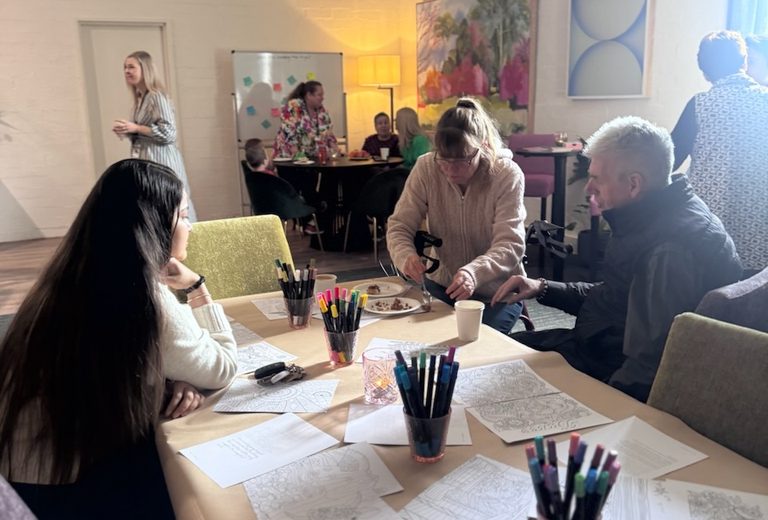
ID: Group of people sitting around a table with colouring in pages.
At My Ability Pathway, wellbeing is something we talk about often, but it is also something we need to make time for intentionally. In the disability sector, so much of the work is centred on supporting others – often through complex, emotional and physically demanding days. For frontline team members in particular, the rhythm of care can mean giving a lot of yourself, day after day.
Recently, we held our Wellbeing Together event at MAP HQ. It was planned around the time of R U OK? Day, but with a slightly different focus. While awareness days can be important reminders to check in, we wanted to create something that felt practical, gentle and ongoing – a space where people could pause, connect and be reminded that wellbeing is not a one-day conversation.
The morning itself was simple, but in many ways that was what made it meaningful. Around the room were small wellbeing stations designed to give people different ways to slow down. Some team members sat together colouring in, enjoying the quiet focus and conversation that can come from doing something with your hands. Others took time to reflect, sitting with prompts that invited them to notice what was happening in their internal world. There was also a massage chair for a much-needed neck and back massage, along with good food, drinks and time to talk.
Nothing about it was complicated. And perhaps that was the point. Sometimes wellbeing begins with permission – permission to step away from the pace of the day, to sit beside someone you may not usually work with, to take a breath, or to notice that you are carrying more than you realised.
Wellbeing Together was primarily created for our team, while also being open to clients. It gave us an opportunity to come together in a way that was relaxed and human, away from tasks, rosters, emails and routines. It was also a chance to bridge the perceived gap that can sometimes exist between frontline and administration teams.
In an organisation like MAP, every role contributes to the same purpose. Some people provide direct support in homes and communities. Others coordinate services, manage systems, communicate with families and stakeholders, or help keep the organisation moving behind the scenes. Events like this remind us that we are not separate groups doing separate work – we are one team, supporting people in different but connected ways.
For people working in the disability sector, wellbeing cannot be an afterthought. Supporting people with significant disabilities can be deeply rewarding, but it can also be exhausting. The emotional labour, the responsibility, the unpredictability and the physical demands can add up quietly over time.
That is why checking in matters – not just with the people around us, but with ourselves. Am I actually doing okay? What do I need right now? Who can I talk to if I am not coping? These questions are not signs of weakness. They are part of staying well enough to keep showing up with care, patience and compassion.
We also used the event as an opportunity to connect our team with local wellbeing resources. Lifeline has recently opened at the Barossa Community Centre on Second Street in Nuriootpa, making support more accessible within our community. While Lifeline is well known for suicide prevention, its services extend beyond crisis support. They offer free, confidential counselling, unlimited support sessions, mental health and emotional wellbeing support, and a safe space to talk through life’s challenges – big or small.
You do not need to be in crisis to reach out. Support can be for stress, anxiety, grief, relationship challenges, work pressures or the everyday weight of life. Knowing where to turn before things become overwhelming is an important part of looking after ourselves and each other.
We also encourage our male team members to explore Good Better Best Men, a volunteer-run organisation offering open men’s groups and workshops focused on connection, wellbeing and supporting one another. Sometimes the hardest step is starting the conversation, and community spaces like these can make that step feel a little easier.
Wellbeing Together was never about replacing formal supports or suggesting that one morning could meet every need. It was about reminding our team that support exists, that connection matters, and that caring for yourself is part of caring well for others.
Our hope is that events like this help create a culture where wellbeing is not only spoken about when things are difficult, but woven into the everyday. A culture where people feel safe to say they need a moment, where reaching out is encouraged, and where no one feels they have to carry things alone.

ID: low angle photo of pink and orange balloons with sad and happy faces.
It can be hard to understand something we cannot see. Psychosocial disability is often hidden beneath the surface, which means its impacts can be overlooked, minimised or misunderstood. For people living with mental health conditions that affect daily life, relationships, work or study, that lack of understanding can lead to stigma, discrimination and sometimes, a painful absence of compassion.
Mental health conditions are, as the name indicates, health conditions. In Australia, they are treated by the healthcare system and supported by Medicare. Psychosocial disability exists when a person living with a mental health condition experiences functional difficulties or barriers directly related to the impacts of that condition.
Those impacts can show up in daily activities, social interactions, work, study and other parts of life. They don’t look the same for everyone. Some people may be able to work or study with support or clear boundaries, while others may go through periods where daily tasks, social connection or employment become very difficult – or even impossible – to manage, at least for a time.
One of the reasons psychosocial disability is so often misunderstood is that mental health conditions are not always visible. The disability impacts can be overlooked or misread. Someone might be labelled as lazy, difficult, messy, withdrawn or unwilling, when what’s really happening is that they are facing functional barriers connected to their mental health condition.
Comments like “be happy” or “run it off” don’t recognise how serious mental health conditions can be, or the very real disability impacts that can come with them. Those kinds of attitudes can add to stigma and make it harder for people to feel understood or supported.
The numbers show just how many people may be missing out on support. Figures from 2022–23 estimate that, across Australia, 230,500 people with severe psychosocial disability and 263,100 people with moderate psychosocial disability were not accessing either NDIS or mainstream support. That works out to more than 68% of people with severe psychosocial disability and more than 84% of people with moderate psychosocial disability not receiving support.
Those are significant numbers, especially when we think about the broader mental health picture. In any given year, an estimated one in five people will experience a mental illness. Not everyone who experiences mental health concerns will also experience psychosocial disability, but it does remind us that these conditions are common and widespread.
For some people, the cause of their psychosocial disability may be very treatable, and recovery from the functional impacts may be possible. For many others, mental health conditions can be chronic or episodic. This means they may flare up and then ease again with time or treatment. Relapses can happen, and treatments may need to be reviewed or adjusted along the way.
Recovery looks different for every person and every condition. It can depend on many things, including what recovery means to the person themselves. For some people, psychosocial disability may continue despite treatment. The NDIS calls this “permanence”. For others, treatment may resolve the functional impairments they experience because of their mental health condition.
Building skills to manage or overcome barriers can make a real difference, but it doesn’t always mean the underlying mental health condition has been “cured”. Many conditions are treatable but not curable, and depending on the person’s circumstances and goals, both mental health treatment and disability support may be needed.
Living with psychosocial disability can be incredibly difficult. It can affect things like housework, isolation, work, relationships, daily tasks, or even understanding what is happening. For some people, recovery is hard because they may not respond to traditional treatments, may be medication resistant, or may not be able to access treatment and therapies.
The good news is that support is available for both mental health conditions and the disability impacts that can come with them. In South Australia, Medicare may provide assistance, and the NDIS remains an option for people living with permanent psychosocial disability. Support phone lines, online chat options and walk-in support clinics are also available.
Progress in mental health is not always easy to see, and it is not always a straight line. Setbacks do not mean progress is not happening. When we understand psychosocial disability with compassion, accuracy and respect, we take an important step toward reducing stigma and helping people access the support they need.
Photo by Madison Oren on Unsplash


ID: Image of a multicoloured brain.
Neurodiverse is a term that lends itself to a wide range of conditions. The word “neurodiversity” was coined in 1998 by Australian sociologist Judy Singer, later leading to the term neurodiverse.
As the word suggests, it relates to the diversity of human brain functions, typified by thinking, learning and behaving differently to ways considered “neurotypical”.
These differences are called “neurotypes”, which are characterised by common experiences among those with a particular neurotype.
Neurotypes include, but are not limited to:
A great resource to learn more about each neurotype is Genius Within.
Neurodivergent people have different strengths and challenges to neurotypical people. While members of each neurotype are likely to have similar experiences, these still vary widely from person to person. After all, no two people’s brains are the same.
While this means that there is no normal for human brain function, medical and social constructs often rely on categories or definitions for ‘normal’. This provides a framework for identifying the differences and diversity of the ways the human brain can function. Acknowledging and understanding these differences empowers people to work with their particular strengths and challenges, ensuring they are able to learn and recognise tools that will help them succeed.
The social model of disability is an important consideration when talking about the overlap of neurodivergence and disability. The social model, a phrase conceived by Mike Oliver in 1983, outlines that disability is an interaction between impairment and environment – specifically, that disability exists when social constructs do not allow for accommodations to be made. A common example used to illustrate the model is a building that has no ramp access. In this case, the barrier is the lack of accessibility rather than an individual who uses a wheelchair.
For some people, the impacts of their neurodivergence leads them to identify as living with a disability, while the same may not be true for another person with similar experiences. It’s highly individual. This Psychology Today article goes into greater detail.
The interaction between neurology and environment is a significant factor for neurodiverse individuals. Some settings align with their needs, while others can cause discomfort and distress. The disability exists when environmental demands and neurology are mismatched. Similarly, some people describe their neurodivergence as a ‘superpower’ – this occurs when the environment allows them to flourish.
Supporting people with neurodivergence comes in several forms. One of the most important is social change to make environments and systems more inclusive and accommodating. This supports people’s strengths and challenges, without forcing them to conform to standards that may be unrealistic.
Communication is another key element. Listening to people and truly hearing their experiences, along with communicating in a personalised, preferred way makes all the difference. For example, some people do better with written communication than verbal. Try to give people the tools they need.
And remember all individuals, neurodivergent or neurotypical are exactly that – individuals. No two people are the same, have the same experiences, capabilities or struggles, regardless of a shared neurotype. Respect, curiosity and support are key to helping anyone succeed.
Nicole Martin

ID: Nicole Martin, Finance and Systems Coordinator at MAP

If you’ve never met me before, I’d describe myself as someone who cares deeply and works hard. I’m the kind of person who likes things to make sense. I like structure, clear expectations, and systems that actually work. I’m also fiercely loyal, especially to people I trust. I’m the person who will problem-solve and keep going even when I’m running on fumes… which, looking back, explains a lot!
I’ve always had a few quirks that make me me. I can hyperfocus like it’s an Olympic sport when I’m interested in something. Building processes, making things more efficient, finding ways to improve the way we work – I love all that. My brain is constantly busy – it’s either in full sprint mode or it’s refusing to move at all.
For me, a good day looks like achieving through meaningful work, supporting others, solving something that’s been stuck, and still having enough mental energy left to be present at home. It’s the kind of day where I finish feeling satisfied rather than drained. Those days are gold.
Before my diagnosis, I used words like “busy” and “all over the place” to describe how my brain worked. In reality, it felt like I was constantly managing myself.
When people think of me, I hope the first thing they see is not the diagnosis! I want them to see someone capable. Someone reliable. Someone who genuinely cares – a person who wants to do things properly and make things better, not just for myself but also for the people around me.
When I look back now, there are so many parts of my life that make more sense since diagnosis.
I could be incredibly driven, productive, and switched on … and then suddenly hit a wall. I could hold huge responsibilities, yet feel completely overwhelmed by small tasks. And I could keep everything together at work but then feel like I’d fall apart the second I got home. I could be organised in some areas, but totally disorganised in others – not in any typical way, but in a “why is this so hard for me?” way.
There were absolutely moments where I felt different and couldn’t explain why. It always felt like I was working twice as hard just to keep up with the basics. I didn’t necessarily think I was failing – I just thought I was … exhausted.
Over time, I developed coping strategies without even realising what they were. I relied heavily on task lists, even if I didn’t complete them, and created systems to hold my life together. I learned how to mask, especially in professional environments – looking calm, capable, and in control while my brain was doing backflips behind the scenes.
I learned how to push through. And I got very good at it. It was exhausting.
Strengths were always there, too; I just didn’t understand them properly. My ability to see patterns, to problem-solve, to focus deeply when something mattered, to work fast under pressure, to care about people and outcomes. Those things weren’t new after diagnosis, they were present all along.
However, so were misunderstandings. The biggest one was a story I told myself: that if I was struggling, it meant I wasn’t trying hard enough – or that I was lazy. Other people misunderstood too sometimes, assuming if you can do the big things, you can also do the small things. But they don’t see how much energy it takes to get there.
I didn’t seek a diagnosis because I suddenly woke up one day and just decided to. It was more like I reached a point where I couldn’t ignore the patterns anymore, especially after having my daughter and those patterns got stronger.
I’d spent years working so hard to stay on top of everything. It worked – until it didn’t. Burnout cycles became more obvious. Overwhelm felt heavier. The mental load was constant. I started to realise that I wasn’t dealing with “stress” or “life.” I was dealing with something deeper in how my brain processed the world.
There wasn’t a single turning point, but many moments that stacked up. Moments where I’d think, “it shouldn’t feel this hard”. Moments where I was doing everything “right” but still struggling. Moments where people would say “just do it” and I couldn’t.
I saw information about ADHD in adults, especially women, and something clicked.
Of course, I had fears and hesitations, and questioned myself constantly. Worrying I was being dramatic, I was afraid I’d be dismissed. I worried that it would seem like I was making excuses. And I worried people wouldn’t take me seriously because I was “functioning.”
If I’m being honest, part of me stressed that if I got assessed and didn’t get a diagnosis, I’d be back at square one with no explanation and no direction.
The process surprised me in a few ways. For one, it was more emotional than I expected. Not just about ticking boxes, I had to reflect on my whole life, revisiting childhood experiences, school, relationships, work … I saw the same patterns at every stage. It was validating, but also confronting.
During the waiting period, my brain did what it does best: it analysed everything. I was constantly reflecting, replaying, second-guessing, and connecting dots. It felt like I was standing on the edge of an answer without being able to grab it yet.
When I received my diagnosis, I didn’t feel one emotion – I felt a huge mix of them.
The biggest was relief, a real, physical relief. Like someone had finally handed me the missing piece of the puzzle. I wasn’t crazy. I wasn’t failing at life in secret.
There was also grief. Grief for younger me, and for all the years I spent being hard on myself. Grief for the times I pushed through when I needed support. Grief for the times I thought I was broken.
There was validation too. And some confusion. Even when something makes sense, it still takes time to absorb it. It shifts the way you see your past and your present at the same time.
I did see myself differently after diagnosis. Not as someone who was both “too much” and “not enough”, but as someone whose brain is wired differently, someone who coped without understanding why.
First, I told people I trusted, people I knew wouldn’t judge me or minimise it. I didn’t want pity. I didn’t want a big emotional moment. I wanted to be understood.
Giving myself time helped me process it in a healthy way. Talking things through. Reading. Learning. Reflecting – and letting myself feel what I felt without trying to rush a “positive spin.” Because it’s not one feeling, it’s a whole journey.
Since diagnosis in June 2025, a lot has changed internally, even if externally it looks similar.
I’m still me. I still work hard. I care a lot. I still love systems, structure, and improving how things run. But I understand myself now – and that has changed everything.
I’ve become more intentional about how I work and communicate, and learned that I need clarity. I need structure, with time to focus without interruptions, planning my energy and not only my time. My boundaries are necessary – and I’ve stopped treating burnout as a personal failing.
Some adjustments have supported my wellbeing. I’m more aware of overwhelm and realistic about my capacity. I’m more willing to say, “I need this in writing,” or “I need time to think.”
The strengths of my neurodivergent identity are huge. My hyperfocus. My ability to solve problems fast. My drive to improve systems. My ability to think strategically and connect dots quickly. Creativity. Passion. Emotional insight. These are not “random personality traits”, they’re part of how my brain works.
One misconception I would love to challenge is that neurodivergence equals inability. It doesn’t. It means difference. The environment and systems matter – a neurodivergent person thrives, not by becoming someone else, but by being supported to work in a way that matches how their brain functions.
If you’re thinking you might be neurodivergent but you don’t have a diagnosis, the biggest thing I can say is, you’re not making it up. And you’re not alone.
You don’t need to wait for a diagnosis to learn to understand yourself. Notice your patterns. Learn about neurodivergence from credible sources. Reflect on what helps you thrive and what drains you. Talk to safe people. Give yourself permission to explore without shame.
Other support options beyond a formal diagnosis include therapy, coaching, work accommodations, peer support and practical strategies. Self-awareness alone is life changing. Diagnosis can be helpful, but isn’t the only path to self-understanding.
Everyone’s journey is different, because everyone’s brain, life experience, trauma history, personality, and environment are different. Some people seek diagnosis early, some late. Some never. Some have access to support while others don’t. There’s no “right” way to do this.
For colleagues, leaders, and allies, inclusion is often simpler than people think, starting with communication that’s clear and respectful. It looks like giving people information in their preferred format, or setting clear expectations without assuming everyone processes the same way. It looks like flexibility and trust.
What helps me feel supported is not being treated as though I’m fragile. It’s being treated like I’m capable, with the understanding that my brain works differently. Meaningful inclusion exists when workplaces not only talk about diversity, but design systems that allow different brains to succeed.
Neurodiversity awareness, to me, means understanding that difference isn’t a flaw.
Recognise that people bring different brains, processing styles, and strengths to the table. Move away from the idea of “one right way” to work, or communicate, or succeed.
One message I’d love readers to take away from my story, is this: you can be successful and still be struggling. You can be high-performing and still be exhausted. You can look like you’re coping and still be drowning inside.
Today, my self-acceptance looks like working with my brain instead of fighting against it. I’ve built support systems instead of relying on sheer willpower. I’m kinder to myself, not because I’m making excuses, but because I finally understand my truth.
My understanding of “difference” has massively evolved. I used to see difference as something to hide. Now, I recognise it is something to understand. To work with. Differences are strengths, not despite them, but because of them.
Honestly, I’m still learning. But I’m learning from a place of compassion now, not criticism.
And that’s made all the difference.
