We value your privacy
This website uses technical, functional and analytical cookies that do not infringe on your privacy.
General purpose platform session cookies are usually used to maintain an anonymised user session by the server.


ID: Photo of the front of a new Specialist Disability Accommodation house in Nuriootpa.
Looking for Specialist Disability Accommodation in Nuriootpa? Finding a suitable home involves more than checking whether a room is available. It means considering how the space works for you, what support you need and whether the location helps you stay connected to the people and places that matter. My Ability Pathway’s current vacancies page lists High Physical Support SDA in Nuriootpa, with housing provided by New Dawn Housing and Supported Independent Living supports delivered by MAP. If you are exploring your next move, here is a starting point for learning about the home and asking the questions that matter to you. Availability can change, so please contact MAP to confirm current vacancies and suitability.
Watch the Nuriootpa SDA video below as a starting point for exploring the home. As you watch, note what you would like to ask about or see during a visit. A video can help you prepare questions, but it cannot confirm whether a home will meet your individual accessibility, equipment or support needs.
MAP’s Nuriootpa vacancy listing describes a purpose-built High Physical Support home with modern accessible design, spacious shared living areas and a private bedroom with an ensuite. It also identifies proximity to local services and community facilities. These features are worth considering in relation to your own routines. How would you move between your bedroom, bathroom and shared spaces? Where would you spend time with visitors? What would help you take part in household activities in the way you prefer? The NDIS describes High Physical Support housing as including a high level of physical access for people who need very high levels of support. That category does not tell you every detail of an individual property. Ask which equipment and technologies are installed, which are provisions for future installation and what would need to be arranged for you.
New Dawn Housing is identified as the housing provider, while MAP provides the Supported Independent Living services. MAP’s listing describes 24/7 SIL support at the Nuriootpa home. Your individual assistance, overnight arrangements and any shared supports still need to be discussed; 24/7 support does not automatically mean continuous one-to-one assistance. SDA relates to the specialist home, while SIL relates to assistance or supervision with daily tasks. They are separate supports, and SDA funding does not include personal care or SIL. For an introduction, read MAP’s guide to SDA and SIL. Ask for clear information about the housing agreement, support agreement, charges and who to contact about each aspect.
For someone who wants to live in the Barossa, location may be an important part of the decision. Consider the people you want nearby, the appointments you attend and the places you enjoy visiting. Rather than relying on the phrase “close to services”, ask about the actual journey: transport, accessible routes, travel time and any assistance required. Your home should be considered alongside your wider life. Shared living also deserves discussion. Ask about the proposed household, privacy, visitors and how different routines can work together, while respecting other residents’ confidentiality.
SDA is for eligible NDIS participants with extreme functional impairment or very high support needs. A listed vacancy does not establish eligibility or guarantee that the property matches your approved funding and circumstances. Your support coordinator or chosen supporter can help you gather questions and understand the information provided. The NDIA explains that SDA residents pay a reasonable rent contribution and other day-to-day living costs, such as electricity. Request a clear breakdown of the costs for this particular home before deciding. There is no need to work through every question alone, but your preferences should remain central throughout.
If you would like to explore the Nuriootpa SDA vacancies, view the New Dawn Housing property listing on Housing Hub, check MAP’s current vacancies or contact MAP to ask about availability and a possible viewing. Call 08 8563 2569 or email ndis@myabilitypathway.org. Whether you are making an enquiry for yourself or supporting someone with their permission, the starting point is the same: what would make this a suitable home for the person who will live here?
Contact MAP to confirm Nuriootpa SDA availability, discuss your needs and ask about a viewing.

ID: photo of a client and support worker smiling at the camera.
A home can have wide doorways, a suitable bathroom and a bedroom you like, yet still leave an important question unanswered: what would living here actually be like? When you are exploring supported living, the building is only part of the decision. Daily routines, privacy, housemates, support arrangements and connection to familiar places all shape whether a home fits your life. A viewing is an opportunity to consider these things, not a test you have to pass or a decision you must make on the spot.
Supported living is a broad expression, not one NDIS funding category. Supported Independent Living (SIL) funds assistance or supervision with daily tasks at home for people with substantial support needs. Specialist Disability Accommodation (SDA) is specialist housing for eligible people with extreme functional impairment or very high support needs. Some people have both; they are not interchangeable. SIL does not pay ordinary expenses such as rent or groceries. You can read MAP’s guide to SDA and SIL for an introduction. Before considering a particular property, ask which home-and-living options may suit your circumstances and what your plan actually includes.
Think about a weekday morning rather than only the best features of the house. When do you like to wake up? How do you prefer meals to happen? What assistance do you need, and how do you communicate when something is not right? Ask how individual routines would work alongside shared support. Discuss what happens when two people need help at the same time, how overnight assistance is arranged and how changes are communicated. These questions help clarify the proposed arrangement; they do not assume that every request or staffing pattern can be accommodated.
Compatibility involves more than similar ages or support needs. Quiet evenings, visitors, pets, cooking, music and use of shared rooms can all matter. You do not need to become close friends with everyone you live with, but you do need space for your own preferences and privacy. Ask how potential housemates are introduced and how everyone’s views are considered. Any information shared should respect the other residents’ privacy. A hypothetical example: someone who enjoys a quiet breakfast may find a busy shared kitchen difficult. Discussing timing and access before a move is more useful than assuming everyone will adapt to one routine.
Ask who provides the housing, who delivers support and which agreement covers each responsibility. Request information you can understand about charges, notice periods, repairs, complaints and changing arrangements. The NDIS Commission’s SIL standard on tenancy, housing and support sets expectations for clear arrangements that distinguish housing from SIL supports and support informed decisions. It is not a substitute for advice about your particular tenancy. Ask what would happen to your housing if you wanted to change your support provider. If an answer is unclear, seek independent advice before signing rather than relying on a verbal assurance. A trusted supporter or independent advocate may help you prepare questions.
A nearby café is only useful if you can get there in a way that works for you. Consider the journey to friends, family, shops, health appointments and activities you already value. In the Barossa and Adelaide’s northern suburbs, compare actual travel arrangements rather than distance alone. Ask about accessible transport, timing, costs and the availability of support to make the trip. A home should be considered in the context of your wider life, not as a reason to start every relationship and routine again.
If exploring a move feels right, ask whether further visits or introductions can be arranged. They may not always be possible, and any costs or funding need to be clarified. With your consent, relevant information about communication, equipment and support needs can help the people involved prepare. Agree who will coordinate next steps and when you will discuss how things are going. Families and support coordinators can help organise information while keeping your preferences central. If people disagree, write down the different concerns rather than allowing the most confident voice to settle the decision.
You do not need all the answers at the first viewing. What matters is having enough clear information and appropriate assistance to make an informed decision. MAP provides SIL supports and works with housing providers in the Barossa. If you are beginning to explore local options, visit MAP’s Barossa SDA information page or contact MAP with your questions. Availability, suitability and funding need to be considered individually.
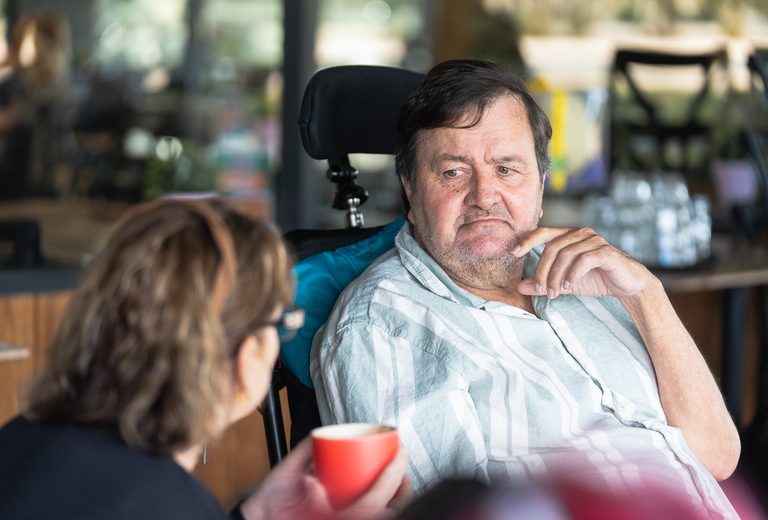
ID: Photo of Ian out at MAP’s Easter Morning Tea event.
For Ian and his family, moving into Specialist Disability Accommodation (SDA) in Nuriootpa has been about much more than finding an accessible house. It has been about creating a home that supports safety, independence, family connection and everyday choice.
After experiencing multiple strokes in 2023, Ian’s life changed significantly. Once a truck driver who had lived independently, Ian became wheelchair bound and needed a home designed around his physical support needs. His daughter, Regina, said the family knew that having access to an SDA home would be important for Ian’s future.
“Having access to an SDA house was what we were needing for his needs going forward,” Regina shared.
Specialist Disability Accommodation is purpose-built housing for NDIS participants with extreme functional impairment or very high support needs. For people like Ian, SDA can make daily routines safer, easier and more comfortable by removing barriers within the home and supporting greater independence.
For Ian, the difference is felt in the everyday details. Regina explained that his SDA home is “designed better” for him because it caters to his needs as a wheelchair user. Open spaces allow him to move through the home more freely, while accessible design features support the routines, interests and choices that continue to matter to him.
“He’s always enjoyed cooking,” Regina said, describing how adjustable kitchen benches allow Ian to remain involved in an activity he enjoys. “Having benches that can move up and down… cater for people who are in wheelchairs.”
Accessible housing is often spoken about in terms of equipment, floorplans and support ratios, but its real value is found in the way it helps people participate in their own lives. Ian’s Nuriootpa SDA home gives him room to move, space for safe transfers and the ability to do meaningful things for himself.
Regina shared that Ian can wheel himself to the front door and open it for her when she visits. It is a simple moment, but one that reflects the importance of independence, privacy and dignity within the home.
“He can wheel himself up,” Regina said. “The bathroom’s big enough so he can get in and out there… he’s got the big space to be able to be lifted to and from bed into wheelchair.”
One of the most important parts of Ian’s SDA journey has been location. Ian lives in the Barossa, close to Regina and his grandchildren. For their family, being near familiar places and people was an important part of finding the right long-term home.
Regina explained that Nuriootpa was a good fit because it kept Ian close to family routines and community connections. “It’s only 30 minutes away from where I live and my kids go to school here in the Barossa,” she said. “We’re always over here… the plan long term [was] to be able to have him as close to family as possible.”
This is why Specialist Disability Accommodation in regional communities like the Barossa matters. Purpose-built SDA homes can help people with disability remain connected to their families, local services, support networks and the communities they know, while receiving the daily support they need to live safely and well.
Ian’s story is a reminder that the right SDA home does more than meet physical access requirements. It supports confidence, comfort, connection and choice. It gives families reassurance that their loved one is living in a place designed around their needs, while also creating opportunities for the person to stay involved in everyday life.
At My Ability Pathway, we believe accessible housing should support people to live with dignity, independence and a strong sense of belonging. Through our Supported Independent Living services within SDA homes across the Barossa, we work alongside participants, families, support coordinators and housing providers to help people build a life that reflects their needs, preferences and goals.
We currently have a vacancy in a Nuriootpa Specialist Disability Accommodation home. If you are eligible for SDA, or know someone who may be looking for accessible housing in the Barossa, we encourage you to reach out to our team. More information about SDA can be found on our Barossa SDA page, and details about our current Nuriootpa vacancy are available on our Current Vacancies page.
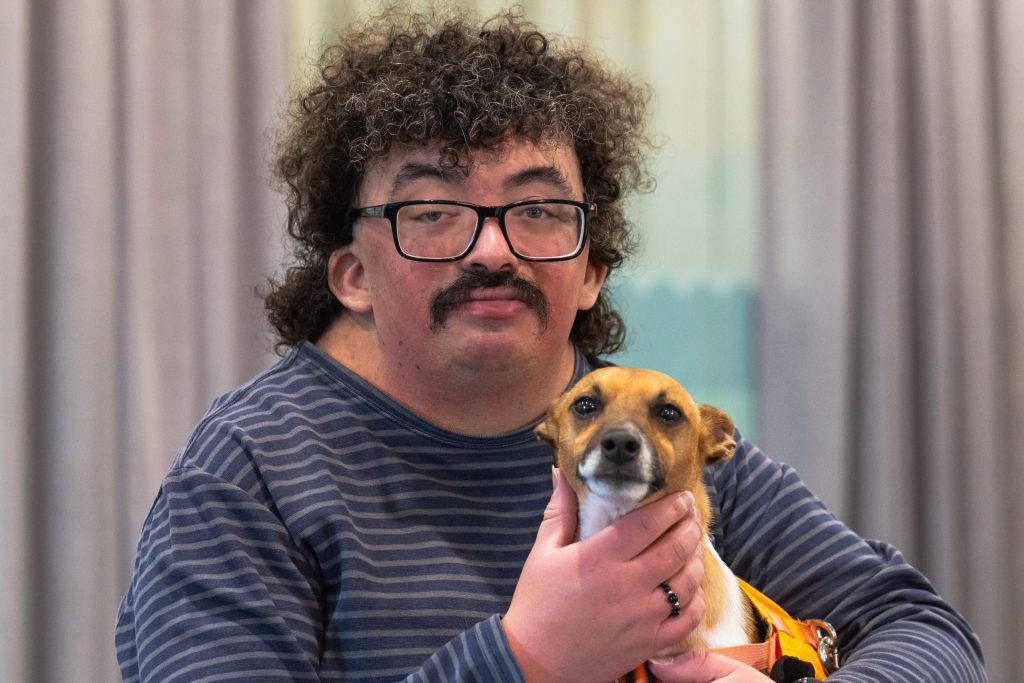
ID: Man sitting and facing the camera holding his pet dog.
For Malcolm Smith, independence doesn’t mean doing everything alone.
Instead, it means having the right support to live life on his own terms.
“There’s two types of independence,” Malcolm explains. ” Independence with help has been very much appreciated.”
Today, Malcolm lives independently with his dog, Bo, in a home that’s filled with routine, purpose and the confidence to enjoy everyday life. It’s a life that wasn’t possible before accessing support through the NDIS.
For Malcolm, support isn’t about someone taking over. It’s about having someone there when he needs it.
Whether it’s preparing healthy meals, attending medical appointments, getting out into the community or trying something new, having trusted support workers has helped Malcolm maintain his independence while building new skills and confidence.
“I’ve been able to cook better meals,” he says. “Just having someone with me when I need it to take me to doctor’s appointments and take me around if I want to go somewhere.”
His week is now full of activities that bring connection and enjoyment. Mondays are spent at an art group. Wednesdays are for cooking. Thursdays include water aerobics with one of his support workers, while Fridays are another opportunity to prepare a hearty meal. Monthly group dinners and social outings provide even more chances to connect with others, and weekends are often spent catching up with family.
These are things Malcolm says simply weren’t part of his life before.
“Yes,” he says. “I couldn’t do these things before.”
Before receiving NDIS supports, Malcolm spent many years living with chronic migraines that significantly impacted his daily life.
“For about 10 years I was mainly alone, very isolated,” he says. “Because of the pain… I wasn’t doing any of that. I wasn’t happy.”
The combination of physical health challenges and isolation meant everyday activities became difficult, and social connection was limited.
Today, life looks very different.
Support through the NDIS has helped Malcolm access community activities, maintain his home with the assistance of a cleaner, and receive equipment that has made a real difference to his independence.
A new mobility scooter has made shopping easier and given him the freedom to take Bo for walks.
“My new gopher has been extremely helpful with taking Bo on his walks,” Malcolm says. “And now I have something that helps me go to the shops better.”
It’s these practical supports that have opened the door to greater independence and a more connected life.
When asked what the right support means to him, Malcolm’s answer is simple.
“The right support is the ability to be yourself,” he says.
“To have someone help you be yourself and help you do your daily activities. And someone who pushes you – only a tiny little bit,” he says. “I don’t like to be pushed too much, only a tiny bit to do something different.”
That balance of encouragement and respect has helped Malcolm grow in confidence while remaining in control of his own life.
For Malcolm’s mum, Carolyn, watching her son’s confidence grow has been one of the greatest rewards.
“As a parent I am so relieved to have the supports in place through the NDIS because it has taken so much pressure off me,” she says.
After raising Malcolm and his sister on her own following the loss of Malcolm’s father when he was young, Carolyn spent many years as his primary support.
Today, she sees a very different Malcolm.
“It’s been fantastic as a parent to see Malcolm be able to grow through the NDIS and My Ability Pathway,” she says.
“The people who come in and support him are really caring and kind people, and I think that’s really important.”
Perhaps the biggest change has been Malcolm’s confidence.
“He was very scared in the beginning of having people coming into his home,” Carolyn recalls. “Now he’s really happy to have people come in. In the past he would never open the door, wouldn’t answer his telephone, and now to see his confidence grow… I’m just proud of the person he has become.”
Malcolm’s story is a reminder that independence looks different for everyone.
Sometimes, independence means asking for help. It means having people around who encourage you, respect your choices and provide the support you need to live the life you want.
With the right supports through the NDIS, Malcolm has gone from years of isolation to a life filled with connection, routine, confidence and choice.
And for Malcolm, that’s exactly what independence means.
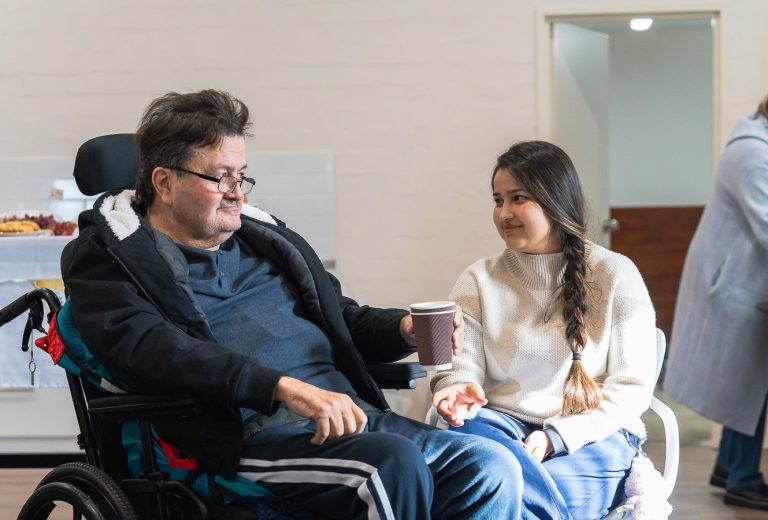
ID: Man in a wheelchair drinking a hot drink next to a female Support Worker at a Morning Tea.
For Ian and his family, the past few years have brought significant and unexpected challenges. Once an interstate truck driver who valued his independence, Ian’s life changed dramatically after experiencing multiple strokes in 2023. Today, he is settled in a Specialist Disability Accommodation (SDA) home in Nuriootpa, where he has the care, accessibility and support he needs to live safely and comfortably.
Before his strokes, Ian lived independently in Eudunda. Although he had already stopped interstate truck driving due to balance difficulties associated with normal pressure hydrocephalus, he continued to manage life on his own. His daughter, Regina, had noticed changes in his mobility, including a shuffling gait and increased periods of sitting or resting.
In September 2023, Ian suffered a haemorrhagic stroke and multiple lacunar strokes, beginning a lengthy and complex health journey. According to Regina, Ian experienced a total of 11 strokes. He had originally been admitted to hospital to receive treatment for his pre-existing hydrocephalus, but this treatment was ultimately deemed too risky due to the severity and frequency of the strokes.
Following his hospitalisation, Ian was unable to return home. Instead, he spent months moving between several hospitals and rehabilitation settings while his family and support team worked to identify the most appropriate long-term housing solution.
Ian entered the NDIS for the first time following his strokes. From the outset, it was clear that his support needs had changed significantly and that accessible housing would play a critical role in his future. During his initial NDIS planning meeting, Ian’s daughter and nominee, Regina, worked alongside his Support Coordinator to advocate for Specialist Disability Accommodation funding.
Given his high care needs, SDA funding was included in Ian’s plan, and he was also granted Medium Term Accommodation (MTA) while suitable long-term housing was identified.
Like many SDA journeys, Ian’s pathway involved a large team working together behind the scenes.
His Support Coordinator collaborated closely with My Ability Pathway’s leadership team, hospital social workers, the YIPRAC team and housing providers to ensure the necessary evidence and documentation were submitted correctly. The process required ongoing communication, frequent follow-up and coordination between multiple stakeholders.
While these administrative processes can often be complex, the goal was to minimise stress for Ian and his family and ensure a smooth transition into appropriate housing.
Location was one of the most important considerations for Ian and his family.
With strong ties to the Kapunda and Eudunda region, Ian wanted to remain as close as possible to his family, while also having access to specialised housing and support services. His Support Coordinator explored available SDA options through Housing Hub and by contacting SDA providers directly. Several properties were considered, but the priority remained finding a home within a reasonable distance of family and community connections.
Ian initially moved into an SDA home in Gawler East, providing him with an immediate solution when suitable accommodation became available. At the same time, plans were underway for new SDA homes to be developed in Nuriootpa, much closer to the area Ian and his family called home.
When the opportunity arose, Ian transitioned into one of the newly completed SDA homes in Nuriootpa, allowing him to be even closer to his support network and maintain stronger connections with family and community.
Today, Ian is enjoying the benefits of living in a purpose-built SDA home that meets his accessibility and support needs. His journey demonstrates the importance of early advocacy, collaborative planning and person-centred decision-making when navigating the SDA process.
Most importantly, it highlights how the right home can do much more than provide accommodation – it can restore connection, improve quality of life and create a foundation for greater independence and wellbeing.
For Ian and his family, finding the right SDA home was about more than a house. It was about finding a place where he could feel safe, supported and close to the people who matter most.
There are currently vacancies available in SDA homes in both Nuriootpa and Tanunda. These homes offer an opportunity for eligible participants to access purpose-built accommodation close to local services, community connections and support networks.
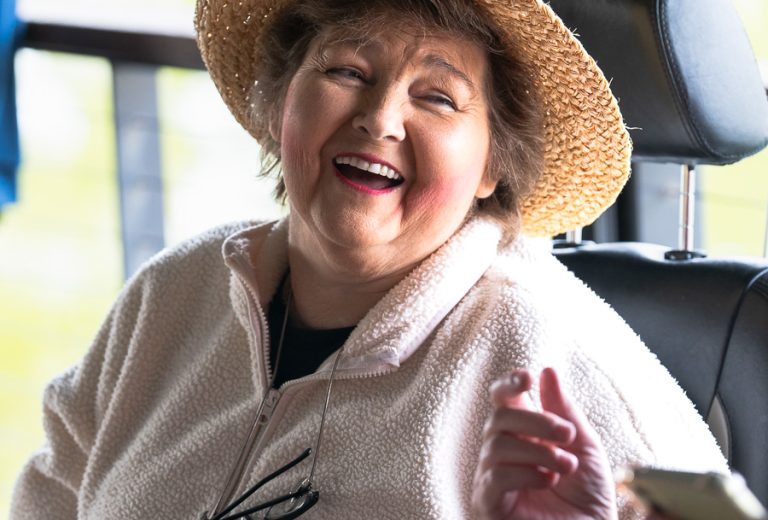
ID: A woman laughing wearing a broad brim straw hat.
Christine remembers the fear more than anything.
Not fear of the unknown – but fear of the everyday.
The simple, human moments most of us take for granted had become the hardest. Standing. Moving. Reaching. Even holding her grandchildren came with a quiet, constant worry in the back of her mind: What if I fall? What if I hurt them? What if I hurt my husband trying to manage on our own?
Before moving into Specialist Disability Accommodation (SDA), life had become a careful balancing act – one where the risks were growing and the support just wasn’t enough.
Her home, though filled with love and familiarity, wasn’t built for what she needed.
“My bathroom [was] very big,” Christine explains, “but it’s not big enough for my wheelchair or my lifter. My husband was able to help me, but not always. He’s getting older too… I had to come here so that I could get the help that I needed so that I didn’t hurt Tony.”
It’s a reality many people face quietly – where love and care alone can’t replace the right environment, the right design, and the right level of support.
Moving into SDA in Gawler changed things for Christine – but not in the way people sometimes assume.
It didn’t take away her independence.
It gave it back.
“I’m getting the help that I need and I’m so much more relaxed… I can concentrate on getting better and building my strength up.”
With the right supports in place, Christine’s focus shifted – from simply getting through the day, to actually living it.
There’s something powerful about feeling safe in your own home. It creates space for everything else – healing, confidence, connection.
And for Christine, something else returned too: hope.
“Oh definitely… I used to be frightened to pick up my grandchildren… but now I’m quite confident in having them come visit me and sit on my lap… I can cuddle them and I can do the things that I need to do to be a great granny.”
That confidence – the ability to be present with the people you love without fear – is what real support looks like.
One of the biggest misconceptions about SDA is that it feels clinical or restrictive.
Christine’s experience tells a very different story.
“It doesn’t stop you from living your life, it helps you.”
Her home isn’t defined by limitations – it’s shaped around possibility.
She bakes. She uses her computer. She hosts friends. She celebrates milestones.
“We had Christmas here and my friends came… we had the best day.”
And when she needs support, it’s there – without hesitation.
“There’s nothing they won’t do for you… If I get stuck… they’re right there.”
This is what person-centred support looks like in action: an environment designed not just for access, but for living well.
For anyone unsure about SDA, Christine doesn’t hesitate.
“Do it, do it. It’s a must. If you’re not sure, if you’re stumbling, if you’re falling – you have to come here and get help, because this is the place to be.”
It’s simple. Honest. And grounded in lived experience.
Christine’s story is just one example of what’s possible when the right environment meets the right support.
And now, more opportunities are becoming available.
Three brand-new SDA homes are being developed in Tanunda, with vacancies expected from July 2026. Designed with accessibility, comfort, and independence in mind, these homes offer:
It’s important to note that while these homes are delivered in partnership with SDA provider, Metcalf Group (SA), My Ability Pathway provides the Supported Independent Living (SIL) supports – ensuring participants receive consistent, person-centred care aligned with their goals.
SDA isn’t just about accessible housing.
It’s about reducing risk.
It’s about restoring confidence.
It’s about creating the conditions where people can reconnect with what matters most.
For Christine, that meant holding her grandchildren again without fear.
For others, it might mean cooking independently, pursuing hobbies, or simply feeling safe enough to relax.
Whatever the goal – the right environment makes it possible.
If you or someone you support could benefit from SDA, now is the time to explore your options.
Secure your future home – complete an Expression of Interest.
Conditions apply.
Our team is here to guide you through the process, answer your questions, and help you determine whether SDA is the right fit. Let us know if you would like one of our complimentary SDA Information Packs to be sent to you.
Because everyone deserves a home that supports not just their needs – but their life.

ID: Photo of Shaun outside, on a sunny day.
As we step into a new year, it’s a wonderful time to reflect on Shaun’s ongoing journey toward independence and the goals that continue to guide him forward. Last year, we shared Shaun’s story—his determination to live in his own home with Supported Independent Living (SIL) services, and the optimism he brings to every step of that journey. Since then, Shaun has continued to build on those foundations with enthusiasm, resilience and a clear focus on what he is working towards.
Reflecting on the year behind
Over the past year, Shaun has navigated change with perseverance. After returning to live with his mother, Coral, Shaun remained committed to his long-term goal of independent living. What could have feltlike a setback instead became a period of growth, reflection and skill-building. Together, Shaun and Coral continued to keep his goals front and centre, using this time to strengthen the skills and confidence needed for the next stage of his journey.
Shaun’s weekly SIL stays have continued to play an important role in maintaining momentum. These supports allow Shaun to practise independence in a supported environment, helping him bridge the gap between family life and living on his own again. During his stays, Shaun takes pride insetting up his space, organising groceries and planning his days. From swimming and shopping to cooking meals and attending concerts, Shaun remains actively engaged and motivated, using his NDIS supports to access meaningful activities while working steadily toward his goals.
Growth through skill-building
Looking back, Shaun has made notable progress in developing everyday living skills. With prompting and support, he continues to manage many daily tasks and safely approaches more complex activities alongside his support team. Each new skill—whether using household appliances or keeping up with chores—represents another step closer to the independent life he envisions.
Shaun’s confidence in decision-making has also continued to grow. Over the past year, he has become increasingly comfortable expressing his preferences and following through on his choices, from selecting clothes to planning outings. This growing self-confidence has been a key part of his progress and supports his ability to take ownership of his goals.
Shaun’s commitment to learning and self-improvement reminds us that progress is ongoing and goals are built one step at a time.
Looking ahead to the year to come
As the new year begins, Shaun continues to balance his love of family life with his desire for independence. Time spent at home with Coral and the comforting presence of his dog, Casper, remains important to him, while supported living continues to offer opportunities for growth and autonomy.
Looking forward, Shaun’s goals may continue to evolve, but his determination remains unchanged. With a positive outlook, strong support network and clear goals in mind, Shaun enters the new year ready to keep building toward a future where he can live independently, confidently and on his own terms.
