We value your privacy
This website uses technical, functional and analytical cookies that do not infringe on your privacy.
General purpose platform session cookies are usually used to maintain an anonymised user session by the server.


ID: Photo of the front of a new Specialist Disability Accommodation house in Nuriootpa.
Looking for Specialist Disability Accommodation in Nuriootpa? Finding a suitable home involves more than checking whether a room is available. It means considering how the space works for you, what support you need and whether the location helps you stay connected to the people and places that matter. My Ability Pathway’s current vacancies page lists High Physical Support SDA in Nuriootpa, with housing provided by New Dawn Housing and Supported Independent Living supports delivered by MAP. If you are exploring your next move, here is a starting point for learning about the home and asking the questions that matter to you. Availability can change, so please contact MAP to confirm current vacancies and suitability.
Watch the Nuriootpa SDA video below as a starting point for exploring the home. As you watch, note what you would like to ask about or see during a visit. A video can help you prepare questions, but it cannot confirm whether a home will meet your individual accessibility, equipment or support needs.
MAP’s Nuriootpa vacancy listing describes a purpose-built High Physical Support home with modern accessible design, spacious shared living areas and a private bedroom with an ensuite. It also identifies proximity to local services and community facilities. These features are worth considering in relation to your own routines. How would you move between your bedroom, bathroom and shared spaces? Where would you spend time with visitors? What would help you take part in household activities in the way you prefer? The NDIS describes High Physical Support housing as including a high level of physical access for people who need very high levels of support. That category does not tell you every detail of an individual property. Ask which equipment and technologies are installed, which are provisions for future installation and what would need to be arranged for you.
New Dawn Housing is identified as the housing provider, while MAP provides the Supported Independent Living services. MAP’s listing describes 24/7 SIL support at the Nuriootpa home. Your individual assistance, overnight arrangements and any shared supports still need to be discussed; 24/7 support does not automatically mean continuous one-to-one assistance. SDA relates to the specialist home, while SIL relates to assistance or supervision with daily tasks. They are separate supports, and SDA funding does not include personal care or SIL. For an introduction, read MAP’s guide to SDA and SIL. Ask for clear information about the housing agreement, support agreement, charges and who to contact about each aspect.
For someone who wants to live in the Barossa, location may be an important part of the decision. Consider the people you want nearby, the appointments you attend and the places you enjoy visiting. Rather than relying on the phrase “close to services”, ask about the actual journey: transport, accessible routes, travel time and any assistance required. Your home should be considered alongside your wider life. Shared living also deserves discussion. Ask about the proposed household, privacy, visitors and how different routines can work together, while respecting other residents’ confidentiality.
SDA is for eligible NDIS participants with extreme functional impairment or very high support needs. A listed vacancy does not establish eligibility or guarantee that the property matches your approved funding and circumstances. Your support coordinator or chosen supporter can help you gather questions and understand the information provided. The NDIA explains that SDA residents pay a reasonable rent contribution and other day-to-day living costs, such as electricity. Request a clear breakdown of the costs for this particular home before deciding. There is no need to work through every question alone, but your preferences should remain central throughout.
If you would like to explore the Nuriootpa SDA vacancies, view the New Dawn Housing property listing on Housing Hub, check MAP’s current vacancies or contact MAP to ask about availability and a possible viewing. Call 08 8563 2569 or email ndis@myabilitypathway.org. Whether you are making an enquiry for yourself or supporting someone with their permission, the starting point is the same: what would make this a suitable home for the person who will live here?
Contact MAP to confirm Nuriootpa SDA availability, discuss your needs and ask about a viewing.

ID: Photo of a group of people outdoors having a picnic and playing games.
Have you ever come home from an activity and thought, “That filled the afternoon, but it was not really for me”? A busy calendar can look positive from the outside. Yet attending activities and feeling connected are not necessarily the same thing. Meaningful community participation begins with what you enjoy, who you want to spend time with and how you want to take part. A good starting question is not “How many outings did we organise?” but “Was this worth doing for you?”
Community might mean a local club, an art class, a library, a familiar café or time with neighbours. It might involve a disability-specific group, a mainstream activity, an online interest group or a combination. No single setting is automatically the most inclusive for everyone. The important questions are whether you want to be there, can participate in a way that suits you and have opportunities for the kind of connection you value. Enjoyment is a valid reason to take part. You do not need to turn every interest into a lesson or a measurable achievement.
Consider a hypothetical person who enjoys plants and wants to try a community gardening group. Getting there matters, but so does what happens after arrival. Can they reach the work area? Are instructions accessible? Is there a task they actually enjoy? Does someone speak directly with them rather than only with their support worker? These details can determine whether an outing becomes a valued part of the week. Meaningful participation is not about making someone more sociable. It is about making room for the involvement they want.
Start with an interest, not a vacant place on a program. Ask what you would like more of: time outdoors, creative expression, familiar conversation or a chance to learn. Being unsure is fine. Looking at a few options can be part of finding out.
Check the details that matter to you, including transport, accessible toilets, noise, seating, communication and breaks. In regional areas, consider the whole journey, including getting home. A venue’s general claim that it is accessible may not answer your particular questions. With your permission, a supporter can help ask about adjustments without sharing unnecessary personal information.
Ask whether a short visit or introductory session is possible, and clarify any charges first. Agree what help you want during the visit. Some people prefer an introduction and then space; others want ongoing assistance to communicate or take part. Neither approach is a better form of independence.
Afterwards, ask: did I enjoy it, feel included and have enough say? What would I change? The answer might be a different time, a smaller group, more assistance or a different activity altogether. Choosing not to return is useful information, not a failure.
The NDIA’s social and recreation support guidance distinguishes disability-related assistance from ordinary activity expenses. Depending on individual circumstances and funding criteria, the NDIS may fund extra help needed because of disability. General costs that everyone pays, such as ordinary membership or entrance fees, remain the participant’s responsibility. Do not assume that an activity, transport arrangement or support charge is funded simply because it links to a goal. Check your plan and current guidance before committing. A support coordinator, where involved, can help clarify questions; they do not approve NDIA funding.
There can be pressure to fill every available hour or keep adding new experiences. A familiar weekly visit may be more valuable than several unfamiliar outings. Rest, time alone and changes of mind also deserve respect. Families and support teams can help by noticing barriers without deciding what a satisfying social life should look like. Community organisations have a part to play too: welcoming communication, workable adjustments and direct engagement should not depend entirely on a support worker’s presence. Paid support can assist participation, but it cannot guarantee friendship or belonging.
The most useful next step might be small: asking about a class, returning to a familiar place or finding a way to join a conversation. Success is not always a larger calendar. It might be greater choice, a comfortable routine or taking part in something you value. MAP’s published community approach emphasises individual interests and connection. To explore assistance in the Barossa, Gawler or Adelaide’s northern suburbs, read about MAP’s disability support services and social and community participation. Begin with what matters to you, then consider what support would make it possible.
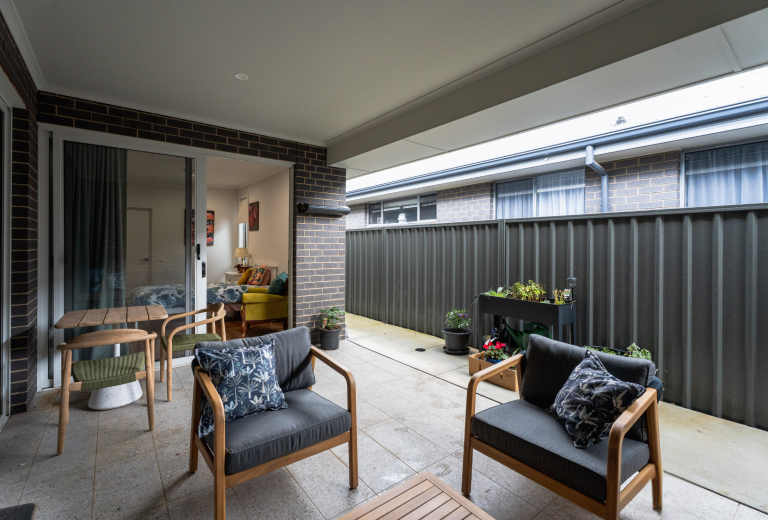
ID: Photo of an alfresco area that has been intentionally designed for a client who has dementia. Featuring sturdy seating areas and easy access to the bedroom.
Good design is about more than creating beautiful spaces. At its best, it helps people feel comfortable, safe and independent in their everyday lives.
When interior designer Steve Angel, from Décor Made Easy, looks at a room, he sees more than furniture, colours and floorplans. He sees opportunity: an opportunity to create a space where someone can continue doing the things they enjoy, feel connected to the people around them and maintain independence in a home that supports their needs.
Recently, Steve worked alongside My Ability Pathway to transform a small north-facing alfresco area into a practical outdoor retreat for a client living with dementia. The client loved gardening and wanted somewhere she could enjoy the sunshine, spend time with family and friends, and continue doing something she was passionate about.
What emerged was much more than an outdoor sitting area. It became a space that supported connection, routine and independence.
For Steve, successful design starts by understanding the individual.
“The client loves gardening, so what we looked to achieve was an extra space for her to have a little bit of autonomy,” Steve explains. “Somewhere where she could sit and have a cup of tea, enjoy the northern sun, have family and friends visit, and create a little bit of space for gardening because that’s what she loves.”
Positioned just outside the client’s bedroom, the outdoor area naturally extends her living space, making it easy to access throughout the day while offering a peaceful place to relax.
“It’s literally off the client’s bedroom… and it’s a great use of the space.” Steve says.
Inclusive design is often about details that many people may not immediately notice, but that can have a significant impact on someone’s confidence, comfort and safety.
For this project, furniture was carefully selected to provide stability and reassurance. Steve chose solid timber seating that would not move unexpectedly when someone sat down, while dining chairs were fitted with rubber stoppers to prevent them from sliding away.
“We wanted fairly generous seating, quite solid, so it’s not something too flimsy if someone isn’t too stable on their feet,” Steve says. “You can sort of flop into it and it won’t slide away.”
Rather than creating a space filled with busy patterns or overwhelming colours, the design remains calm and inviting. As Steve puts it, “It’s just simplistic, with a bit of colour in the cushions. Nothing too demanding or dramatic.”
Through previous work designing dementia-specific environments in aged care spaces, Steve has seen firsthand how thoughtful design can improve quality of life. One of the biggest lessons was understanding that people living with dementia may experience their surroundings differently.
Something as simple as a patterned floor can create confusion. Steve recalls learning that flooring with strong borders or contrasting lines could sometimes be perceived as an obstacle that residents felt they needed to step over.
“People thought patterned floors or border lines were something they had to step over, so we learned we couldn’t have those sorts of designs because they affected people’s confidence to move freely.”
Those observations also revealed creative ways to gently guide movement without using physical barriers. In one aged care setting, a wallpaper border placed at eye level helped guide a resident through a space where she had previously become stuck, preserving her freedom while reducing frustration and confusion.
“We discovered we could use visual cues to encourage people through spaces or away from certain areas without putting up barriers. It worked extremely well.”
Colour and contrast also play an important role, particularly for people experiencing vision changes. Steve learned that artwork, patterns and decorative elements work best when they feature clear edges and strong contrast.
“We learned that artwork needed nice sharp edges and good contrast. Anything blurry or soft could become difficult to interpret, so we were very mindful of choosing crisp patterns and images.”
For Steve, inclusive design is about helping people maintain control over their daily lives and continue doing the things that matter to them.
He recalls working with an older woman who had severe arthritis and struggled to use the chain-operated blinds installed in her room. The blinds may have looked modern, but they were not functional for the person using them.
“She used to have to call staff just to put the blind up or down.”
By replacing them with motorised blinds and an accessible wall-mounted remote, she was able to manage them independently and no longer needed to ask staff for help.
“She became so much more independent because she was in control of that.”
For Steve, this is what inclusive design is all about: thinking first, rather than simply following design trends.
“It’s a little bit more thinking first, and not just saying, ‘Well, that’s the fashion in design.’ Let’s think about whether that’s suitable.”
Inclusive design does not require creating clinical spaces or removing personality from a home. Instead, it means understanding how people experience their environment and making thoughtful choices that support safety, confidence and independence.
Whether it is selecting stable furniture, creating clearer visual cues, improving accessibility or enabling people to continue pursuing the hobbies they love, thoughtful design can have a lasting impact on quality of life.
As Steve’s work shows, the most successful spaces are not necessarily the most stylish or the most expensive. They are the spaces that help people keep doing what matters most.
“If design can help people become independent – whatever that means for them – that’s a fantastic thing.”

ID: Photo of people sitting and listening to a women talk.
On Friday 1 May, My Ability Pathway was proud to host a Foundations Disability Inclusion Training at our HQ, bringing together more than 20 attendees from across the Barossa and surrounding regions.
Delivered by JFA Purple Orange, the session welcomed people from a diverse range of industries and backgrounds – including local businesses, community organisations, disability services, education, health, and hospitality.
While the training itself provided practical tools and insights around disability inclusion, what stood out most was the quality of the conversations happening throughout the day.
There was genuine curiosity, openness, and a shared willingness to learn. Attendees reflected on how inclusion shows up in everyday interactions, workplace culture, customer service, communication, and community participation. Just as importantly, there was space for people to ask questions, challenge assumptions, and connect with others who are equally passionate about creating more inclusive environments.
For My Ability Pathway Director Barbara Lightburn, the event reinforced the importance of bringing opportunities like this to regional communities.
“It’s not often this type of training is delivered locally in the Barossa, so it was fantastic to see such a strong cross-section of the community represented. Inclusion grows through conversations, shared learning, and people being willing to take that first step.”
A key focus of the session was helping attendees feel more confident in the language they use, the environments they create, and the everyday actions that contribute to inclusion.
Importantly, the event also created valuable networking opportunities, with attendees making new connections across industries and sectors – something that will continue to strengthen collaboration and inclusion across the region long after the session ended.
At My Ability Pathway, we believe inclusive communities are built collectively. Seeing so many local organisations and individuals investing their time into learning and connection was incredibly encouraging.
We’d like to sincerely thank JFA Purple Orange for delivering such an engaging and thought-provoking session, and thank everyone who attended and contributed so openly throughout the day.
Because meaningful change often starts with a conversation – and Friday proved just how powerful those conversations can be.
To find out more about JFA Purple Orange and the different trainings they offer, head to their website.


ID: Image of a multicoloured brain.
Neurodiverse is a term that lends itself to a wide range of conditions. The word “neurodiversity” was coined in 1998 by Australian sociologist Judy Singer, later leading to the term neurodiverse.
As the word suggests, it relates to the diversity of human brain functions, typified by thinking, learning and behaving differently to ways considered “neurotypical”.
These differences are called “neurotypes”, which are characterised by common experiences among those with a particular neurotype.
Neurotypes include, but are not limited to:
A great resource to learn more about each neurotype is Genius Within.
Neurodivergent people have different strengths and challenges to neurotypical people. While members of each neurotype are likely to have similar experiences, these still vary widely from person to person. After all, no two people’s brains are the same.
While this means that there is no normal for human brain function, medical and social constructs often rely on categories or definitions for ‘normal’. This provides a framework for identifying the differences and diversity of the ways the human brain can function. Acknowledging and understanding these differences empowers people to work with their particular strengths and challenges, ensuring they are able to learn and recognise tools that will help them succeed.
The social model of disability is an important consideration when talking about the overlap of neurodivergence and disability. The social model, a phrase conceived by Mike Oliver in 1983, outlines that disability is an interaction between impairment and environment – specifically, that disability exists when social constructs do not allow for accommodations to be made. A common example used to illustrate the model is a building that has no ramp access. In this case, the barrier is the lack of accessibility rather than an individual who uses a wheelchair.
For some people, the impacts of their neurodivergence leads them to identify as living with a disability, while the same may not be true for another person with similar experiences. It’s highly individual. This Psychology Today article goes into greater detail.
The interaction between neurology and environment is a significant factor for neurodiverse individuals. Some settings align with their needs, while others can cause discomfort and distress. The disability exists when environmental demands and neurology are mismatched. Similarly, some people describe their neurodivergence as a ‘superpower’ – this occurs when the environment allows them to flourish.
Supporting people with neurodivergence comes in several forms. One of the most important is social change to make environments and systems more inclusive and accommodating. This supports people’s strengths and challenges, without forcing them to conform to standards that may be unrealistic.
Communication is another key element. Listening to people and truly hearing their experiences, along with communicating in a personalised, preferred way makes all the difference. For example, some people do better with written communication than verbal. Try to give people the tools they need.
And remember all individuals, neurodivergent or neurotypical are exactly that – individuals. No two people are the same, have the same experiences, capabilities or struggles, regardless of a shared neurotype. Respect, curiosity and support are key to helping anyone succeed.
By Clair Halkias

ID: Jigsaw puzzle heart on a wooden table.
When the National Autism Strategy 2025-2031 was first released, it marked a powerful moment for autism inclusion in Australia – a long-awaited national framework co-designed with Autistic people, families, carers and advocates. Its vision was clear: a safe and inclusive society where Autistic people are supported and empowered to thrive.

Now, twelve months on, some of that promise is starting to take shape – even as the broader policy landscape shifts beneath it.
Concrete Actions Through the First Action Plan
The First Action Plan (2025-26) outlined early steps across social inclusion, economic inclusion and diagnosis,services and supports. These include initiatives to:
This plan has set in motion groundwork for longer-term change – with accountability measures and monitoring built into implementation.
Community Responses Reflect Hope – and Frustration
Across the autism community, reactions have included optimism that a strategic framework exists, and concern that the pace and scale of meaningful change isn’t yet enough. Some people have welcomed the clearer national direction; others feel that key challenges remain unaddressed in practice, including:
Focus on Early Childhood Support Models
Beyond the Strategy itself, broader national policy discussions are influencing how autism supports are delivered:
This is important context: while the Strategy lays a framework for inclusion, these broader policy changes affect how autism support– especially for children – is structured in practice.
Health & Mental Health Roadmap
Although the Strategy includes health and mental health as a core pillar, its full implementation relies on the separate but connected National Roadmap to Improve the Health and Mental Health of Autistic People – work that continues to develop.
Research and Measurement
One of the Strategy’s commitments is to boost data and evidence, including autism prevalence studies. Recent government investment has supported epidemiological research, which will provide better national insights and guide future services and policies.
Voices From the Community
One year on, the autism community is still passionately engaging with what the Strategy means in reality:
“This won’t change things overnight, but it does create a national baseline the government can be held accountable to.” –Community commenter on public forum.
Others have highlighted the ongoing tension between strategic direction and day-to-day experiences of support, employment and health care. Many are watching to see whether the Strategy translates into measurable improvements in waiting times, employment rates and quality of services.
As we move further into the Strategy’s timeline, here are the key areas to watch:
✅ Implementation of the Action Plan – Will commitments turn into real services, programs and outcomes that people can access?
✅Health and Mental Health Roadmap delivery – A crucial piece of the puzzle for wellbeing and continuity of care.
✅Cross-sector collaboration – Including education, employment, housing, health, and mainstream service systems.
✅Community leadership in policy decisions – Ensuring Autistic voices remain central in shaping action.
The National Autism Strategy provides tools for advocacy and community momentum:
Together, a year on from the launch of the Strategy, there’s both reason for cautious optimism and a clear case for continued engagement. If inclusion, support and real opportunity are going to become realities – not just aspirations – it will take sustained effort across government, community and lived experience leadership.
