We value your privacy
This website uses technical, functional and analytical cookies that do not infringe on your privacy.
General purpose platform session cookies are usually used to maintain an anonymised user session by the server.

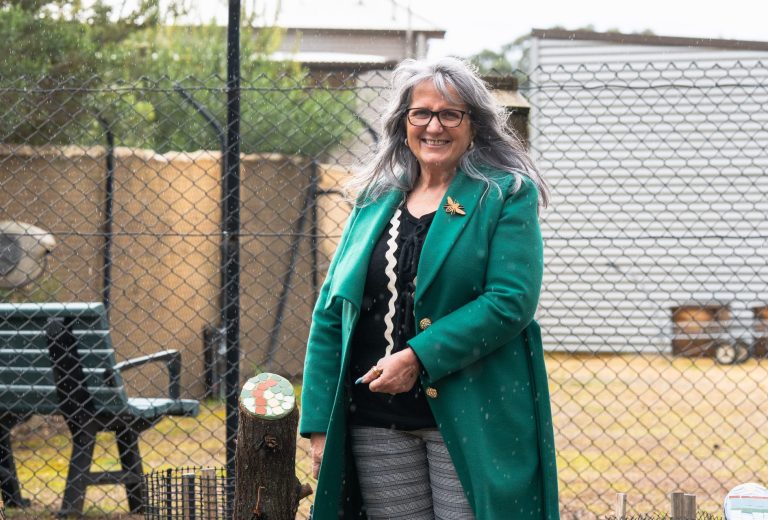
ID: Reta standing next to her mosaic which is part of the Reconciliation Mosaic Project at Barossa Bushgardens.
Sometimes, the people who have the greatest impact are the ones who never set out looking for recognition.
For those who know Reta, it will come as no surprise that after decades spent supporting others, advocating for the disadvantaged and championing equality, she still speaks about her work with the same passion and conviction that first drew her into the sector.
In fact, she was preparing to retire.
“I was 60 years old and I was going to retire,” she laughs.
Instead, an opportunity arose at My Ability Pathway. Although administration was completely new territory, Barbara and Charlotte recognised the incredible depth of knowledge and experience Reta could bring to the organisation. Today, she continues to support the team, mentor colleagues and share her wisdom whenever needed.
“I feel very privileged that they value my opinion when it comes to community,” she says.
And what an opinion it is.
Reta’s journey began with a childhood dream of becoming a nurse. After moving to the Barossa in her late twenties, she met Sophie, then Director of Nursing at Barossa Village, who offered her a shift that would change the course of her life.
“The rest is history,” she says.
Following a decade in aged care and some significant personal experiences, Reta discovered a calling that would shape the rest of her career.
“I came to the realisation that there were people who didn’t have a voice and weren’t being heard,” she explains.
“That’s what led me to become an advocate.”
Over the years, Reta has worked across disability, homelessness, domestic violence and child protection, but she always finds herself returning to disability support.
For Reta, advocacy has never been about speaking for people. It has been about ensuring people are heard and supported to live the lives they choose.
“I come from the belief that everybody is equal and that we all have the right, given the opportunity, to live our life to our full potential and be treated with dignity, irrespective of where we come from and who we are.”
It is a philosophy that has guided her both personally and professionally.
Anyone who has worked alongside Reta knows that her knowledge is immense, but what stands out even more is her unwavering passion for people.
She describes herself as “quite assertive” when advocating for others, although those around her would simply call it dedication.
At MAP, we are incredibly fortunate to have someone with Reta’s lived experience, compassion and wisdom. Her ability to mentor others, provide perspective and remind us of the importance of community is invaluable.
Quite simply, Reta is one of those people who makes everyone around her better.
During National Reconciliation Week, we are reminded that reconciliation is about relationships, respect and opportunities.
At My Ability Pathway, these values underpin everything we do. We recognise that reconciliation is not a destination but an ongoing journey – one that requires listening, learning and walking together.
This year, we were excited to see Reta contribute to the Reconciliation Mosaic Project at the Barossa Bushgardens. Bringing together children from Nuriootpa Kindergarten, an OSHC group and members of the community, the project was guided by an Indigenous artist and explored our connections to land and to one another.
Reta’s piece featured two intertwining trees.
“It’s about standing together against any problems in the past and standing together moving forward and supporting each other, irrespective of where we come from or who we are,” she says.
It’s a beautiful reflection of the values she has embodied throughout her entire life.
And perhaps that’s what makes Reta so special.
Not just her decades of experience, her advocacy, or her wealth of knowledge – but her enduring belief that everyone deserves dignity, respect and the opportunity to thrive.
At My Ability Pathway, we are grateful every day that she chose not to retire.
Because our team, and our community, are stronger because of it.

ID: Photo of people sitting and listening to a women talk.
On Friday 1 May, My Ability Pathway was proud to host a Foundations Disability Inclusion Training at our HQ, bringing together more than 20 attendees from across the Barossa and surrounding regions.
Delivered by JFA Purple Orange, the session welcomed people from a diverse range of industries and backgrounds – including local businesses, community organisations, disability services, education, health, and hospitality.
While the training itself provided practical tools and insights around disability inclusion, what stood out most was the quality of the conversations happening throughout the day.
There was genuine curiosity, openness, and a shared willingness to learn. Attendees reflected on how inclusion shows up in everyday interactions, workplace culture, customer service, communication, and community participation. Just as importantly, there was space for people to ask questions, challenge assumptions, and connect with others who are equally passionate about creating more inclusive environments.
For My Ability Pathway Director Barbara Lightburn, the event reinforced the importance of bringing opportunities like this to regional communities.
“It’s not often this type of training is delivered locally in the Barossa, so it was fantastic to see such a strong cross-section of the community represented. Inclusion grows through conversations, shared learning, and people being willing to take that first step.”
A key focus of the session was helping attendees feel more confident in the language they use, the environments they create, and the everyday actions that contribute to inclusion.
Importantly, the event also created valuable networking opportunities, with attendees making new connections across industries and sectors – something that will continue to strengthen collaboration and inclusion across the region long after the session ended.
At My Ability Pathway, we believe inclusive communities are built collectively. Seeing so many local organisations and individuals investing their time into learning and connection was incredibly encouraging.
We’d like to sincerely thank JFA Purple Orange for delivering such an engaging and thought-provoking session, and thank everyone who attended and contributed so openly throughout the day.
Because meaningful change often starts with a conversation – and Friday proved just how powerful those conversations can be.
To find out more about JFA Purple Orange and the different trainings they offer, head to their website.
By Clair Halkias

ID: Jigsaw puzzle heart on a wooden table.
When the National Autism Strategy 2025-2031 was first released, it marked a powerful moment for autism inclusion in Australia – a long-awaited national framework co-designed with Autistic people, families, carers and advocates. Its vision was clear: a safe and inclusive society where Autistic people are supported and empowered to thrive.

Now, twelve months on, some of that promise is starting to take shape – even as the broader policy landscape shifts beneath it.
Concrete Actions Through the First Action Plan
The First Action Plan (2025-26) outlined early steps across social inclusion, economic inclusion and diagnosis,services and supports. These include initiatives to:
This plan has set in motion groundwork for longer-term change – with accountability measures and monitoring built into implementation.
Community Responses Reflect Hope – and Frustration
Across the autism community, reactions have included optimism that a strategic framework exists, and concern that the pace and scale of meaningful change isn’t yet enough. Some people have welcomed the clearer national direction; others feel that key challenges remain unaddressed in practice, including:
Focus on Early Childhood Support Models
Beyond the Strategy itself, broader national policy discussions are influencing how autism supports are delivered:
This is important context: while the Strategy lays a framework for inclusion, these broader policy changes affect how autism support– especially for children – is structured in practice.
Health & Mental Health Roadmap
Although the Strategy includes health and mental health as a core pillar, its full implementation relies on the separate but connected National Roadmap to Improve the Health and Mental Health of Autistic People – work that continues to develop.
Research and Measurement
One of the Strategy’s commitments is to boost data and evidence, including autism prevalence studies. Recent government investment has supported epidemiological research, which will provide better national insights and guide future services and policies.
Voices From the Community
One year on, the autism community is still passionately engaging with what the Strategy means in reality:
“This won’t change things overnight, but it does create a national baseline the government can be held accountable to.” –Community commenter on public forum.
Others have highlighted the ongoing tension between strategic direction and day-to-day experiences of support, employment and health care. Many are watching to see whether the Strategy translates into measurable improvements in waiting times, employment rates and quality of services.
As we move further into the Strategy’s timeline, here are the key areas to watch:
✅ Implementation of the Action Plan – Will commitments turn into real services, programs and outcomes that people can access?
✅Health and Mental Health Roadmap delivery – A crucial piece of the puzzle for wellbeing and continuity of care.
✅Cross-sector collaboration – Including education, employment, housing, health, and mainstream service systems.
✅Community leadership in policy decisions – Ensuring Autistic voices remain central in shaping action.
The National Autism Strategy provides tools for advocacy and community momentum:
Together, a year on from the launch of the Strategy, there’s both reason for cautious optimism and a clear case for continued engagement. If inclusion, support and real opportunity are going to become realities – not just aspirations – it will take sustained effort across government, community and lived experience leadership.
