We value your privacy
This website uses technical, functional and analytical cookies that do not infringe on your privacy.
General purpose platform session cookies are usually used to maintain an anonymised user session by the server.


ID: photo of a client and support worker smiling at the camera.
A home can have wide doorways, a suitable bathroom and a bedroom you like, yet still leave an important question unanswered: what would living here actually be like? When you are exploring supported living, the building is only part of the decision. Daily routines, privacy, housemates, support arrangements and connection to familiar places all shape whether a home fits your life. A viewing is an opportunity to consider these things, not a test you have to pass or a decision you must make on the spot.
Supported living is a broad expression, not one NDIS funding category. Supported Independent Living (SIL) funds assistance or supervision with daily tasks at home for people with substantial support needs. Specialist Disability Accommodation (SDA) is specialist housing for eligible people with extreme functional impairment or very high support needs. Some people have both; they are not interchangeable. SIL does not pay ordinary expenses such as rent or groceries. You can read MAP’s guide to SDA and SIL for an introduction. Before considering a particular property, ask which home-and-living options may suit your circumstances and what your plan actually includes.
Think about a weekday morning rather than only the best features of the house. When do you like to wake up? How do you prefer meals to happen? What assistance do you need, and how do you communicate when something is not right? Ask how individual routines would work alongside shared support. Discuss what happens when two people need help at the same time, how overnight assistance is arranged and how changes are communicated. These questions help clarify the proposed arrangement; they do not assume that every request or staffing pattern can be accommodated.
Compatibility involves more than similar ages or support needs. Quiet evenings, visitors, pets, cooking, music and use of shared rooms can all matter. You do not need to become close friends with everyone you live with, but you do need space for your own preferences and privacy. Ask how potential housemates are introduced and how everyone’s views are considered. Any information shared should respect the other residents’ privacy. A hypothetical example: someone who enjoys a quiet breakfast may find a busy shared kitchen difficult. Discussing timing and access before a move is more useful than assuming everyone will adapt to one routine.
Ask who provides the housing, who delivers support and which agreement covers each responsibility. Request information you can understand about charges, notice periods, repairs, complaints and changing arrangements. The NDIS Commission’s SIL standard on tenancy, housing and support sets expectations for clear arrangements that distinguish housing from SIL supports and support informed decisions. It is not a substitute for advice about your particular tenancy. Ask what would happen to your housing if you wanted to change your support provider. If an answer is unclear, seek independent advice before signing rather than relying on a verbal assurance. A trusted supporter or independent advocate may help you prepare questions.
A nearby café is only useful if you can get there in a way that works for you. Consider the journey to friends, family, shops, health appointments and activities you already value. In the Barossa and Adelaide’s northern suburbs, compare actual travel arrangements rather than distance alone. Ask about accessible transport, timing, costs and the availability of support to make the trip. A home should be considered in the context of your wider life, not as a reason to start every relationship and routine again.
If exploring a move feels right, ask whether further visits or introductions can be arranged. They may not always be possible, and any costs or funding need to be clarified. With your consent, relevant information about communication, equipment and support needs can help the people involved prepare. Agree who will coordinate next steps and when you will discuss how things are going. Families and support coordinators can help organise information while keeping your preferences central. If people disagree, write down the different concerns rather than allowing the most confident voice to settle the decision.
You do not need all the answers at the first viewing. What matters is having enough clear information and appropriate assistance to make an informed decision. MAP provides SIL supports and works with housing providers in the Barossa. If you are beginning to explore local options, visit MAP’s Barossa SDA information page or contact MAP with your questions. Availability, suitability and funding need to be considered individually.
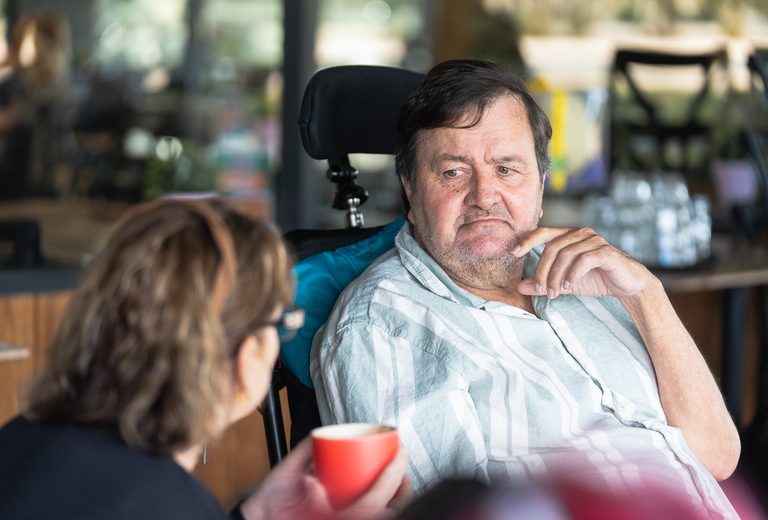
ID: Photo of Ian out at MAP’s Easter Morning Tea event.
For Ian and his family, moving into Specialist Disability Accommodation (SDA) in Nuriootpa has been about much more than finding an accessible house. It has been about creating a home that supports safety, independence, family connection and everyday choice.
After experiencing multiple strokes in 2023, Ian’s life changed significantly. Once a truck driver who had lived independently, Ian became wheelchair bound and needed a home designed around his physical support needs. His daughter, Regina, said the family knew that having access to an SDA home would be important for Ian’s future.
“Having access to an SDA house was what we were needing for his needs going forward,” Regina shared.
Specialist Disability Accommodation is purpose-built housing for NDIS participants with extreme functional impairment or very high support needs. For people like Ian, SDA can make daily routines safer, easier and more comfortable by removing barriers within the home and supporting greater independence.
For Ian, the difference is felt in the everyday details. Regina explained that his SDA home is “designed better” for him because it caters to his needs as a wheelchair user. Open spaces allow him to move through the home more freely, while accessible design features support the routines, interests and choices that continue to matter to him.
“He’s always enjoyed cooking,” Regina said, describing how adjustable kitchen benches allow Ian to remain involved in an activity he enjoys. “Having benches that can move up and down… cater for people who are in wheelchairs.”
Accessible housing is often spoken about in terms of equipment, floorplans and support ratios, but its real value is found in the way it helps people participate in their own lives. Ian’s Nuriootpa SDA home gives him room to move, space for safe transfers and the ability to do meaningful things for himself.
Regina shared that Ian can wheel himself to the front door and open it for her when she visits. It is a simple moment, but one that reflects the importance of independence, privacy and dignity within the home.
“He can wheel himself up,” Regina said. “The bathroom’s big enough so he can get in and out there… he’s got the big space to be able to be lifted to and from bed into wheelchair.”
One of the most important parts of Ian’s SDA journey has been location. Ian lives in the Barossa, close to Regina and his grandchildren. For their family, being near familiar places and people was an important part of finding the right long-term home.
Regina explained that Nuriootpa was a good fit because it kept Ian close to family routines and community connections. “It’s only 30 minutes away from where I live and my kids go to school here in the Barossa,” she said. “We’re always over here… the plan long term [was] to be able to have him as close to family as possible.”
This is why Specialist Disability Accommodation in regional communities like the Barossa matters. Purpose-built SDA homes can help people with disability remain connected to their families, local services, support networks and the communities they know, while receiving the daily support they need to live safely and well.
Ian’s story is a reminder that the right SDA home does more than meet physical access requirements. It supports confidence, comfort, connection and choice. It gives families reassurance that their loved one is living in a place designed around their needs, while also creating opportunities for the person to stay involved in everyday life.
At My Ability Pathway, we believe accessible housing should support people to live with dignity, independence and a strong sense of belonging. Through our Supported Independent Living services within SDA homes across the Barossa, we work alongside participants, families, support coordinators and housing providers to help people build a life that reflects their needs, preferences and goals.
We currently have a vacancy in a Nuriootpa Specialist Disability Accommodation home. If you are eligible for SDA, or know someone who may be looking for accessible housing in the Barossa, we encourage you to reach out to our team. More information about SDA can be found on our Barossa SDA page, and details about our current Nuriootpa vacancy are available on our Current Vacancies page.
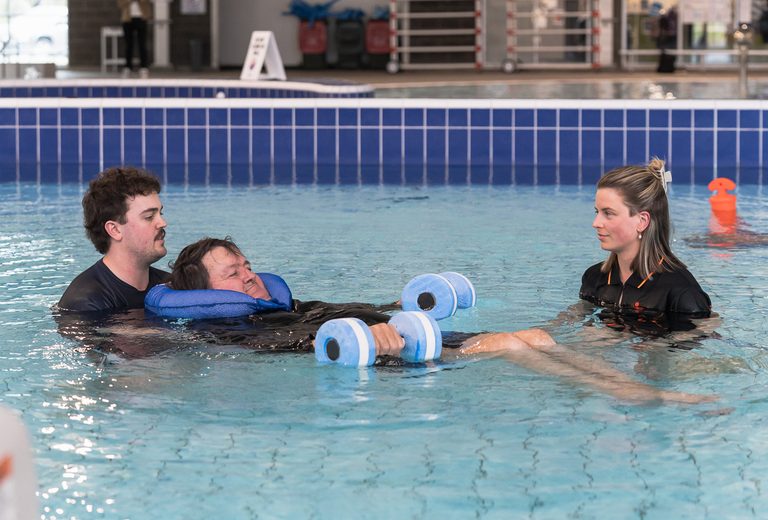
ID: A photo of Ian at The Rex Barossa Aquatic Fitness with Physiotherapist Aaron (left) and My Ability Pathway Service Delivery Lead Brooke (right).
For Ian, hydrotherapy is about more than exercise. It is time out of the house, time away from the routines of everyday life, and an opportunity to move in a way that feels more possible.
Supported by his My Ability Pathway team and guided by Aaron from Tanunda Physiotherapy, Ian has been attending hydrotherapy as part of his broader therapy routine. Together, they are working toward a goal that holds deep meaning for him: walking.
When asked what walking again would mean to him, Ian’s answer was simple: “A lot. I used to do a lot of it.”
Hydrotherapy uses the warmth, buoyancy and support of water to help people move with less pressure on their joints. For Ian, the water provides a space where exercise can feel more achievable than it does on land.
“When the water’s fairly warm it’s beautiful,” Ian said. While he is still working toward getting more movement and strength back in his legs, hydrotherapy has become an important part of that process.
Ian’s support worker Ryan has seen the difference that consistent therapy is making. “Since I’ve started working with you, you’ve definitely got more flexibility in your legs,” Ryan said. “You can straighten up a lot more than you used to.”
That progress matters. For many people, therapy is not about one big moment of change. It is about small improvements over time: a little more movement, a little more confidence, a little more comfort, and the support to keep going.
Ryan supports Ian to get to and from hydrotherapy, helping make the routine possible. For Ian, this practical support means he can continue accessing therapy, stay connected to his goals and take part in something he enjoys.
“It gets me out of the house,” Ian said. “It’s much easier to do the exercises in the water than it is on dry land.”
That sense of enjoyment is just as important as the exercises themselves. When supports are built around a person’s goals, interests and daily life, therapy can become something meaningful rather than just another appointment.
Aaron, Ian’s physiotherapist from Tanunda Physiotherapy, has been supporting Ian through a mix of hydrotherapy and land-based therapy. He has seen how the water can create opportunities that may not be available in other environments.
“The hydrotherapy is definitely fantastic for Ian,” Aaron said. “He’s allowed to do a lot more things in the water than he might not be able to do on land, and it’s an opportunity to just relax a little bit as well, just get out of the chair and move a little bit more freely in the water.”
For Ian, this combination of movement, relaxation and support is helping him continue working toward his goals. Each session is another step in building flexibility, confidence and capacity.
At My Ability Pathway, support looks different for every person. For some people, it might be building independence at home. For others, it might be reconnecting with community, learning new skills or working toward mobility goals. For Ian, hydrotherapy is one part of a bigger journey – one guided by patience, encouragement and the belief that every step forward matters.
And while Ian is clear that he is still working toward where he wants to be, he is also clear about what keeps him going: the chance to move, to get out, and to keep working toward walking again.
Progress can take time, but with the right team and the right supports around him, Ian is continuing to move forward – in the water, on land, and toward the goals that matter most to him.
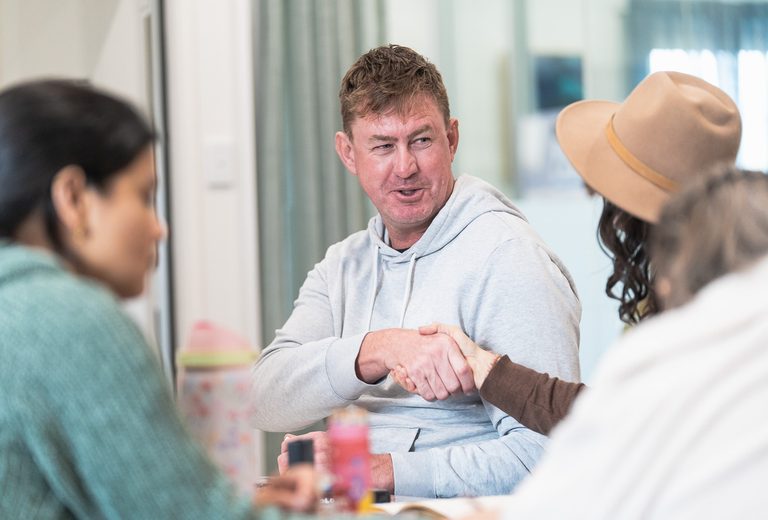
ID: Man sitting at a table and shaking hands with a women wearing a hat
When Ashley reflects on his journey, he doesn’t begin with what has been lost. He begins with gratitude, perspective and a steady belief that each day still holds the possibility of something good.
“It’s been a challenging journey, but I think it’s an exciting journey,” Ashley shares. “Every day I face my challenges, yet that is okay, my cup is half full. I’m thankful for what I have today and where I’ve come from if we looked at it from where I was to where I’m now.”
It is this sense of optimism that has carried Ashley through a period of enormous change. After becoming unwell, Ashley found himself in hospital in Adelaide, facing a future that suddenly looked very different from the life he had known. Independence, something he had once been able to rely on without much thought, was no longer guaranteed. Everyday tasks such as showering, getting dressed and moving through the day now required support.
“I no longer had independence anymore,” Ashley says. “I could no longer do what I used to be able to do and I needed help with my daily tasks.”
That adjustment was not only physical. For Ashley, coming to terms with the change also meant working through the emotional weight of uncertainty. He was trying to understand what life might look like, how he would manage, and how he could rebuild a sense of control. While the experience was difficult, Ashley was surrounded by family who helped him through those early stages.
At the time, Ashley and his family were living around two and a half hours from Adelaide. Being away from his wife and two boys during his hospital and rehabilitation journey was hard. As rehab continued, Ashley moved to the Barossa, where family support and local services helped make his recovery feel more possible.
A key part of that shift was discovering support close to home. Ashley was able to access hydrotherapy in Nuriootpa, continuing the rehabilitation he had begun in hospital. From there, more local supports became part of his life, including physiotherapy, occupational therapy, exercise physiology and community-based activities.
For Ashley, returning to the Barossa was more than a practical decision. It was a homecoming. A Barossa local, born and bred, he knew the area, the people and the sense of community that had shaped him. Moving back gave Ashley the chance to be closer to the supports, relationships and familiar places that could help him keep moving forward.
“The whole community piece is a huge part for me,” Ashley explains. Before becoming unwell, connection and supporting others had been a big part of his identity. When illness changed his daily life, that sense of involvement was something he deeply missed. Rebuilding those connections became an important part of his wellbeing.
Since moving back, Ashley has found strength not only in formal supports, but in the everyday power of community. He speaks about social outings, local groups and shared experiences with others who understand pain, fatigue and the challenges that are not always visible to the outside world.
“We’re all living through these similar things,” Ashley says. “Everyone has a very challenging journey and I think rolling this together, we need to support and be there for each other.”
That shared understanding matters. Ashley knows that not every disability, illness or ongoing health challenge is immediately visible. He has noticed that when people are not using a wheelchair or walking aid, others may assume they are okay. For Ashley, spaces where people can speak openly, feel understood and be met without judgement are essential.
Connection has also supported Ashley’s confidence, self-worth and passion for advocacy. His journey has helped him see how important it is for people to have someone to talk to, somewhere to belong, and access to the right supports in their own community. He believes there is value in more local opportunities where people can connect, share and support one another.
Acceptance has been a long process. Ashley is honest about that. There are days that are harder than others, and the journey has required him to get to know what he describes as “the new me”. But even within that reality, Ashley continues to choose hope.
“Some days are worse than others yet I’m thankful for every day,” he says. “There are good things to look forward to.”
Ashley’s story is a reminder that rehabilitation is not only about appointments, exercises or clinical progress. It is also about family, community, connection and having the right supports close enough to make daily life feel achievable. For Ashley, coming home to the Barossa has meant being surrounded by people and services that support his healing, independence and sense of purpose.
His cup-half-full outlook does not ignore the challenges he faces. Instead, it makes space for them while still recognising how far he has come. Ashley’s optimism, honesty and commitment to supporting others continue to shape his journey – one day, one connection and one step at a time.
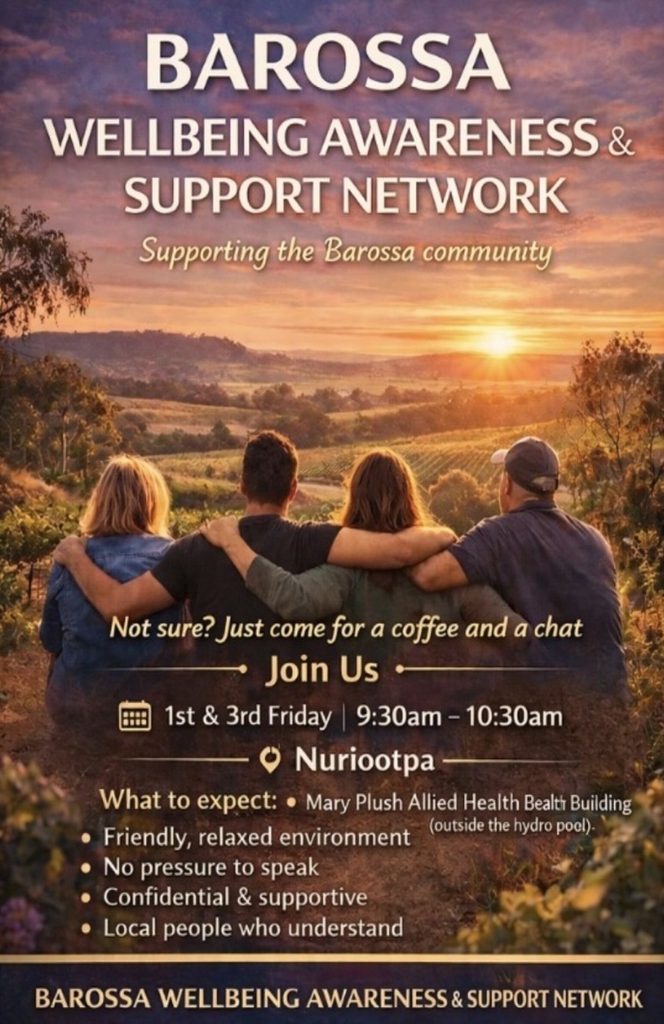
Ashley also helps run the Barossa Wellbeing Awareness & Support Network, held on the 1st and 3rd Friday of each month from 9:30am to 10:30am at the Mary Plush Allied Health Building. The group offers a friendly, relaxed and confidential space where there is no pressure to speak, just support from local people who understand. See the poster below for more information.
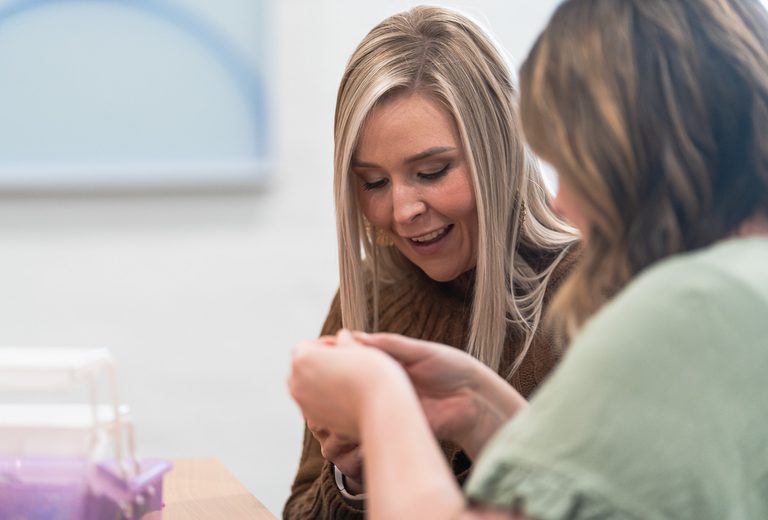
ID: Photo of two women making bracelets.
When Bianca joined My Ability Pathway as our new HR & Payroll Administrator, she stepped into more than a new workplace. She stepped into a new industry, a new role, and a team she says made her feel welcome from the very beginning.
“I’m brand new in the disability sector,” Bianca shared. “I have never worked in the disability sector…. I’m brand new to the role.”
But while there has been plenty to learn, Bianca says one thing stood out quickly: the support around her.
“Everyone is so supportive. It’s very inclusive,” she said. “From day one I’ve been part of the team, whether I’ve been part of the industry or not. I’ve felt very welcome.”
Outside of work, Bianca finds meaning and release through watercolour painting. What began around two years ago during a deeply difficult time has become an important part of how she expresses herself and makes sense of her experiences.
“I started about two years ago just after the passing of my dad,” Bianca explained. “I didn’t have the opportunity to go back home or to see him, or visit him in hospital. So I struggled with the grief process and I feel like art has given me the opportunity to deal with that grief.”
For Bianca, painting is not about perfection. It is about having somewhere safe to put feelings that can be hard to say out loud. It is a healthy coping mechanism, a creative outlet, and a reminder that expression can take many forms.
“It’s been really freeing in a sense,” she said. “I feel like that’s what art means for a lot of people. They use it as a coping mechanism, as a healthy coping mechanism.”
This year, Bianca took another brave step by submitting one of her artworks to the SALA Festival’s BE SEEN exhibition, presented by Barossa Village. The exhibition celebrates “bold journeys, fearless creativity, and the vibrancy of those souls often overlooked,” with the full collection on display at Barossa Village Lodge in Nuriootpa from 3–31 August.
Creative arts can offer people a way to communicate what words cannot always hold. Whether through painting, drawing, music, writing, movement or craft, creativity can help people explore emotion, identity, connection and healing in a way that feels personal and empowering.
For some, art is a quiet space to reflect. For others, it becomes a way to share a story, celebrate culture, process grief, or feel connected to community. Exhibitions like BE SEEN are important because they create space for those stories to be recognised, valued and celebrated.
Bianca’s artwork carries part of her own story, including why she began painting and why she believes art matters.
“I think it’s a really great tool for people to utilise when they need a way to express their feelings, to deal with their grief,” she said. “For me it was very hard, I didn’t have any family here to talk to and that was a way of expressing what I felt.”
We are proud to celebrate Bianca not only as part of the MAP team, but as someone willing to share her creativity and personal journey with the wider community. Her story is a beautiful reminder that creativity can help us process life’s hardest moments, connect with others, and be seen. You can visit the BE SEEN full collection at Barossa Village Lodge, 14 Scholz Avenue, Nuriootpa, from 3–31 August, Monday to Friday, 8:30am–4:30pm.
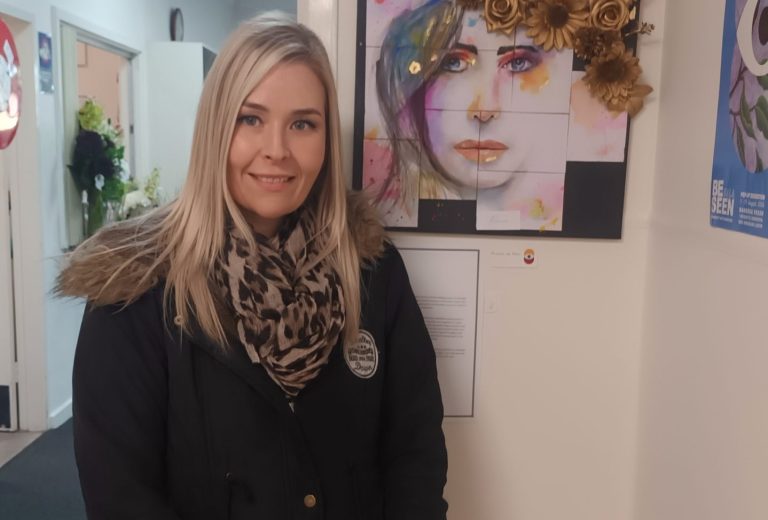
Bianca at the Barossa Village SALA Exhibition Opening on Monday 3 August 2026.
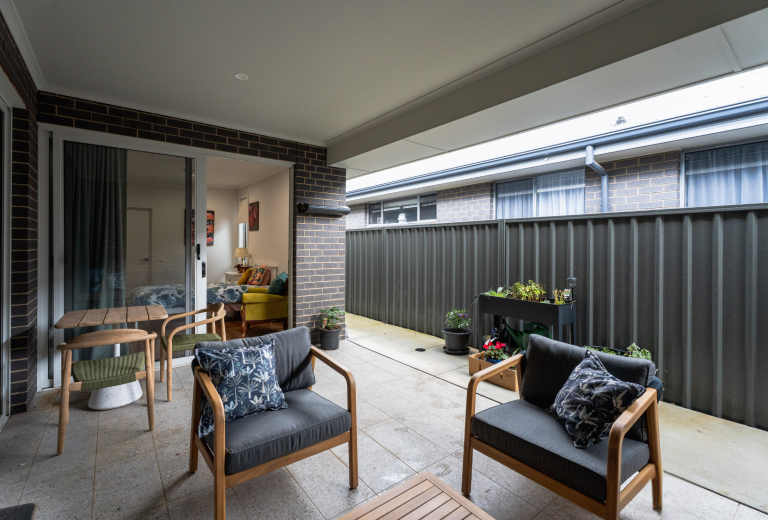
ID: Photo of an alfresco area that has been intentionally designed for a client who has dementia. Featuring sturdy seating areas and easy access to the bedroom.
Good design is about more than creating beautiful spaces. At its best, it helps people feel comfortable, safe and independent in their everyday lives.
When interior designer Steve Angel, from Décor Made Easy, looks at a room, he sees more than furniture, colours and floorplans. He sees opportunity: an opportunity to create a space where someone can continue doing the things they enjoy, feel connected to the people around them and maintain independence in a home that supports their needs.
Recently, Steve worked alongside My Ability Pathway to transform a small north-facing alfresco area into a practical outdoor retreat for a client living with dementia. The client loved gardening and wanted somewhere she could enjoy the sunshine, spend time with family and friends, and continue doing something she was passionate about.
What emerged was much more than an outdoor sitting area. It became a space that supported connection, routine and independence.
For Steve, successful design starts by understanding the individual.
“The client loves gardening, so what we looked to achieve was an extra space for her to have a little bit of autonomy,” Steve explains. “Somewhere where she could sit and have a cup of tea, enjoy the northern sun, have family and friends visit, and create a little bit of space for gardening because that’s what she loves.”
Positioned just outside the client’s bedroom, the outdoor area naturally extends her living space, making it easy to access throughout the day while offering a peaceful place to relax.
“It’s literally off the client’s bedroom… and it’s a great use of the space.” Steve says.
Inclusive design is often about details that many people may not immediately notice, but that can have a significant impact on someone’s confidence, comfort and safety.
For this project, furniture was carefully selected to provide stability and reassurance. Steve chose solid timber seating that would not move unexpectedly when someone sat down, while dining chairs were fitted with rubber stoppers to prevent them from sliding away.
“We wanted fairly generous seating, quite solid, so it’s not something too flimsy if someone isn’t too stable on their feet,” Steve says. “You can sort of flop into it and it won’t slide away.”
Rather than creating a space filled with busy patterns or overwhelming colours, the design remains calm and inviting. As Steve puts it, “It’s just simplistic, with a bit of colour in the cushions. Nothing too demanding or dramatic.”
Through previous work designing dementia-specific environments in aged care spaces, Steve has seen firsthand how thoughtful design can improve quality of life. One of the biggest lessons was understanding that people living with dementia may experience their surroundings differently.
Something as simple as a patterned floor can create confusion. Steve recalls learning that flooring with strong borders or contrasting lines could sometimes be perceived as an obstacle that residents felt they needed to step over.
“People thought patterned floors or border lines were something they had to step over, so we learned we couldn’t have those sorts of designs because they affected people’s confidence to move freely.”
Those observations also revealed creative ways to gently guide movement without using physical barriers. In one aged care setting, a wallpaper border placed at eye level helped guide a resident through a space where she had previously become stuck, preserving her freedom while reducing frustration and confusion.
“We discovered we could use visual cues to encourage people through spaces or away from certain areas without putting up barriers. It worked extremely well.”
Colour and contrast also play an important role, particularly for people experiencing vision changes. Steve learned that artwork, patterns and decorative elements work best when they feature clear edges and strong contrast.
“We learned that artwork needed nice sharp edges and good contrast. Anything blurry or soft could become difficult to interpret, so we were very mindful of choosing crisp patterns and images.”
For Steve, inclusive design is about helping people maintain control over their daily lives and continue doing the things that matter to them.
He recalls working with an older woman who had severe arthritis and struggled to use the chain-operated blinds installed in her room. The blinds may have looked modern, but they were not functional for the person using them.
“She used to have to call staff just to put the blind up or down.”
By replacing them with motorised blinds and an accessible wall-mounted remote, she was able to manage them independently and no longer needed to ask staff for help.
“She became so much more independent because she was in control of that.”
For Steve, this is what inclusive design is all about: thinking first, rather than simply following design trends.
“It’s a little bit more thinking first, and not just saying, ‘Well, that’s the fashion in design.’ Let’s think about whether that’s suitable.”
Inclusive design does not require creating clinical spaces or removing personality from a home. Instead, it means understanding how people experience their environment and making thoughtful choices that support safety, confidence and independence.
Whether it is selecting stable furniture, creating clearer visual cues, improving accessibility or enabling people to continue pursuing the hobbies they love, thoughtful design can have a lasting impact on quality of life.
As Steve’s work shows, the most successful spaces are not necessarily the most stylish or the most expensive. They are the spaces that help people keep doing what matters most.
“If design can help people become independent – whatever that means for them – that’s a fantastic thing.”

ID: Two men walking forward, looking at the camera. The man on the left is supporting the man on the right.
Michael’s story is one of resilience, dignity, and the power of consistent, thoughtful care. Living with Parkinson’s disease and dementia, his journey has brought challenges – but it has also highlighted how the right support can help preserve independence, mobility, and wellbeing.
As his daughter Carmen reflects, “Dad’s journey hasn’t been easy… from being a fit, working man to not knowing what his future held… was a challenging time for our family.”
Despite these challenges, Michael remains, first and foremost, a person who enjoys movement, thrives on routine, and values connection.
Conditions like Parkinson’s disease and dementia can significantly affect mobility, coordination, and overall physical wellbeing over time. Maintaining movement is not just about physical health – it’s about preserving confidence, comfort, and a sense of self.
Consistency plays a powerful role here. Familiar routines and repeated activities help reduce confusion and anxiety, creating a sense of safety and predictability. As Michael’s team explains, “A consistent approach allows Michael to feel more comfortable, safe, and confident during activities.”
This consistency also reinforces movement patterns, supporting independence and helping to maintain mobility for as long as possible.
Michael receives personalised exercise physiology support in his home environment – an approach that allows his therapy to fit seamlessly into his daily life.
His sessions include a variety of engaging, purposeful activities such as:
Each activity is carefully adapted to suit Michael’s needs, abilities, and even how he is feeling on the day. Importantly, the program is built around what he enjoys – particularly walking – helping him stay motivated and engaged. Alongside this, Michael attends regular physiotherapy sessions, with both disciplines working together to support his mobility, safety, and independence.
Over time, the impact of familiar faces and regular routines has been significant. Trusted support workers and structured sessions not only encourage participation but also build confidence.
As his care team notes, “Having familiar support workers, repeated exercise routines, and structured sessions helps him better understand what is expected and encourages participation.”
Consistency also plays a key role in physical outcomes – supporting balance, stability, and strength through regular practice.
While Parkinson’s disease and dementia are progressive conditions, the results of Michael’s ongoing support highlight the difference consistent care can make.
Since beginning his program:
His team reflects positively on these outcomes: “Overall… the ongoing exercise support has played an important role in maintaining his mobility, preventing falls and keeping him engaged and active in a safe environment.”
For Carmen, the changes go beyond physical health:
“Dad’s mobility has increased and he has been happier, more well and his mental health has improved.”
And the impact on daily life is meaningful:
“Dad’s mobility means he can move with comfort and ease, get out to the community more often… and live more independently.”
Michael’s story is a reminder that even in the face of progressive conditions, thoughtful and tailored support can make a profound difference.
Through consistent care, personalised therapy, and familiar routines, it is possible to preserve not just physical ability – but dignity, confidence, and quality of life.
At My Ability Pathway (MAP), there is a deep commitment to providing high-quality Supported Independent Living (SIL) supports that are centred around each individual. This means working alongside people like Michael to understand what matters most to them – whether that’s maintaining mobility, staying connected to community, or simply feeling comfortable in their daily routines.

ID: photo of a person sitting in a wheelchair facing away from the camera.
At My Ability Pathway (MAP), meaningful outcomes often begin with listening – really listening – to a person’s history, preferences, and what brings them comfort.
For one of our clients – who lives with Down Syndrome and Dementia and is non-verbal – this approach led to the introduction of a simulated pet through Dementia Support Australia, championed by MAP’s Support Coordination team.
The idea was sparked during a visit from a Behaviour Practitioner, who took the time to understand the client’s background. A simple but important detail stood out: she had always had dogs. Building on this, the practitioner arranged for a simulated pet to be introduced – something familiar, comforting, and aligned with her lived experience.
The introduction itself was calm and intentional. While seated at the dining table, staff gently placed the simulated pet in front of the client, modelling interaction by softly stroking it and speaking to it. What followed was a natural progression – initial observation, then curiosity, and soon, active engagement.
Since then, the impact has been clear.
The client presents with a noticeably happier and more positive mood, regularly engaging with the pet through touch and exploration. She strokes it, activates its sounds, and spends time interacting with its different textures – from its ears to its paws – often smiling throughout. These moments of sensory engagement have become meaningful parts of her day.
For a client who communicates non-verbally, connection looks different – but no less powerful. She now points to the simulated pet to gain staff attention, inviting shared interaction and creating opportunities for connection. What may seem like a small gesture is, in reality, a significant form of communication and choice.
This outcome is a strong reflection of what person-centred practice looks like in action. By exploring creative, tailored supports, the team has enabled greater emotional expression, engagement, and enjoyment – supporting the client to connect with the world around her in a way that feels natural and meaningful.
Behind this outcome is proactive and thoughtful Support Coordination. Recognising an opportunity to better support the client, the Support Coordinator reached out to Dementia Australia for guidance. This led to a referral to Dementia Support Australia, with consent from the client’s nominee – ultimately opening the door to a tailored intervention that has made a real difference.
Simulated pets are therapeutic tools – often robotic or plush animals – designed to replicate the look, feel, and responsiveness of real pets. Commonly used in dementia care, they provide comfort and emotional connection without the responsibilities or risks associated with live animals.
They can help reduce anxiety, agitation, and social isolation, while encouraging sensory engagement and nurturing behaviours such as holding, stroking, or interacting with the pet. For individuals with limited verbal communication, simulated pets offer a powerful non-verbal way to express emotion and build connection – supporting wellbeing in a way that is both gentle and deeply personal.
For more information on virtual simulated pets visit: https://www.dementia.com.au/resource-hub/the-use-of-simulated-pets-in-dementia-care
Photo by Steven HWG on Unsplash

ID: Picture of two men on a motorbike.
At My Ability Pathway, our Support Coordination team often talks about goals, plans and progress. But sometimes, the most powerful outcomes aren’t written in a plan – they’re felt in the wind on your face, the sound of an engine starting, and the spark of recognition in someone’s eyes.
Today, 5 March 2026, we saw exactly that with John, one of MAP’s Support Coordination clients.
John lives with Frontal Lobe Dementia, also known as Frontotemporal Dementia (FTD). FTD is a progressive neurodegenerative disease that causes shrinkage (atrophy) in the brain’s frontal and temporal lobes. It most commonly affects people between the ages of 45 and 65.
Unlike other forms of dementia that begin with memory loss, FTD often first presents as dramatic changes in personality, behaviour and language.
Common impacts include:
There are two main subtypes:
FTD is caused by abnormal protein build-up in the brain. In around 30–40% of cases, there is a genetic link. There is currently no cure, and diagnosis relies on neurological assessments, behavioural evaluations and brain imaging that shows atrophy.
In recent years, public awareness of FTD has increased following the diagnosis of actor Bruce Willis, helping many families better understand the condition and its impact.
While life expectancy varies widely, supportive care, routine, therapies and medication can help manage symptoms such as agitation, depression and sleep changes.
But beyond the clinical description is something equally important: identity. And that’s where John’s story comes in.
For many people living with FTD, it’s not only abilities that change – it’s interests and motivation too. Activities that once brought joy can feel distant, confusing or overwhelming.
John used to ride motorcycles. It wasn’t just a hobby; it was part of who he was.
As dementia progressed, riding became difficult. John shared that it wasn’t only about forgetting how to ride – it was about losing confidence. People would tell him he was doing it wrong. His balance worried him. Gradually, the bikes stopped.
And with that, something else quietened too.
His wife Terri has watched these changes unfold. Over the years, John has shown less interest in many of the things that once energised him. So when something sparks engagement, it matters.
After talking with John, Support Coordinator Beth started thinking differently. What if this wasn’t about what John could no longer do – but about how we could safely reconnect him with what he loved?
Beth reached out to Keith from the Long Riders Motorcycle Club Adelaide. Without hesitation, Keith offered to come to John’s home and spend time talking bikes.
That visit alone made a difference.
They sat together – John, Terri and Keith – swapping stories. They talked about John’s first bike, a Suzuki. They reminisced about runs, rides and the open road.
John worried about his balance. Keith reassured him.
And then John’s humour surfaced:
“I’ve got some bungee straps out the back if you need to strap me down.”
The room filled with laughter.
It was a glimpse of the John Terri knows so well.
Soon enough, they stepped outside to Keith’s bike.
John was asked, “How are you feeling?”
“Nervous. It’s been a long time.”
The first ride was just around the block – a gentle reintroduction to the sensation. A quick stop back home. A moment to regroup.
Then they headed out for a longer ride around town.
This was something different for Terri. John rarely leaves the house without her now, which makes us acutely aware of the pressures carried by carers – the constant responsibility, the fatigue, the hypervigilance, the quiet mental load. Moments like this highlight an important question in disability and dementia support: who’s caring for the carer?
Creating space for John to safely reconnect with something meaningful also created space – even briefly – for Terri to breathe.
There is no cure for Frontal Lobe Dementia. We cannot stop the progression.
But we can support identity.
We can create moments of connection.
We can work creatively around challenges.
Today wasn’t about motorcycles alone. It was about dignity. Confidence. Laughter. Community.
It was about remembering that even when the brain changes, the person is still there.
At MAP, Support Coordination is not just about navigating systems – it’s about listening deeply enough to ask: What still matters?
For John, it turns out, it’s still the rumble of a bike beneath him and the freedom of the road ahead.

ID: Photo of Shaun outside, on a sunny day.
As we step into a new year, it’s a wonderful time to reflect on Shaun’s ongoing journey toward independence and the goals that continue to guide him forward. Last year, we shared Shaun’s story—his determination to live in his own home with Supported Independent Living (SIL) services, and the optimism he brings to every step of that journey. Since then, Shaun has continued to build on those foundations with enthusiasm, resilience and a clear focus on what he is working towards.
Reflecting on the year behind
Over the past year, Shaun has navigated change with perseverance. After returning to live with his mother, Coral, Shaun remained committed to his long-term goal of independent living. What could have feltlike a setback instead became a period of growth, reflection and skill-building. Together, Shaun and Coral continued to keep his goals front and centre, using this time to strengthen the skills and confidence needed for the next stage of his journey.
Shaun’s weekly SIL stays have continued to play an important role in maintaining momentum. These supports allow Shaun to practise independence in a supported environment, helping him bridge the gap between family life and living on his own again. During his stays, Shaun takes pride insetting up his space, organising groceries and planning his days. From swimming and shopping to cooking meals and attending concerts, Shaun remains actively engaged and motivated, using his NDIS supports to access meaningful activities while working steadily toward his goals.
Growth through skill-building
Looking back, Shaun has made notable progress in developing everyday living skills. With prompting and support, he continues to manage many daily tasks and safely approaches more complex activities alongside his support team. Each new skill—whether using household appliances or keeping up with chores—represents another step closer to the independent life he envisions.
Shaun’s confidence in decision-making has also continued to grow. Over the past year, he has become increasingly comfortable expressing his preferences and following through on his choices, from selecting clothes to planning outings. This growing self-confidence has been a key part of his progress and supports his ability to take ownership of his goals.
Shaun’s commitment to learning and self-improvement reminds us that progress is ongoing and goals are built one step at a time.
Looking ahead to the year to come
As the new year begins, Shaun continues to balance his love of family life with his desire for independence. Time spent at home with Coral and the comforting presence of his dog, Casper, remains important to him, while supported living continues to offer opportunities for growth and autonomy.
Looking forward, Shaun’s goals may continue to evolve, but his determination remains unchanged. With a positive outlook, strong support network and clear goals in mind, Shaun enters the new year ready to keep building toward a future where he can live independently, confidently and on his own terms.
