We value your privacy
This website uses technical, functional and analytical cookies that do not infringe on your privacy.
General purpose platform session cookies are usually used to maintain an anonymised user session by the server.


ID: Photo of the front of a new Specialist Disability Accommodation house in Nuriootpa.
Looking for Specialist Disability Accommodation in Nuriootpa? Finding a suitable home involves more than checking whether a room is available. It means considering how the space works for you, what support you need and whether the location helps you stay connected to the people and places that matter. My Ability Pathway’s current vacancies page lists High Physical Support SDA in Nuriootpa, with housing provided by New Dawn Housing and Supported Independent Living supports delivered by MAP. If you are exploring your next move, here is a starting point for learning about the home and asking the questions that matter to you. Availability can change, so please contact MAP to confirm current vacancies and suitability.
Watch the Nuriootpa SDA video below as a starting point for exploring the home. As you watch, note what you would like to ask about or see during a visit. A video can help you prepare questions, but it cannot confirm whether a home will meet your individual accessibility, equipment or support needs.
MAP’s Nuriootpa vacancy listing describes a purpose-built High Physical Support home with modern accessible design, spacious shared living areas and a private bedroom with an ensuite. It also identifies proximity to local services and community facilities. These features are worth considering in relation to your own routines. How would you move between your bedroom, bathroom and shared spaces? Where would you spend time with visitors? What would help you take part in household activities in the way you prefer? The NDIS describes High Physical Support housing as including a high level of physical access for people who need very high levels of support. That category does not tell you every detail of an individual property. Ask which equipment and technologies are installed, which are provisions for future installation and what would need to be arranged for you.
New Dawn Housing is identified as the housing provider, while MAP provides the Supported Independent Living services. MAP’s listing describes 24/7 SIL support at the Nuriootpa home. Your individual assistance, overnight arrangements and any shared supports still need to be discussed; 24/7 support does not automatically mean continuous one-to-one assistance. SDA relates to the specialist home, while SIL relates to assistance or supervision with daily tasks. They are separate supports, and SDA funding does not include personal care or SIL. For an introduction, read MAP’s guide to SDA and SIL. Ask for clear information about the housing agreement, support agreement, charges and who to contact about each aspect.
For someone who wants to live in the Barossa, location may be an important part of the decision. Consider the people you want nearby, the appointments you attend and the places you enjoy visiting. Rather than relying on the phrase “close to services”, ask about the actual journey: transport, accessible routes, travel time and any assistance required. Your home should be considered alongside your wider life. Shared living also deserves discussion. Ask about the proposed household, privacy, visitors and how different routines can work together, while respecting other residents’ confidentiality.
SDA is for eligible NDIS participants with extreme functional impairment or very high support needs. A listed vacancy does not establish eligibility or guarantee that the property matches your approved funding and circumstances. Your support coordinator or chosen supporter can help you gather questions and understand the information provided. The NDIA explains that SDA residents pay a reasonable rent contribution and other day-to-day living costs, such as electricity. Request a clear breakdown of the costs for this particular home before deciding. There is no need to work through every question alone, but your preferences should remain central throughout.
If you would like to explore the Nuriootpa SDA vacancies, view the New Dawn Housing property listing on Housing Hub, check MAP’s current vacancies or contact MAP to ask about availability and a possible viewing. Call 08 8563 2569 or email ndis@myabilitypathway.org. Whether you are making an enquiry for yourself or supporting someone with their permission, the starting point is the same: what would make this a suitable home for the person who will live here?
Contact MAP to confirm Nuriootpa SDA availability, discuss your needs and ask about a viewing.

ID: Photo of a group of people outdoors having a picnic and playing games.
Have you ever come home from an activity and thought, “That filled the afternoon, but it was not really for me”? A busy calendar can look positive from the outside. Yet attending activities and feeling connected are not necessarily the same thing. Meaningful community participation begins with what you enjoy, who you want to spend time with and how you want to take part. A good starting question is not “How many outings did we organise?” but “Was this worth doing for you?”
Community might mean a local club, an art class, a library, a familiar café or time with neighbours. It might involve a disability-specific group, a mainstream activity, an online interest group or a combination. No single setting is automatically the most inclusive for everyone. The important questions are whether you want to be there, can participate in a way that suits you and have opportunities for the kind of connection you value. Enjoyment is a valid reason to take part. You do not need to turn every interest into a lesson or a measurable achievement.
Consider a hypothetical person who enjoys plants and wants to try a community gardening group. Getting there matters, but so does what happens after arrival. Can they reach the work area? Are instructions accessible? Is there a task they actually enjoy? Does someone speak directly with them rather than only with their support worker? These details can determine whether an outing becomes a valued part of the week. Meaningful participation is not about making someone more sociable. It is about making room for the involvement they want.
Start with an interest, not a vacant place on a program. Ask what you would like more of: time outdoors, creative expression, familiar conversation or a chance to learn. Being unsure is fine. Looking at a few options can be part of finding out.
Check the details that matter to you, including transport, accessible toilets, noise, seating, communication and breaks. In regional areas, consider the whole journey, including getting home. A venue’s general claim that it is accessible may not answer your particular questions. With your permission, a supporter can help ask about adjustments without sharing unnecessary personal information.
Ask whether a short visit or introductory session is possible, and clarify any charges first. Agree what help you want during the visit. Some people prefer an introduction and then space; others want ongoing assistance to communicate or take part. Neither approach is a better form of independence.
Afterwards, ask: did I enjoy it, feel included and have enough say? What would I change? The answer might be a different time, a smaller group, more assistance or a different activity altogether. Choosing not to return is useful information, not a failure.
The NDIA’s social and recreation support guidance distinguishes disability-related assistance from ordinary activity expenses. Depending on individual circumstances and funding criteria, the NDIS may fund extra help needed because of disability. General costs that everyone pays, such as ordinary membership or entrance fees, remain the participant’s responsibility. Do not assume that an activity, transport arrangement or support charge is funded simply because it links to a goal. Check your plan and current guidance before committing. A support coordinator, where involved, can help clarify questions; they do not approve NDIA funding.
There can be pressure to fill every available hour or keep adding new experiences. A familiar weekly visit may be more valuable than several unfamiliar outings. Rest, time alone and changes of mind also deserve respect. Families and support teams can help by noticing barriers without deciding what a satisfying social life should look like. Community organisations have a part to play too: welcoming communication, workable adjustments and direct engagement should not depend entirely on a support worker’s presence. Paid support can assist participation, but it cannot guarantee friendship or belonging.
The most useful next step might be small: asking about a class, returning to a familiar place or finding a way to join a conversation. Success is not always a larger calendar. It might be greater choice, a comfortable routine or taking part in something you value. MAP’s published community approach emphasises individual interests and connection. To explore assistance in the Barossa, Gawler or Adelaide’s northern suburbs, read about MAP’s disability support services and social and community participation. Begin with what matters to you, then consider what support would make it possible.
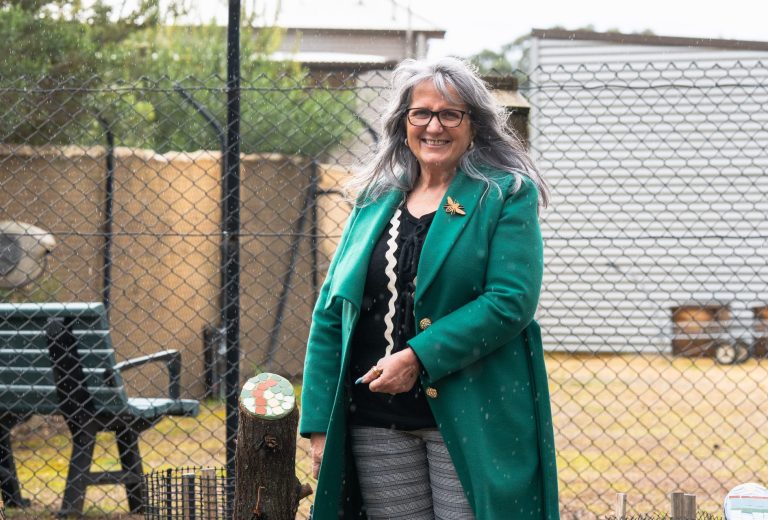
ID: Reta standing next to her mosaic which is part of the Reconciliation Mosaic Project at Barossa Bushgardens.
Sometimes, the people who have the greatest impact are the ones who never set out looking for recognition.
For those who know Reta, it will come as no surprise that after decades spent supporting others, advocating for the disadvantaged and championing equality, she still speaks about her work with the same passion and conviction that first drew her into the sector.
In fact, she was preparing to retire.
“I was 60 years old and I was going to retire,” she laughs.
Instead, an opportunity arose at My Ability Pathway. Although administration was completely new territory, Barbara and Charlotte recognised the incredible depth of knowledge and experience Reta could bring to the organisation. Today, she continues to support the team, mentor colleagues and share her wisdom whenever needed.
“I feel very privileged that they value my opinion when it comes to community,” she says.
And what an opinion it is.
Reta’s journey began with a childhood dream of becoming a nurse. After moving to the Barossa in her late twenties, she met Sophie, then Director of Nursing at Barossa Village, who offered her a shift that would change the course of her life.
“The rest is history,” she says.
Following a decade in aged care and some significant personal experiences, Reta discovered a calling that would shape the rest of her career.
“I came to the realisation that there were people who didn’t have a voice and weren’t being heard,” she explains.
“That’s what led me to become an advocate.”
Over the years, Reta has worked across disability, homelessness, domestic violence and child protection, but she always finds herself returning to disability support.
For Reta, advocacy has never been about speaking for people. It has been about ensuring people are heard and supported to live the lives they choose.
“I come from the belief that everybody is equal and that we all have the right, given the opportunity, to live our life to our full potential and be treated with dignity, irrespective of where we come from and who we are.”
It is a philosophy that has guided her both personally and professionally.
Anyone who has worked alongside Reta knows that her knowledge is immense, but what stands out even more is her unwavering passion for people.
She describes herself as “quite assertive” when advocating for others, although those around her would simply call it dedication.
At MAP, we are incredibly fortunate to have someone with Reta’s lived experience, compassion and wisdom. Her ability to mentor others, provide perspective and remind us of the importance of community is invaluable.
Quite simply, Reta is one of those people who makes everyone around her better.
During National Reconciliation Week, we are reminded that reconciliation is about relationships, respect and opportunities.
At My Ability Pathway, these values underpin everything we do. We recognise that reconciliation is not a destination but an ongoing journey – one that requires listening, learning and walking together.
This year, we were excited to see Reta contribute to the Reconciliation Mosaic Project at the Barossa Bushgardens. Bringing together children from Nuriootpa Kindergarten, an OSHC group and members of the community, the project was guided by an Indigenous artist and explored our connections to land and to one another.
Reta’s piece featured two intertwining trees.
“It’s about standing together against any problems in the past and standing together moving forward and supporting each other, irrespective of where we come from or who we are,” she says.
It’s a beautiful reflection of the values she has embodied throughout her entire life.
And perhaps that’s what makes Reta so special.
Not just her decades of experience, her advocacy, or her wealth of knowledge – but her enduring belief that everyone deserves dignity, respect and the opportunity to thrive.
At My Ability Pathway, we are grateful every day that she chose not to retire.
Because our team, and our community, are stronger because of it.
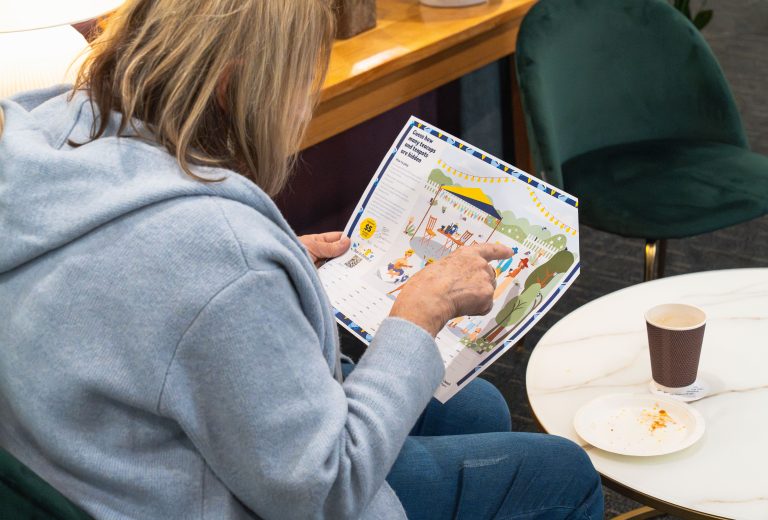
ID: A women playing the Biggest Morning Tea ‘Guess how many teacups’ game to raise funds for Cancer Council.
More than 30 people came together recently for My Ability Pathway’s third and final Australia’s Biggest Morning Tea, raising an incredible $1,108 for Cancer Council and surpassing our fundraising goal of $1,000.
It was lovely to see so many familiar faces, with clients, support workers, team members, families and local supporters gathering to enjoy good food, great company and the chance to support a cause that touches so many lives.
Like many Australians, we all know someone who has been affected by cancer. Over the past three years, these events have given us the opportunity to come together, show our support and give back in a meaningful way. Thanks to the generosity of everyone involved, we have now raised over $3,500 for Cancer Council since hosting our first Biggest Morning Tea.
This year’s event was particularly special. Not only did we exceed our fundraising target, but we were also heartened by the strong turnout and the sense of connection that filled the room. From delicious treats and coffee to raffle prizes and plenty of laughter, the morning was a reminder of what we can achieve when we come together.
As we close the chapter on our Biggest Morning Tea tradition, we do so with immense gratitude to everyone who has supported us over the past three years. While this marks the end of our involvement with this particular fundraiser, it certainly won’t be the end of our commitment to supporting meaningful causes.
We look forward to turning our attention to other worthwhile initiatives in the future and continuing to create opportunities for our community to make a difference.
Thank you to everyone who attended, donated, purchased raffle tickets, contributed prizes and helped make our final Biggest Morning Tea such a memorable success. Together, we have made a real difference.
Special thanks to the businesses and individuals who supported this event through donated goods:

ID: Photo of people sitting and listening to a women talk.
On Friday 1 May, My Ability Pathway was proud to host a Foundations Disability Inclusion Training at our HQ, bringing together more than 20 attendees from across the Barossa and surrounding regions.
Delivered by JFA Purple Orange, the session welcomed people from a diverse range of industries and backgrounds – including local businesses, community organisations, disability services, education, health, and hospitality.
While the training itself provided practical tools and insights around disability inclusion, what stood out most was the quality of the conversations happening throughout the day.
There was genuine curiosity, openness, and a shared willingness to learn. Attendees reflected on how inclusion shows up in everyday interactions, workplace culture, customer service, communication, and community participation. Just as importantly, there was space for people to ask questions, challenge assumptions, and connect with others who are equally passionate about creating more inclusive environments.
For My Ability Pathway Director Barbara Lightburn, the event reinforced the importance of bringing opportunities like this to regional communities.
“It’s not often this type of training is delivered locally in the Barossa, so it was fantastic to see such a strong cross-section of the community represented. Inclusion grows through conversations, shared learning, and people being willing to take that first step.”
A key focus of the session was helping attendees feel more confident in the language they use, the environments they create, and the everyday actions that contribute to inclusion.
Importantly, the event also created valuable networking opportunities, with attendees making new connections across industries and sectors – something that will continue to strengthen collaboration and inclusion across the region long after the session ended.
At My Ability Pathway, we believe inclusive communities are built collectively. Seeing so many local organisations and individuals investing their time into learning and connection was incredibly encouraging.
We’d like to sincerely thank JFA Purple Orange for delivering such an engaging and thought-provoking session, and thank everyone who attended and contributed so openly throughout the day.
Because meaningful change often starts with a conversation – and Friday proved just how powerful those conversations can be.
To find out more about JFA Purple Orange and the different trainings they offer, head to their website.
