We value your privacy
This website uses technical, functional and analytical cookies that do not infringe on your privacy.
General purpose platform session cookies are usually used to maintain an anonymised user session by the server.


ID: Photo of the front of a new Specialist Disability Accommodation house in Nuriootpa.
Looking for Specialist Disability Accommodation in Nuriootpa? Finding a suitable home involves more than checking whether a room is available. It means considering how the space works for you, what support you need and whether the location helps you stay connected to the people and places that matter. My Ability Pathway’s current vacancies page lists High Physical Support SDA in Nuriootpa, with housing provided by New Dawn Housing and Supported Independent Living supports delivered by MAP. If you are exploring your next move, here is a starting point for learning about the home and asking the questions that matter to you. Availability can change, so please contact MAP to confirm current vacancies and suitability.
Watch the Nuriootpa SDA video below as a starting point for exploring the home. As you watch, note what you would like to ask about or see during a visit. A video can help you prepare questions, but it cannot confirm whether a home will meet your individual accessibility, equipment or support needs.
MAP’s Nuriootpa vacancy listing describes a purpose-built High Physical Support home with modern accessible design, spacious shared living areas and a private bedroom with an ensuite. It also identifies proximity to local services and community facilities. These features are worth considering in relation to your own routines. How would you move between your bedroom, bathroom and shared spaces? Where would you spend time with visitors? What would help you take part in household activities in the way you prefer? The NDIS describes High Physical Support housing as including a high level of physical access for people who need very high levels of support. That category does not tell you every detail of an individual property. Ask which equipment and technologies are installed, which are provisions for future installation and what would need to be arranged for you.
New Dawn Housing is identified as the housing provider, while MAP provides the Supported Independent Living services. MAP’s listing describes 24/7 SIL support at the Nuriootpa home. Your individual assistance, overnight arrangements and any shared supports still need to be discussed; 24/7 support does not automatically mean continuous one-to-one assistance. SDA relates to the specialist home, while SIL relates to assistance or supervision with daily tasks. They are separate supports, and SDA funding does not include personal care or SIL. For an introduction, read MAP’s guide to SDA and SIL. Ask for clear information about the housing agreement, support agreement, charges and who to contact about each aspect.
For someone who wants to live in the Barossa, location may be an important part of the decision. Consider the people you want nearby, the appointments you attend and the places you enjoy visiting. Rather than relying on the phrase “close to services”, ask about the actual journey: transport, accessible routes, travel time and any assistance required. Your home should be considered alongside your wider life. Shared living also deserves discussion. Ask about the proposed household, privacy, visitors and how different routines can work together, while respecting other residents’ confidentiality.
SDA is for eligible NDIS participants with extreme functional impairment or very high support needs. A listed vacancy does not establish eligibility or guarantee that the property matches your approved funding and circumstances. Your support coordinator or chosen supporter can help you gather questions and understand the information provided. The NDIA explains that SDA residents pay a reasonable rent contribution and other day-to-day living costs, such as electricity. Request a clear breakdown of the costs for this particular home before deciding. There is no need to work through every question alone, but your preferences should remain central throughout.
If you would like to explore the Nuriootpa SDA vacancies, view the New Dawn Housing property listing on Housing Hub, check MAP’s current vacancies or contact MAP to ask about availability and a possible viewing. Call 08 8563 2569 or email ndis@myabilitypathway.org. Whether you are making an enquiry for yourself or supporting someone with their permission, the starting point is the same: what would make this a suitable home for the person who will live here?
Contact MAP to confirm Nuriootpa SDA availability, discuss your needs and ask about a viewing.
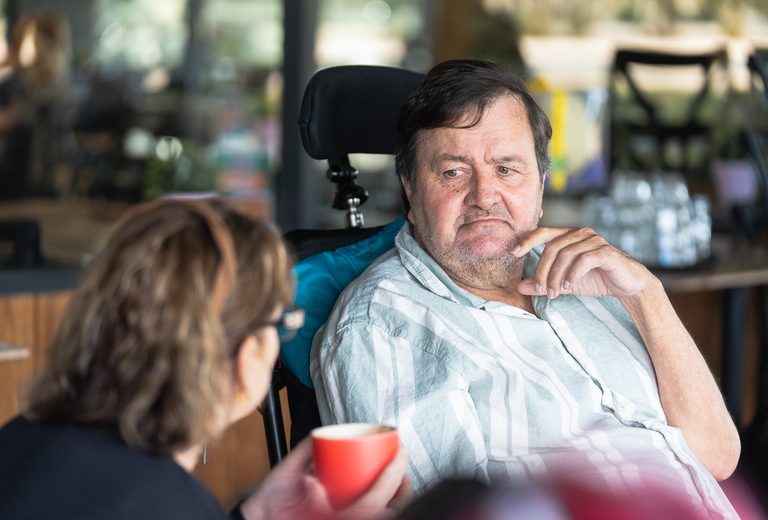
ID: Photo of Ian out at MAP’s Easter Morning Tea event.
For Ian and his family, moving into Specialist Disability Accommodation (SDA) in Nuriootpa has been about much more than finding an accessible house. It has been about creating a home that supports safety, independence, family connection and everyday choice.
After experiencing multiple strokes in 2023, Ian’s life changed significantly. Once a truck driver who had lived independently, Ian became wheelchair bound and needed a home designed around his physical support needs. His daughter, Regina, said the family knew that having access to an SDA home would be important for Ian’s future.
“Having access to an SDA house was what we were needing for his needs going forward,” Regina shared.
Specialist Disability Accommodation is purpose-built housing for NDIS participants with extreme functional impairment or very high support needs. For people like Ian, SDA can make daily routines safer, easier and more comfortable by removing barriers within the home and supporting greater independence.
For Ian, the difference is felt in the everyday details. Regina explained that his SDA home is “designed better” for him because it caters to his needs as a wheelchair user. Open spaces allow him to move through the home more freely, while accessible design features support the routines, interests and choices that continue to matter to him.
“He’s always enjoyed cooking,” Regina said, describing how adjustable kitchen benches allow Ian to remain involved in an activity he enjoys. “Having benches that can move up and down… cater for people who are in wheelchairs.”
Accessible housing is often spoken about in terms of equipment, floorplans and support ratios, but its real value is found in the way it helps people participate in their own lives. Ian’s Nuriootpa SDA home gives him room to move, space for safe transfers and the ability to do meaningful things for himself.
Regina shared that Ian can wheel himself to the front door and open it for her when she visits. It is a simple moment, but one that reflects the importance of independence, privacy and dignity within the home.
“He can wheel himself up,” Regina said. “The bathroom’s big enough so he can get in and out there… he’s got the big space to be able to be lifted to and from bed into wheelchair.”
One of the most important parts of Ian’s SDA journey has been location. Ian lives in the Barossa, close to Regina and his grandchildren. For their family, being near familiar places and people was an important part of finding the right long-term home.
Regina explained that Nuriootpa was a good fit because it kept Ian close to family routines and community connections. “It’s only 30 minutes away from where I live and my kids go to school here in the Barossa,” she said. “We’re always over here… the plan long term [was] to be able to have him as close to family as possible.”
This is why Specialist Disability Accommodation in regional communities like the Barossa matters. Purpose-built SDA homes can help people with disability remain connected to their families, local services, support networks and the communities they know, while receiving the daily support they need to live safely and well.
Ian’s story is a reminder that the right SDA home does more than meet physical access requirements. It supports confidence, comfort, connection and choice. It gives families reassurance that their loved one is living in a place designed around their needs, while also creating opportunities for the person to stay involved in everyday life.
At My Ability Pathway, we believe accessible housing should support people to live with dignity, independence and a strong sense of belonging. Through our Supported Independent Living services within SDA homes across the Barossa, we work alongside participants, families, support coordinators and housing providers to help people build a life that reflects their needs, preferences and goals.
We currently have a vacancy in a Nuriootpa Specialist Disability Accommodation home. If you are eligible for SDA, or know someone who may be looking for accessible housing in the Barossa, we encourage you to reach out to our team. More information about SDA can be found on our Barossa SDA page, and details about our current Nuriootpa vacancy are available on our Current Vacancies page.
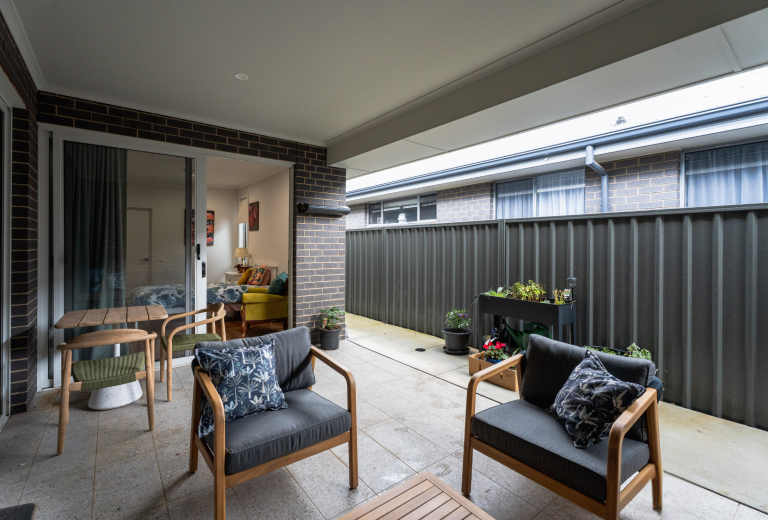
ID: Photo of an alfresco area that has been intentionally designed for a client who has dementia. Featuring sturdy seating areas and easy access to the bedroom.
Good design is about more than creating beautiful spaces. At its best, it helps people feel comfortable, safe and independent in their everyday lives.
When interior designer Steve Angel, from Décor Made Easy, looks at a room, he sees more than furniture, colours and floorplans. He sees opportunity: an opportunity to create a space where someone can continue doing the things they enjoy, feel connected to the people around them and maintain independence in a home that supports their needs.
Recently, Steve worked alongside My Ability Pathway to transform a small north-facing alfresco area into a practical outdoor retreat for a client living with dementia. The client loved gardening and wanted somewhere she could enjoy the sunshine, spend time with family and friends, and continue doing something she was passionate about.
What emerged was much more than an outdoor sitting area. It became a space that supported connection, routine and independence.
For Steve, successful design starts by understanding the individual.
“The client loves gardening, so what we looked to achieve was an extra space for her to have a little bit of autonomy,” Steve explains. “Somewhere where she could sit and have a cup of tea, enjoy the northern sun, have family and friends visit, and create a little bit of space for gardening because that’s what she loves.”
Positioned just outside the client’s bedroom, the outdoor area naturally extends her living space, making it easy to access throughout the day while offering a peaceful place to relax.
“It’s literally off the client’s bedroom… and it’s a great use of the space.” Steve says.
Inclusive design is often about details that many people may not immediately notice, but that can have a significant impact on someone’s confidence, comfort and safety.
For this project, furniture was carefully selected to provide stability and reassurance. Steve chose solid timber seating that would not move unexpectedly when someone sat down, while dining chairs were fitted with rubber stoppers to prevent them from sliding away.
“We wanted fairly generous seating, quite solid, so it’s not something too flimsy if someone isn’t too stable on their feet,” Steve says. “You can sort of flop into it and it won’t slide away.”
Rather than creating a space filled with busy patterns or overwhelming colours, the design remains calm and inviting. As Steve puts it, “It’s just simplistic, with a bit of colour in the cushions. Nothing too demanding or dramatic.”
Through previous work designing dementia-specific environments in aged care spaces, Steve has seen firsthand how thoughtful design can improve quality of life. One of the biggest lessons was understanding that people living with dementia may experience their surroundings differently.
Something as simple as a patterned floor can create confusion. Steve recalls learning that flooring with strong borders or contrasting lines could sometimes be perceived as an obstacle that residents felt they needed to step over.
“People thought patterned floors or border lines were something they had to step over, so we learned we couldn’t have those sorts of designs because they affected people’s confidence to move freely.”
Those observations also revealed creative ways to gently guide movement without using physical barriers. In one aged care setting, a wallpaper border placed at eye level helped guide a resident through a space where she had previously become stuck, preserving her freedom while reducing frustration and confusion.
“We discovered we could use visual cues to encourage people through spaces or away from certain areas without putting up barriers. It worked extremely well.”
Colour and contrast also play an important role, particularly for people experiencing vision changes. Steve learned that artwork, patterns and decorative elements work best when they feature clear edges and strong contrast.
“We learned that artwork needed nice sharp edges and good contrast. Anything blurry or soft could become difficult to interpret, so we were very mindful of choosing crisp patterns and images.”
For Steve, inclusive design is about helping people maintain control over their daily lives and continue doing the things that matter to them.
He recalls working with an older woman who had severe arthritis and struggled to use the chain-operated blinds installed in her room. The blinds may have looked modern, but they were not functional for the person using them.
“She used to have to call staff just to put the blind up or down.”
By replacing them with motorised blinds and an accessible wall-mounted remote, she was able to manage them independently and no longer needed to ask staff for help.
“She became so much more independent because she was in control of that.”
For Steve, this is what inclusive design is all about: thinking first, rather than simply following design trends.
“It’s a little bit more thinking first, and not just saying, ‘Well, that’s the fashion in design.’ Let’s think about whether that’s suitable.”
Inclusive design does not require creating clinical spaces or removing personality from a home. Instead, it means understanding how people experience their environment and making thoughtful choices that support safety, confidence and independence.
Whether it is selecting stable furniture, creating clearer visual cues, improving accessibility or enabling people to continue pursuing the hobbies they love, thoughtful design can have a lasting impact on quality of life.
As Steve’s work shows, the most successful spaces are not necessarily the most stylish or the most expensive. They are the spaces that help people keep doing what matters most.
“If design can help people become independent – whatever that means for them – that’s a fantastic thing.”
