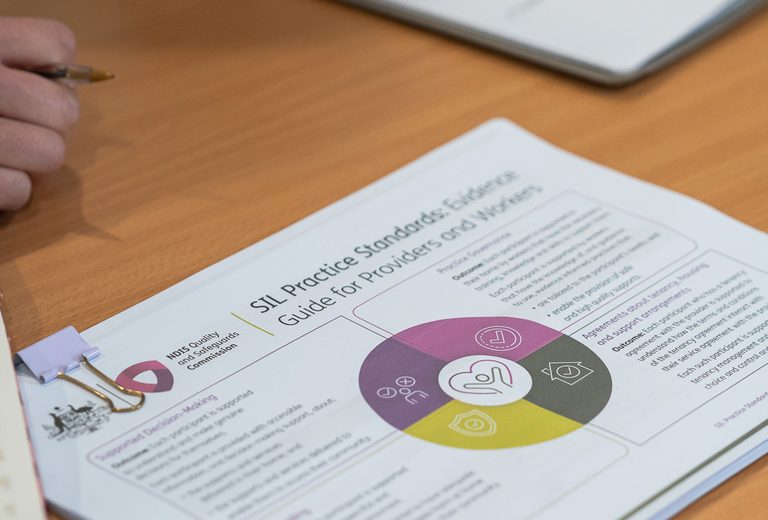
ID: Photo of a print out of the new SIL Practice Standards.
There has been a lot of conversation recently about the newly released Supported Independent Living (SIL) Practice Standards.
Introduced by the NDIS Quality and Safeguards Commission, the standards are designed to uphold the rights, safety and wellbeing of participants who receive SIL supports. People with SIL funding often receive support for most, or all, of the day, including overnight support.
The introduction of these standards also sits alongside new registration requirements for NDIS providers offering SIL supports. The standards came into effect on 1 July 2026, with providers needing to have mandatory NDIS registration in place, or have applied for it, by 1 October 2026.
The SIL Practice Standards
The SIL Practice Standards are made up of four key areas: Supported Decision-making, Safeguarding, Practice Governance, and Agreements about Tenancy, Housing and Support Arrangements. Together, these areas are designed to support:
- consistent service delivery
- quality and safety for participants
- accountability across the sector
While there is a compliance element to the standards, and providers will be audited against them, these areas go deeper than meeting requirements. They are about strengthening quality, consistency and person-centred outcomes for participants.
Each area includes a dedicated intent, individualised quality indicators, and statements around expectations and outcomes. These can be viewed on the NDIS Commission website.
For participants, families and support networks, these benchmarks can also help build a clearer understanding of what quality supports should look like in a SIL setting.
Supported Decision-making: Ensures participants are supported, where needed, to make decisions about their own lives, rather than having decisions made for them.
Safeguarding: Outlines how SIL providers work to keep participants safe from harm, abuse, violence and neglect, while respecting choice, dignity of risk and individual decision-making. It also ensures SIL workers have the skills to identify and respond to signs of harm using a person-centred, trauma-informed approach.
Practice Governance: Sets out how providers are responsible for creating and maintaining safe living environments, supported by practice leadership, clear processes and good governance.
Agreements about Tenancy, Housing and Support Arrangements: Ensures providers have clear agreements in place that distinguish SIL supports from tenancy or housing arrangements. It also outlines how participants are supported to make decisions about who they live with, how support is delivered, and how changes can be made.
The quality indicators for each area map out the key, measurable criteria needed to demonstrate the outcomes of the SIL Practice Standards.
Further Information
The NDIS Commission has shared resources to help participants, families, support people, providers and teams understand the SIL Practice Standards. These can be found here.
At MAP, we will continue to share updates and take a deeper look into each area of the SIL Practice Standards over the coming months, so keep an eye out.