We value your privacy
This website uses technical, functional and analytical cookies that do not infringe on your privacy.
General purpose platform session cookies are usually used to maintain an anonymised user session by the server.

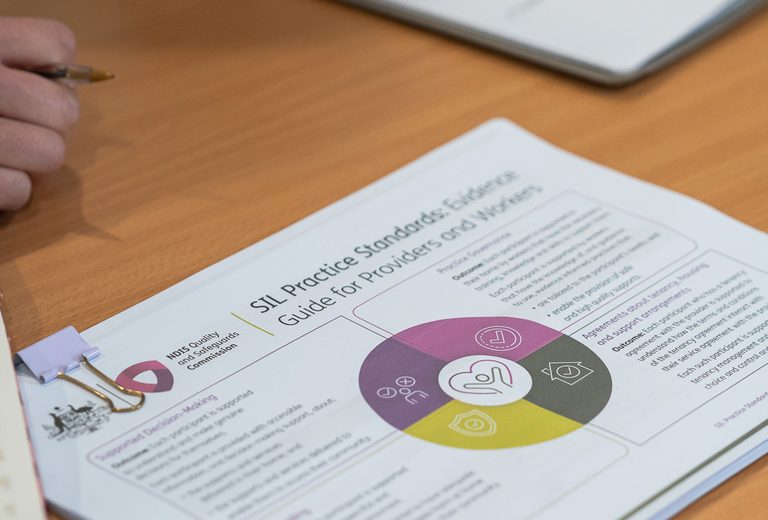
ID: Photo of a print out of the new SIL Practice Standards.
There has been a lot of conversation recently about the newly released Supported Independent Living (SIL) Practice Standards.
Introduced by the NDIS Quality and Safeguards Commission, the standards are designed to uphold the rights, safety and wellbeing of participants who receive SIL supports. People with SIL funding often receive support for most, or all, of the day, including overnight support.
The introduction of these standards also sits alongside new registration requirements for NDIS providers offering SIL supports. The standards came into effect on 1 July 2026, with providers needing to have mandatory NDIS registration in place, or have applied for it, by 1 October 2026.
The SIL Practice Standards are made up of four key areas: Supported Decision-making, Safeguarding, Practice Governance, and Agreements about Tenancy, Housing and Support Arrangements. Together, these areas are designed to support:
While there is a compliance element to the standards, and providers will be audited against them, these areas go deeper than meeting requirements. They are about strengthening quality, consistency and person-centred outcomes for participants.
Each area includes a dedicated intent, individualised quality indicators, and statements around expectations and outcomes. These can be viewed on the NDIS Commission website.
For participants, families and support networks, these benchmarks can also help build a clearer understanding of what quality supports should look like in a SIL setting.
Supported Decision-making: Ensures participants are supported, where needed, to make decisions about their own lives, rather than having decisions made for them.
Safeguarding: Outlines how SIL providers work to keep participants safe from harm, abuse, violence and neglect, while respecting choice, dignity of risk and individual decision-making. It also ensures SIL workers have the skills to identify and respond to signs of harm using a person-centred, trauma-informed approach.
Practice Governance: Sets out how providers are responsible for creating and maintaining safe living environments, supported by practice leadership, clear processes and good governance.
Agreements about Tenancy, Housing and Support Arrangements: Ensures providers have clear agreements in place that distinguish SIL supports from tenancy or housing arrangements. It also outlines how participants are supported to make decisions about who they live with, how support is delivered, and how changes can be made.
The quality indicators for each area map out the key, measurable criteria needed to demonstrate the outcomes of the SIL Practice Standards.
The NDIS Commission has shared resources to help participants, families, support people, providers and teams understand the SIL Practice Standards. These can be found here.
At MAP, we will continue to share updates and take a deeper look into each area of the SIL Practice Standards over the coming months, so keep an eye out.
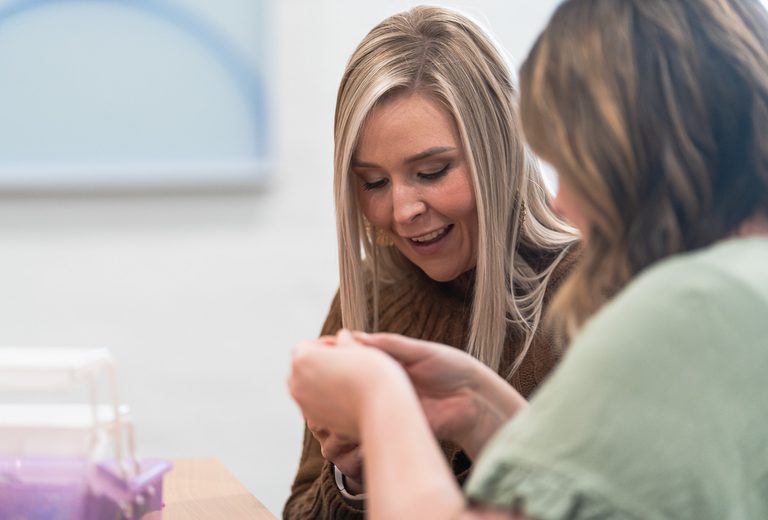
ID: Photo of two women making bracelets.
When Bianca joined My Ability Pathway as our new HR & Payroll Administrator, she stepped into more than a new workplace. She stepped into a new industry, a new role, and a team she says made her feel welcome from the very beginning.
“I’m brand new in the disability sector,” Bianca shared. “I have never worked in the disability sector…. I’m brand new to the role.”
But while there has been plenty to learn, Bianca says one thing stood out quickly: the support around her.
“Everyone is so supportive. It’s very inclusive,” she said. “From day one I’ve been part of the team, whether I’ve been part of the industry or not. I’ve felt very welcome.”
Outside of work, Bianca finds meaning and release through watercolour painting. What began around two years ago during a deeply difficult time has become an important part of how she expresses herself and makes sense of her experiences.
“I started about two years ago just after the passing of my dad,” Bianca explained. “I didn’t have the opportunity to go back home or to see him, or visit him in hospital. So I struggled with the grief process and I feel like art has given me the opportunity to deal with that grief.”
For Bianca, painting is not about perfection. It is about having somewhere safe to put feelings that can be hard to say out loud. It is a healthy coping mechanism, a creative outlet, and a reminder that expression can take many forms.
“It’s been really freeing in a sense,” she said. “I feel like that’s what art means for a lot of people. They use it as a coping mechanism, as a healthy coping mechanism.”
This year, Bianca took another brave step by submitting one of her artworks to the SALA Festival’s BE SEEN exhibition, presented by Barossa Village. The exhibition celebrates “bold journeys, fearless creativity, and the vibrancy of those souls often overlooked,” with the full collection on display at Barossa Village Lodge in Nuriootpa from 3–31 August.
Creative arts can offer people a way to communicate what words cannot always hold. Whether through painting, drawing, music, writing, movement or craft, creativity can help people explore emotion, identity, connection and healing in a way that feels personal and empowering.
For some, art is a quiet space to reflect. For others, it becomes a way to share a story, celebrate culture, process grief, or feel connected to community. Exhibitions like BE SEEN are important because they create space for those stories to be recognised, valued and celebrated.
Bianca’s artwork carries part of her own story, including why she began painting and why she believes art matters.
“I think it’s a really great tool for people to utilise when they need a way to express their feelings, to deal with their grief,” she said. “For me it was very hard, I didn’t have any family here to talk to and that was a way of expressing what I felt.”
We are proud to celebrate Bianca not only as part of the MAP team, but as someone willing to share her creativity and personal journey with the wider community. Her story is a beautiful reminder that creativity can help us process life’s hardest moments, connect with others, and be seen. You can visit the BE SEEN full collection at Barossa Village Lodge, 14 Scholz Avenue, Nuriootpa, from 3–31 August, Monday to Friday, 8:30am–4:30pm.
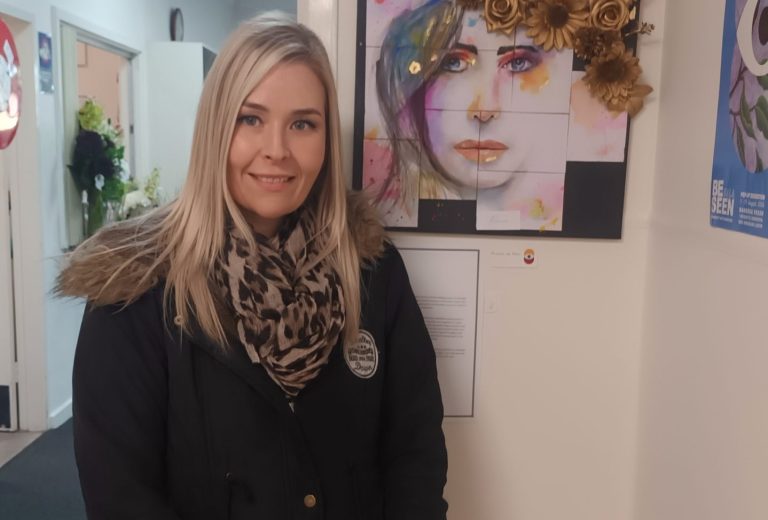
Bianca at the Barossa Village SALA Exhibition Opening on Monday 3 August 2026.

ID: low angle photo of pink and orange balloons with sad and happy faces.
It can be hard to understand something we cannot see. Psychosocial disability is often hidden beneath the surface, which means its impacts can be overlooked, minimised or misunderstood. For people living with mental health conditions that affect daily life, relationships, work or study, that lack of understanding can lead to stigma, discrimination and sometimes, a painful absence of compassion.
Mental health conditions are, as the name indicates, health conditions. In Australia, they are treated by the healthcare system and supported by Medicare. Psychosocial disability exists when a person living with a mental health condition experiences functional difficulties or barriers directly related to the impacts of that condition.
Those impacts can show up in daily activities, social interactions, work, study and other parts of life. They don’t look the same for everyone. Some people may be able to work or study with support or clear boundaries, while others may go through periods where daily tasks, social connection or employment become very difficult – or even impossible – to manage, at least for a time.
One of the reasons psychosocial disability is so often misunderstood is that mental health conditions are not always visible. The disability impacts can be overlooked or misread. Someone might be labelled as lazy, difficult, messy, withdrawn or unwilling, when what’s really happening is that they are facing functional barriers connected to their mental health condition.
Comments like “be happy” or “run it off” don’t recognise how serious mental health conditions can be, or the very real disability impacts that can come with them. Those kinds of attitudes can add to stigma and make it harder for people to feel understood or supported.
The numbers show just how many people may be missing out on support. Figures from 2022–23 estimate that, across Australia, 230,500 people with severe psychosocial disability and 263,100 people with moderate psychosocial disability were not accessing either NDIS or mainstream support. That works out to more than 68% of people with severe psychosocial disability and more than 84% of people with moderate psychosocial disability not receiving support.
Those are significant numbers, especially when we think about the broader mental health picture. In any given year, an estimated one in five people will experience a mental illness. Not everyone who experiences mental health concerns will also experience psychosocial disability, but it does remind us that these conditions are common and widespread.
For some people, the cause of their psychosocial disability may be very treatable, and recovery from the functional impacts may be possible. For many others, mental health conditions can be chronic or episodic. This means they may flare up and then ease again with time or treatment. Relapses can happen, and treatments may need to be reviewed or adjusted along the way.
Recovery looks different for every person and every condition. It can depend on many things, including what recovery means to the person themselves. For some people, psychosocial disability may continue despite treatment. The NDIS calls this “permanence”. For others, treatment may resolve the functional impairments they experience because of their mental health condition.
Building skills to manage or overcome barriers can make a real difference, but it doesn’t always mean the underlying mental health condition has been “cured”. Many conditions are treatable but not curable, and depending on the person’s circumstances and goals, both mental health treatment and disability support may be needed.
Living with psychosocial disability can be incredibly difficult. It can affect things like housework, isolation, work, relationships, daily tasks, or even understanding what is happening. For some people, recovery is hard because they may not respond to traditional treatments, may be medication resistant, or may not be able to access treatment and therapies.
The good news is that support is available for both mental health conditions and the disability impacts that can come with them. In South Australia, Medicare may provide assistance, and the NDIS remains an option for people living with permanent psychosocial disability. Support phone lines, online chat options and walk-in support clinics are also available.
Progress in mental health is not always easy to see, and it is not always a straight line. Setbacks do not mean progress is not happening. When we understand psychosocial disability with compassion, accuracy and respect, we take an important step toward reducing stigma and helping people access the support they need.
Photo by Madison Oren on Unsplash
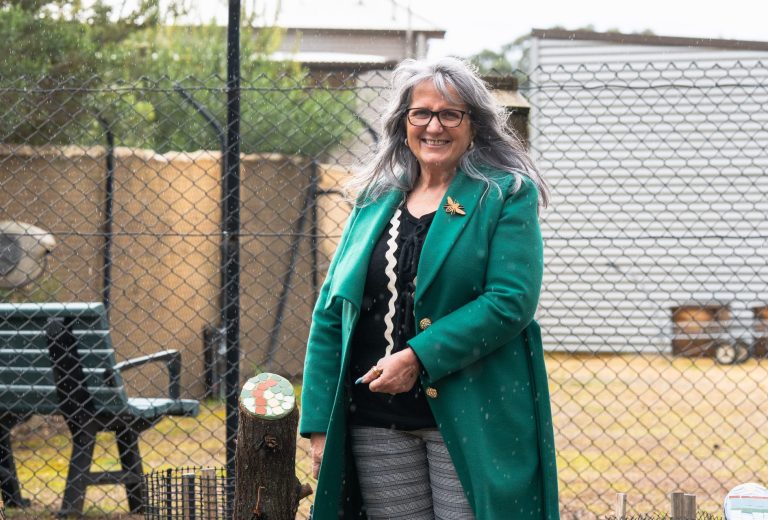
ID: Reta standing next to her mosaic which is part of the Reconciliation Mosaic Project at Barossa Bushgardens.
Sometimes, the people who have the greatest impact are the ones who never set out looking for recognition.
For those who know Reta, it will come as no surprise that after decades spent supporting others, advocating for the disadvantaged and championing equality, she still speaks about her work with the same passion and conviction that first drew her into the sector.
In fact, she was preparing to retire.
“I was 60 years old and I was going to retire,” she laughs.
Instead, an opportunity arose at My Ability Pathway. Although administration was completely new territory, Barbara and Charlotte recognised the incredible depth of knowledge and experience Reta could bring to the organisation. Today, she continues to support the team, mentor colleagues and share her wisdom whenever needed.
“I feel very privileged that they value my opinion when it comes to community,” she says.
And what an opinion it is.
Reta’s journey began with a childhood dream of becoming a nurse. After moving to the Barossa in her late twenties, she met Sophie, then Director of Nursing at Barossa Village, who offered her a shift that would change the course of her life.
“The rest is history,” she says.
Following a decade in aged care and some significant personal experiences, Reta discovered a calling that would shape the rest of her career.
“I came to the realisation that there were people who didn’t have a voice and weren’t being heard,” she explains.
“That’s what led me to become an advocate.”
Over the years, Reta has worked across disability, homelessness, domestic violence and child protection, but she always finds herself returning to disability support.
For Reta, advocacy has never been about speaking for people. It has been about ensuring people are heard and supported to live the lives they choose.
“I come from the belief that everybody is equal and that we all have the right, given the opportunity, to live our life to our full potential and be treated with dignity, irrespective of where we come from and who we are.”
It is a philosophy that has guided her both personally and professionally.
Anyone who has worked alongside Reta knows that her knowledge is immense, but what stands out even more is her unwavering passion for people.
She describes herself as “quite assertive” when advocating for others, although those around her would simply call it dedication.
At MAP, we are incredibly fortunate to have someone with Reta’s lived experience, compassion and wisdom. Her ability to mentor others, provide perspective and remind us of the importance of community is invaluable.
Quite simply, Reta is one of those people who makes everyone around her better.
During National Reconciliation Week, we are reminded that reconciliation is about relationships, respect and opportunities.
At My Ability Pathway, these values underpin everything we do. We recognise that reconciliation is not a destination but an ongoing journey – one that requires listening, learning and walking together.
This year, we were excited to see Reta contribute to the Reconciliation Mosaic Project at the Barossa Bushgardens. Bringing together children from Nuriootpa Kindergarten, an OSHC group and members of the community, the project was guided by an Indigenous artist and explored our connections to land and to one another.
Reta’s piece featured two intertwining trees.
“It’s about standing together against any problems in the past and standing together moving forward and supporting each other, irrespective of where we come from or who we are,” she says.
It’s a beautiful reflection of the values she has embodied throughout her entire life.
And perhaps that’s what makes Reta so special.
Not just her decades of experience, her advocacy, or her wealth of knowledge – but her enduring belief that everyone deserves dignity, respect and the opportunity to thrive.
At My Ability Pathway, we are grateful every day that she chose not to retire.
Because our team, and our community, are stronger because of it.
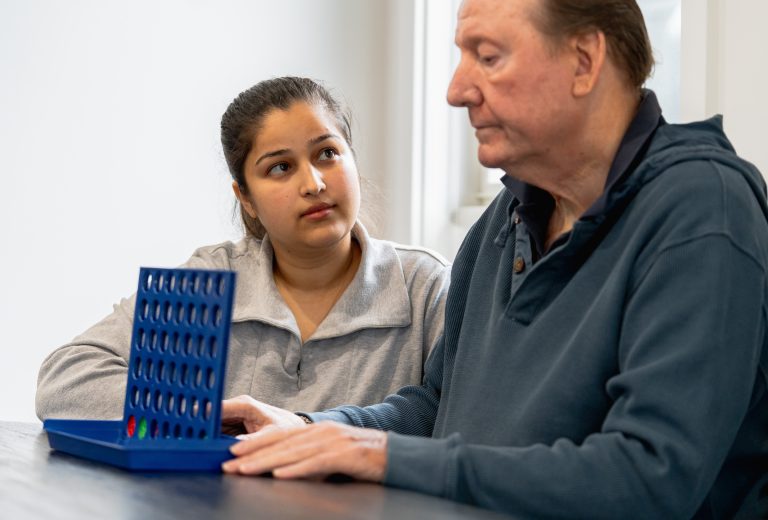
ID: A women carer sitting at a table with a man playing connect four.
At My Ability Pathway, every team member brings a unique story, shaped by experiences that fuel their passion for supporting others. For Smriti, her journey into the disability sector is rooted deeply in compassion, family, and a desire to make a meaningful difference.
Before joining MAP, Smriti worked in the aged care sector, where she developed a strong commitment to supporting vulnerable communities. Her connection to care, however, began much earlier.
“I used to live with my grandparents because my Mum & Dad were both abroad, so that has pushed me to this point,” she shares.
That early experience instilled a natural sense of empathy and responsibility – qualities that continue to shape the way she supports participants today. Transitioning into her role at MAP felt like a natural step, allowing her to expand her impact while continuing to grow personally and professionally.
“Especially joining MAP, it has helped me with personal growth… it’s been really empowering.”
For Smriti, one of the most rewarding aspects of working in the disability sector is the constant sense of variety and progress. No two days are the same – and that’s exactly what keeps her motivated.
“Every day is different, that’s for sure,” she says.
But it’s the small, meaningful milestones that leave the biggest impression. Watching participants build confidence and independence over time is what makes the work truly fulfilling.
“I like seeing how the clients are more confident in what they are doing… it’s nice to see them build their confidence over time.”
Smriti describes her role not as being at the forefront, but as standing just behind participants – supporting, encouraging, and celebrating their achievements.
“It’s nice to just be in the background and look at them reach those goals.”
Working in the disability sector isn’t just about supporting others – it’s also a journey of self-growth. Smriti believes the impact goes both ways, leaving lasting changes not only in the lives of participants but also in those who support them.
“If you want something that’s really, really rewarding and fulfilling and you want to make changes in lives, including your own, then I’d say that the disability sector is that.”
Smriti’s story reflects what so many MAP team members experience – purpose-driven work that empowers both participants and support workers alike. Through compassion, consistency, and connection, meaningful change becomes possible every day.
Her journey is a powerful reminder that growth doesn’t always happen in big, dramatic moments. Often, it’s found in the quiet progress, the steady confidence-building, and the shared wins along the way.

ID: Photo of people in a work meeting
Growing up, I knew I was flexible.
I could do the cool party trick of clasping my hands together and somehow getting my arms all the way around my body without letting go. I could do the splits without practice. I could place my hands flat on the floor without bending my knees. My fingers are all double-jointed, which made for some pretty freaky-looking hand tricks.
At first, it felt fun. Different. Almost like a talent.
What I didn’t realise at the time was that my body was quietly trying to tell me something.
May is globally recognised as Ehlers-Danlos Syndrome and Hypermobility Spectrum Disorder awareness month – a time to shine a light on conditions that are often invisible, misunderstood, and difficult to diagnose.
For me, the signs were there long before I had a name for any of it.
In high school, I started getting migraines. In Year 12, I developed a shin splint. I was constantly finding bruises in random places with no memory of how they got there. Joints would dislocate easily – and by easily, I mean sometimes I’d simply sit down and my knee would pop out of place. Rolled ankles were practically guaranteed during PE.
And then there was the fatigue.
Not “I stayed up too late” tired. A deep, relentless exhaustion that followed me everywhere.
If I was sitting still for too long, staying awake became a battle. Uni lectures were especially difficult. I lost count of how many times I fell asleep in my seat – not because I wasn’t interested, and not because I hadn’t slept, but because my body simply shut down when stationary for too long. Snacks during lectures became a survival strategy. The hour-plus drive home afterwards was awful. I used to keep my mum on speed dial because talking to someone was often the only thing that helped me stay awake.
There were other symptoms I couldn’t explain, too – like air hunger, that unsettling feeling of not being able to take a full breath no matter how deeply you inhale. For many people with HSD, connective tissue differences can affect the way the ribcage expands and moves, making something as automatic as breathing suddenly feel like work.
The strange thing is, for years I thought this was normal.
I thought everyone’s joints hurt. I thought everyone felt exhausted all the time. I thought everyone bruised easily, rolled their ankles constantly, or felt breathless for no obvious reason.
Then I was rear-ended at a traffic light and experienced whiplash.
What followed were months of appointments with different healthcare professionals. Physiotherapists. Chiropractors. Osteopaths. I’d get temporary relief, but nothing lasted. One chiropractor would realign my spine only for it to shift again almost immediately.
Eventually, I was diagnosed with HSD.
The diagnosis itself was strangely anticlimactic. I was handed an A4 piece of paper with a little bit of information and sent on my way. No real explanation. No roadmap. No support network. Just a label for something I barely understood.
But at the same time, it finally made sense.
The joint pain. The instability. The bruising. The fatigue.
Unfortunately, my experience of waiting years for answers isn’t unusual.
Recent global research involving almost 4,000 people found that, despite affecting as many as one in 500 people, those living with HSD wait an average of 17 years from symptom onset to diagnosis, while people with hypermobile EDS wait even longer – 22 years on average. Most reported experiencing symptoms in childhood or adolescence but were often misdiagnosed or dismissed before finally receiving answers.
That statistic stopped me in my tracks when I first read it, because it reflects what so many of us already know: the symptoms are real, but recognition often comes far too late.
Later in life, I spent years seeing specialists trying to work out ongoing gut issues, only to eventually learn that this too can be connected to HSD.
That’s one of the hardest parts about invisible disabilities and conditions like HSD and EDS – symptoms don’t fit neatly into one box. They affect multiple systems throughout the body, not just joints. Research now confirms what many people with lived experience have known all along: HSD is far more than simply being “double-jointed.”
Most of what I’ve learned since my diagnosis hasn’t come from the healthcare system. It’s come from lived experience, online communities, and social media – from other people with HSD and EDS sharing what has helped them navigate daily life.
And along the way, I’ve also learned how frustrating misconceptions can be.
“Just exercise more.”
“Just stretch.”
These comments are usually well-intentioned, but they completely miss the reality of living with hypermobility.
If you’re hypermobile, exercising the wrong muscles or moving in the wrong way can cause more injuries. I was constantly pulling or pinching muscles because my body was compensating in ways it shouldn’t have to.
And stretching? My muscles are already overworked. They’re tight for a reason. They’re trying to hold my body together.
I used to explain hypermobility to people by saying, “My muscles do the job my ligaments are supposed to do.”
Even though I know it’s a lot more complicated than that, it’s still the simplest way I know how to describe it.
The reality of invisible disability is that people often only see what’s on the surface.
I “look fine”.
But what people don’t see are the joints slipping out of place, the constant fatigue, the pain, the muscle tension, the migraines, the air hunger, the digestive issues, or the way everyday tasks can take more energy than they should.
That’s why awareness matters.
Not for sympathy, but for understanding.
Because there are so many people living with conditions like HSD and EDS who are still searching for answers, still trying to explain symptoms nobody else can see, or still questioning whether what they experience is “normal”.
Invisible disabilities need the same recognition, compassion, and support as visible ones.
You really can’t judge a body by the way it looks.

ID: Two men walking towards the camera. The man on the left has Down Syndrome.
For Dave, working in the disability sector was never just about finding a job – it was about finding something that meant more.
Like many, his journey started with study. While completing a Certificate III in Individual Support (Ageing and Disability) through TAFE, Dave was introduced to My Ability Pathway (MAP) during a presentation. What stood out wasn’t just the information – it was the feeling he got about the organisation itself.
“I thought they seemed very, very professional,” Dave says. “So I thought, I’ll give them a buzz and see if there is the possibility of a job.”
That one decision turned into the beginning of a career.
Dave joined MAP as a Support Worker while still studying – an opportunity that gave him immediate, real-world experience in a role built around people, not just tasks.
What drew him in initially still holds true today.
“Their professionalism and their 1:1 care really appealed,” he says. “And they had friendly staff.”
It’s a simple observation, but one that reflects something deeper about the work – the importance of genuine connection and consistency in support.
Because at its core, this industry isn’t about ticking boxes. It’s about showing up for someone else.
Within just six months, Dave transitioned into a Key Worker position – a natural progression that reflects both his commitment and the opportunities available within the sector.
His role has since expanded beyond direct support into leadership and coordination.
“I’ve had a little bit more hands on with administration… helping teach other workers and running the house day to day,” he explains. “A lot of paperwork – it’s a good challenge.”
It’s a shift that highlights something often overlooked: growth in this sector doesn’t mean stepping away from people – it means finding new ways to support them, while also supporting your team.
Ask Dave what he enjoys most about his role, and his answer is immediate.
“Probably a bit of the teaching and making a difference to other people’s lives.”
There’s a quiet honesty in that response. It speaks to the heart of disability support – that the reward isn’t about recognition, but about impact.
It’s about what you can give.
And that perspective shapes how Dave sees the work as a whole.
“Any of us could be in that position at any time,” he says. “It’s nice to know that there are caring people out there.”
For anyone considering a career in the sector, Dave’s advice is simple:
“Definitely jump at it – because it’s very rewarding. Not just for yourself, but for the clients as well.”
It’s a reminder that this kind of work asks something of you – your time, your patience, your empathy – but it also gives something back that’s hard to find elsewhere.
A sense of purpose.
A chance to grow.
And the opportunity to make a real difference in someone’s everyday life.
Because in the end, it’s not about the job title.
It’s about the impact you leave behind.
If you have experience as a Support Worker in aged care or disability and are looking for the stability of a rostered line of 38+ hours per week, we’d love to hear from you. Explore current opportunities and apply via My Ability Pathway Careers.

ID: A photo of a women and a man smiling.
Across three very different journeys, a common thread emerges: sometimes the most meaningful careers begin in unexpected places. For three of the MAP team, the path into disability support didn’t start in healthcare or community services—it started in the fast-paced, high-pressure world of commercial kitchens.
As chefs, Subi, Lana and Chris mastered long hours, intense environments, and the art of staying calm when everything around them demanded urgency. Over time, each of them was pulled toward something more sustainable, more balanced, and ultimately, more purposeful.
Drawn to disability support by a deep motivation to connect, to care, and to make a tangible difference in people’s lives, the diversity of career experience amongst MAP’s team showcases how transferable skills like resilience, organisation, and empathy opens doors to an entirely new career.
As chefs, Subi, Lana and Chris were accustomed to long hours, and busy weeks. “I used to be working sixteen-hour shifts,” Subi says. “It was very intense.”
Transitioning into disability support offered not just a change of role, but a shift in lifestyle. “I used to be a chef for seven years,” Chris reflects. “But then three years ago I got married … and I couldn’t balance my work/life.” Being able to prioritise time with family, the transition to the disability industry offered increased flexibility and structure. This has led to a renewed sense of balance and wellbeing, Importantly, this balance didn’t come at the cost of fulfilment—quite the opposite.
“I decided to pursue opportunities that would provide a better work-life balance,” Lana says. “And I find the work highly rewarding. Seeing the smiles on the clients’ faces brings me daily joy and a real sense of fulfillment in my work.
Subi agrees. “To see people smiling, a smile on their face is all we want. That’s the most satisfying thing in this role.”
“Being a chef was a very demanding job,” Subi remembers. “Disability is not an easy industry either. But it’s a very fulfilling job. You can make a difference in people’s lives.”
Despite leaving the kitchen behind, none of our team started from scratch. In fact, their hospitality experience became a strong foundation for success in support work. Working under pressure is a critical strength, as Chris highlights: “It’s pretty demanding working in the kitchen. I moved to a pub in Melbourne; in the first weekend we did 4000 meals. But I was calm and focused. That’s one thing that I bring into this sphere. Then I started as a support worker. For the first time, I was greeted when I walked into a job. By the client. That felt different for me. It’s very rewarding.”
“I can handle pressure and be calm,” Subi agrees. “I’m very good at dealing with people.”
Organisational skills and time management are other key things our team attribute to their time in the kitchen. As Lana shares, “My strong organisational and time management abilities enable me to stay on task and ensure that all responsibilities are completed efficiently for my clients.”
For Subi, Lana and Chris, the move into disability support work initially seemed like natural stopping point. However, all three describe their experiences with MAP opening doors to leadership opportunities and career progression—an often overlooked avenue in support work.
“I never thought of being in a leadership role of being a Key Worker,” Chris says. “I took it because working with different clients changed my mind. I’m almost a year into the leadership role and now I believe that I’m the perfect fit.”
“I did not initially see myself progressing into more senior roles,” Lana agrees. “However, my commitment to my clients grew and I developed a strong desire to do more. As a result, stepping into a higher-level role became a natural progression in my career.”
Subi shared a similar experience, and adds, “If you have the right team around you, it gives you confidence, it helps you to see the things that you have not discovered by yourself.”
The strongest theme shared is the emotional impact of support work. These moments capture what makes disability support unique—the ability to see, feel, and be part of meaningful change in someone’s life.
While deeply fulfilling, all three acknowledged that the work comes with challenges and requires the right mindset. “If you’ve got … a good attitude and you feel empathy and you want to do something rewarding, I would definitely recommend disability support work,” Chris says.
“Stepping into disability support work is both a meaningful and rewarding journey,” Lana agrees, while Subi says, “If you do the right thing, it can make an impact on people. There was a client with us, we had a very hard beginning with him. The whole team could see the difference in his life, the positive impact our support had on him. That hit me hard.”
Chris, too, shares a highlight moment in his journey so far. “I have my client who doesn’t speak at all, speak for about two minutes. Twice! I just laughed and cried, I was so over the moon, it was very rewarding.”
For Lana, this experience comes often. “Since joining MAP, I have experienced this feeling many times. The growth I have seen in our clients—their increased confidence and capacity building—is truly remarkable.”
From the intensity of the kitchen to the impact of disability support, Subi, Lana and Chris’s stories celebrate change and finding meaningful work that supports not just their clients, but also themselves. They’re united by where they came from, as well as where they’ve arrived: roles grounded in empathy, purpose, and connection.
For anyone considering a similar move, their experiences offer a simple but powerful message—your skills are more transferable than you think, and the right opportunity can lead to professional growth and a deeper sense of fulfilment in both work and life.
If you have experience as a Support Worker in aged care or disability and are looking for the stability of a rostered line of 38+ hours per week, we’d love to hear from you. Explore current opportunities and apply via My Ability Pathway Careers.
Barbara Lightburn

ID: A woman playing Yahtzee
Many people see turnover in the disability sector as a problem that organisations should always try to fix. However, the reality is more complex. In our industry, the work is demanding. Supporting people with disability requires emotional resilience, strong teamwork, and a commitment to consistently high standards. It is meaningful work, but it is not easy work. Because of this, not every person who enters the sector will find the right fit in every organisation. And that’s OK.
At MAP, we recognise something important about culture: alignment matters more than retention at any cost. Sometimes, the best outcome for both the organisation and the person is realising that the environment is not the right fit. Leaving when values do not match is not a failure. It is clarity.
Too often, turnover is treated purely as a recruitment problem. Organisations focus on hiring faster, filling rosters, or increasing retention at any cost. But a leadership lens asks a different question: what is turnover telling us about the organisation itself?
Sometimes turnover signals problems in systems, leadership, or support. But at other times, it simply reflects a natural process of cultural alignment. When organisations are clear about their expectations and values, people are better able to decide whether that environment is the right fit for them. In this sense, turnover can be a sign that culture is becoming clearer, not weaker.
The disability sector experiences higher workforce turnover than many other industries. Research on the NDIS workforce suggests annual turnover rates of around 17–25%, compared with an average of about 12% across all sectors.
There are several reasons for this. The work can be emotionally demanding. Team members support people through complex situations and must respond with professionalism, patience and consistency. At the same time, participant needs, schedules and circumstances can change quickly.
Many people join the sector because they want to help others, which is a powerful motivation. However, delivering high-quality services also requires strong teamwork, accountability and the ability to work within clear systems.
When expectations are unclear, people can feel frustrated or disconnected from their roles. Clear expectations help people understand how to succeed.
This is why culture matters.
Many organisations describe their culture with words like compassion, respect, or teamwork. But real culture is not just about posters or slogans. Culture is defined by how decisions are made, how people behave and what standards are reinforced every day.
At MAP, we use the MAP Way of Working, or WoW, to make our culture clear and visible. The WoW gives us a shared way of working together. It guides decisions, sets clear expectations for behaviour, and helps leaders keep standards consistent across the organisation.
A key idea behind the MAP Way of Working is simple:
Quality you can feel starts with standards you can see.
People should not have to guess what good looks like. Expectations should be clear, practical and consistently applied.
We also believe that quality does not happen by accident. Great services are engineered. Participants and families should not have to hope for a good shift or a great support worker. The system should create that consistency.
As we often say at MAP:
People shouldn’t have to hope they get a good shift — the system keeps the promise.
This approach moves responsibility from chance to careful planning. When systems are strong and expectations are clear, both team members and participants benefit.
Strong teams work best when everyone knows what is expected of them.
At MAP, we focus on behaviours like:
One leadership principle we teach is “no surprises.”
When issues come up, we encourage people to speak up early so they can be fixed quickly. Small problems are easier to solve than big ones. This mindset is captured in another MAP leadership phrase:
Early flag. Fast fix.
Raise concerns early, while they are still small and easy to manage. Then act quickly to solve them. This approach helps prevent last-minute crises and builds a culture where people feel responsible for solving problems instead of avoiding them.
In healthy teams, accountability is not about punishment. It is about showing respect. When people hold each other accountable, they recognise that their actions affect the team, the organisation, and the people we support.
Peer-to-peer accountability is often the most powerful form of accountability. Team members help each other stay on track because they care about shared standards and outcomes. Holding someone accountable means you care enough about them and the team to have an honest conversation.
We strongly believe that everyone has hidden potential. The role of leadership is to create the environment where that potential can emerge. Empowering people does not mean lowering expectations. In fact, it means the opposite.
People grow when they have high expectations and clear support. When team members know what is expected and feel that leaders believe in them, they are more likely to step up, take ownership, and contribute fully to the team.
Even with clear systems and strong leadership, not everyone will feel that the organisation’s culture is right for them. Some people prefer workplaces with less structure or accountability. Others may find that disability support work is different from what they first thought. When this happens, it is important to be honest.
Organisations should not lower their standards just to reduce turnover. Doing this can weaken the culture and affect the quality of services for participants. Instead, organisations should be clear about their expectations and let people decide if the environment is right for them. Sometimes this leads to growth and development.
Other times, it means someone chooses a different path. Both outcomes can be positive.
When people leave because the culture is not the right fit, it can actually make the remaining team stronger. Teams work best when everyone shares the same commitment to standards, accountability, and working together.
When those expectations are clear, people who align with the culture tend to thrive. They feel a sense of purpose and ownership in the work they do. Those who do not fit often find workplaces that suit their preferences and style better. In this way, turnover is not always a failure. Sometimes, it is just part of building the right team.
At MAP, we work to build a culture where expectations are clear, systems support quality, and people feel empowered to do their best.
Our goal is simple:
MAP is known for one thing: quality you can feel, because we built our system to deliver it.
When culture is clear and standards are visible, everyone benefits.
Participants get better support.
Teams work together more effectively.
And people can decide if the organisation’s way of working is right for them.

ID: A smiling woman with dark hair wearing a green top.
Career changes can often feel daunting, especially when moving into a completely different industry. But as Skye has discovered since joining My Ability Pathway (MAP) as Workforce Planner, the skills you develop throughout your career can be more transferable than you might think.
As MAP’s Workforce Planner, Skye plays a key role in ensuring the organisation’s services run smoothly.
“As MAP’s Workforce Planner, I coordinate client support schedules and support operational planning,” Skye explains. “My role focuses on streamlining processes, analysing data, and providing behind-the-scenes support so teams can deliver consistent, high-quality outcomes for our clients.”
While much of the work happens behind the scenes, it plays an important part in ensuring teams have the structure and support they need to deliver the best possible outcomes.
Before joining MAP, Skye spent more than 25 years working in the franchising industry in roles spanning legal and compliance, finance, debt recovery and administration. Those experiences provided a strong foundation in organisation, planning and operational systems.
Today, she’s applying those skills in a new environment.
“My goal at MAP is to continue strengthening workforce planning and operational systems while supporting the team to work efficiently and confidently,” she says. “I’m rapidly learning about the disability sector while contributing to MAP’s ongoing growth and improvement.”
Skye’s journey to MAP began in an unexpected way.
“In late 2025, MAP identified a need for stronger workforce planning and operational support,” she explains. “Through a school-pick up conversation with Charlotte, I was introduced to the opportunity – it quickly became clear the role aligned well with my skills and experience.”
Not long after, Skye stepped into the newly created Workforce Planner role and began applying her experience to a sector focused on supporting people and communities.
Transitioning into disability services brought some new perspectives and learning opportunities.
“The biggest adjustment has been shifting from a process-driven environment to one where participant outcomes come first,” Skye says.
“While systems and structure remain important, flexibility is essential in disability services. Learning to balance efficiency with care-focused decision-making has been a rewarding challenge.”
For anyone considering a career change into the disability sector, Skye believes transferable skills are incredibly valuable.
“Don’t underestimate the value of your transferable skills!” she says. “Skills like organisation, planning, communication, and problem-solving are highly relevant.”
She also encourages people to approach the change with curiosity and patience.
“Be open to learning, ask questions (I’ve asked plenty!) and give yourself time to adjust. MAP is very supportive and encourages people to grow into their roles.”
These skills don’t just help individuals transition into new roles – they also strengthen organisations.
“Transferable skills bring fresh perspectives and practical solutions,” Skye explains. “They help improve processes, support teams, and ensure services run smoothly.”
“At MAP, these skills directly contribute to better coordination, stronger operations, and improved outcomes for our clients.”
Like any role, workforce planning comes with both rewarding moments and challenges.
“A highlight is seeing schedules, systems, and processes working well and knowing the team feels supported,” Skye says.
At the same time, the role requires strong organisation and adaptability.
“A challenge is managing multiple moving parts across the organisation – but staying organised, adaptable, and calm helps.”
What makes a difference, she says, is the supportive culture at MAP.
“The collaborative culture at MAP makes a big difference.”
For Skye, one of the most important things people should know about working at MAP is that diverse experiences are valued.
“MAP values diverse experience and supports people to succeed, regardless of their background,” she says.
“Even if you come from a different industry, your skills can make a real and meaningful impact here – for both the team and the people we support.”
