We value your privacy
This website uses technical, functional and analytical cookies that do not infringe on your privacy.
General purpose platform session cookies are usually used to maintain an anonymised user session by the server.


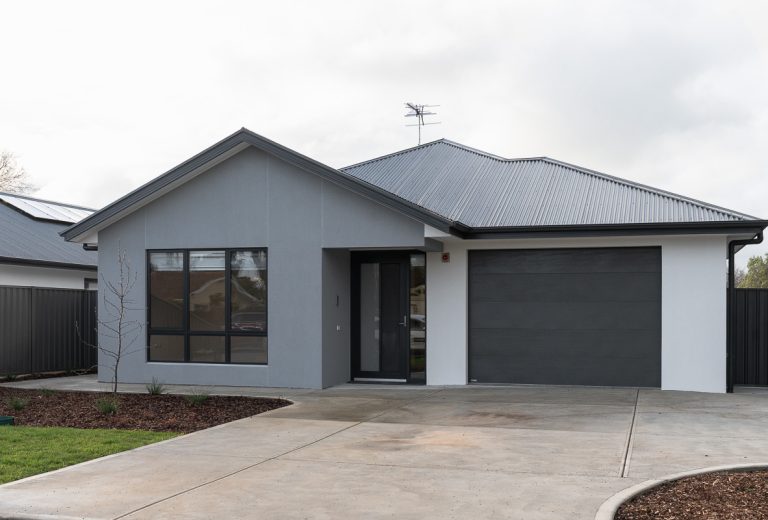
ID: Photo of the front of a new Specialist Disability Accommodation house in Nuriootpa.
Looking for Specialist Disability Accommodation in Nuriootpa? Finding a suitable home involves more than checking whether a room is available. It means considering how the space works for you, what support you need and whether the location helps you stay connected to the people and places that matter. My Ability Pathway’s current vacancies page lists High Physical Support SDA in Nuriootpa, with housing provided by New Dawn Housing and Supported Independent Living supports delivered by MAP. If you are exploring your next move, here is a starting point for learning about the home and asking the questions that matter to you. Availability can change, so please contact MAP to confirm current vacancies and suitability.
Watch the Nuriootpa SDA video below as a starting point for exploring the home. As you watch, note what you would like to ask about or see during a visit. A video can help you prepare questions, but it cannot confirm whether a home will meet your individual accessibility, equipment or support needs.
MAP’s Nuriootpa vacancy listing describes a purpose-built High Physical Support home with modern accessible design, spacious shared living areas and a private bedroom with an ensuite. It also identifies proximity to local services and community facilities. These features are worth considering in relation to your own routines. How would you move between your bedroom, bathroom and shared spaces? Where would you spend time with visitors? What would help you take part in household activities in the way you prefer? The NDIS describes High Physical Support housing as including a high level of physical access for people who need very high levels of support. That category does not tell you every detail of an individual property. Ask which equipment and technologies are installed, which are provisions for future installation and what would need to be arranged for you.
New Dawn Housing is identified as the housing provider, while MAP provides the Supported Independent Living services. MAP’s listing describes 24/7 SIL support at the Nuriootpa home. Your individual assistance, overnight arrangements and any shared supports still need to be discussed; 24/7 support does not automatically mean continuous one-to-one assistance. SDA relates to the specialist home, while SIL relates to assistance or supervision with daily tasks. They are separate supports, and SDA funding does not include personal care or SIL. For an introduction, read MAP’s guide to SDA and SIL. Ask for clear information about the housing agreement, support agreement, charges and who to contact about each aspect.
For someone who wants to live in the Barossa, location may be an important part of the decision. Consider the people you want nearby, the appointments you attend and the places you enjoy visiting. Rather than relying on the phrase “close to services”, ask about the actual journey: transport, accessible routes, travel time and any assistance required. Your home should be considered alongside your wider life. Shared living also deserves discussion. Ask about the proposed household, privacy, visitors and how different routines can work together, while respecting other residents’ confidentiality.
SDA is for eligible NDIS participants with extreme functional impairment or very high support needs. A listed vacancy does not establish eligibility or guarantee that the property matches your approved funding and circumstances. Your support coordinator or chosen supporter can help you gather questions and understand the information provided. The NDIA explains that SDA residents pay a reasonable rent contribution and other day-to-day living costs, such as electricity. Request a clear breakdown of the costs for this particular home before deciding. There is no need to work through every question alone, but your preferences should remain central throughout.
If you would like to explore the Nuriootpa SDA vacancies, view the New Dawn Housing property listing on Housing Hub, check MAP’s current vacancies or contact MAP to ask about availability and a possible viewing. Call 08 8563 2569 or email ndis@myabilitypathway.org. Whether you are making an enquiry for yourself or supporting someone with their permission, the starting point is the same: what would make this a suitable home for the person who will live here?
Contact MAP to confirm Nuriootpa SDA availability, discuss your needs and ask about a viewing.
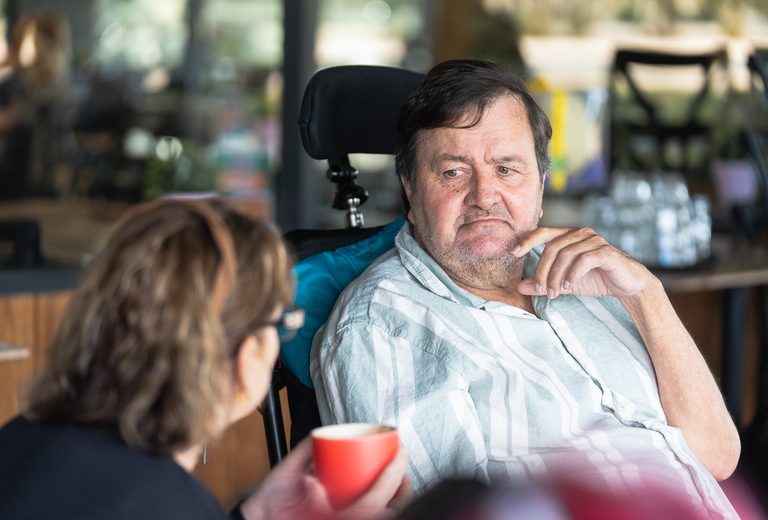
ID: Photo of Ian out at MAP’s Easter Morning Tea event.
For Ian and his family, moving into Specialist Disability Accommodation (SDA) in Nuriootpa has been about much more than finding an accessible house. It has been about creating a home that supports safety, independence, family connection and everyday choice.
After experiencing multiple strokes in 2023, Ian’s life changed significantly. Once a truck driver who had lived independently, Ian became wheelchair bound and needed a home designed around his physical support needs. His daughter, Regina, said the family knew that having access to an SDA home would be important for Ian’s future.
“Having access to an SDA house was what we were needing for his needs going forward,” Regina shared.
Specialist Disability Accommodation is purpose-built housing for NDIS participants with extreme functional impairment or very high support needs. For people like Ian, SDA can make daily routines safer, easier and more comfortable by removing barriers within the home and supporting greater independence.
For Ian, the difference is felt in the everyday details. Regina explained that his SDA home is “designed better” for him because it caters to his needs as a wheelchair user. Open spaces allow him to move through the home more freely, while accessible design features support the routines, interests and choices that continue to matter to him.
“He’s always enjoyed cooking,” Regina said, describing how adjustable kitchen benches allow Ian to remain involved in an activity he enjoys. “Having benches that can move up and down… cater for people who are in wheelchairs.”
Accessible housing is often spoken about in terms of equipment, floorplans and support ratios, but its real value is found in the way it helps people participate in their own lives. Ian’s Nuriootpa SDA home gives him room to move, space for safe transfers and the ability to do meaningful things for himself.
Regina shared that Ian can wheel himself to the front door and open it for her when she visits. It is a simple moment, but one that reflects the importance of independence, privacy and dignity within the home.
“He can wheel himself up,” Regina said. “The bathroom’s big enough so he can get in and out there… he’s got the big space to be able to be lifted to and from bed into wheelchair.”
One of the most important parts of Ian’s SDA journey has been location. Ian lives in the Barossa, close to Regina and his grandchildren. For their family, being near familiar places and people was an important part of finding the right long-term home.
Regina explained that Nuriootpa was a good fit because it kept Ian close to family routines and community connections. “It’s only 30 minutes away from where I live and my kids go to school here in the Barossa,” she said. “We’re always over here… the plan long term [was] to be able to have him as close to family as possible.”
This is why Specialist Disability Accommodation in regional communities like the Barossa matters. Purpose-built SDA homes can help people with disability remain connected to their families, local services, support networks and the communities they know, while receiving the daily support they need to live safely and well.
Ian’s story is a reminder that the right SDA home does more than meet physical access requirements. It supports confidence, comfort, connection and choice. It gives families reassurance that their loved one is living in a place designed around their needs, while also creating opportunities for the person to stay involved in everyday life.
At My Ability Pathway, we believe accessible housing should support people to live with dignity, independence and a strong sense of belonging. Through our Supported Independent Living services within SDA homes across the Barossa, we work alongside participants, families, support coordinators and housing providers to help people build a life that reflects their needs, preferences and goals.
We currently have a vacancy in a Nuriootpa Specialist Disability Accommodation home. If you are eligible for SDA, or know someone who may be looking for accessible housing in the Barossa, we encourage you to reach out to our team. More information about SDA can be found on our Barossa SDA page, and details about our current Nuriootpa vacancy are available on our Current Vacancies page.
ID: Photo of the front of a modern SDA home in Tanunda.
Finding the right home can be life-changing. For people with disability, a home that is safe, accessible and designed around individual needs can create new opportunities for independence, confidence and connection.
In the heart of Tanunda, three new Specialist Disability Accommodation (SDA) dwellings are helping create that opportunity. Built by Metcalf Group (SA), with Metcalf Inclusive Living as the registered SDA Provider, these purpose-built homes have been thoughtfully designed to support people to live with greater comfort, choice and dignity.
My Ability Pathway provides the Supported Independent Living (SIL) supports within the homes, working alongside residents to build daily routines, develop skills, participate in their community and live as independently as possible.
Each Tanunda SDA dwelling has been created with accessibility at the centre of its design. The homes include large bedrooms with individually controlled heating and cooling, allowing each resident to enjoy their own level of comfort throughout the year. Every bedroom also includes a modern, fully accessible ensuite, supporting privacy, dignity and ease in everyday routines.
Shared living has also been carefully considered. With two separate living areas and a generous undercover alfresco, residents have space to spend time together, welcome family and friends, or enjoy quiet moments in a more private setting.
Accessibility continues throughout the entire property. From the kerb through to the alfresco area, clear and continuous pathways support safe and easy movement for wheelchair users. Practical features, such as an accessible front entry door with an integrated sliding screen, help make the homes welcoming, functional and easy to live in.
Built to the High Physical Support SDA Design Standard, the homes include provisions for future ceiling hoists, automated doors and blinds, and the installation of handrails. These features mean the environment can be adapted as a person’s support needs change over time, helping residents feel secure in a home that can continue to support them into the future.
Soft ambient hallway lighting has been installed to improve visibility in the evening while creating a warm, calm atmosphere. In the kitchen, accessible design features include an adjustable-height benchtop, provision for adjustable overhead cupboards and a side-opening oven, supporting residents to take part in daily living tasks with greater ease and confidence.
Located in Tanunda, the homes offer a balance of quiet residential living and connection to local services. Foodland, pharmacies, cafés and shopping are only a short drive away, while Tanunda Hospital is located nearby. For residents, this means everyday essentials, health services and community activities are within easy reach.
Safety and sustainability have also been considered throughout the design. A commercial fire sprinkler system, monitored by the Metropolitan Fire Service, provides added peace of mind for residents, families and support providers. Solar panels and battery storage support improved energy efficiency, while landscaped gardens with automatic irrigation create an attractive, low-maintenance outdoor environment to enjoy throughout the year.
SDA and SIL often work together, but they are different parts of a person’s NDIS support. SDA refers to the physical home – the purpose-built dwelling designed for people with significant functional impairment or very high support needs. SIL refers to the support a person receives to live as independently as possible, including help with daily routines, personal care, skill development and community participation.
In Tanunda, Metcalf Group (SA) has built the SDA dwellings, Metcalf Inclusive Living is the registered SDA Provider, and My Ability Pathway provides the Supported Independent Living supports. Together, these roles help create homes where residents can feel safe, supported and truly at home.
If you would like to learn more about Specialist Disability Accommodation, the difference between SDA and SIL, or the current vacancies, click here for more information and to submit an expression of interest or click the button below.
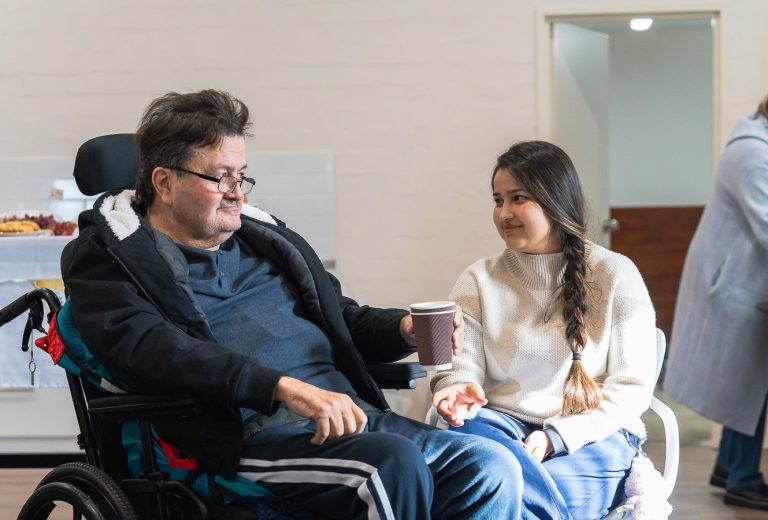
ID: Man in a wheelchair drinking a hot drink next to a female Support Worker at a Morning Tea.
For Ian and his family, the past few years have brought significant and unexpected challenges. Once an interstate truck driver who valued his independence, Ian’s life changed dramatically after experiencing multiple strokes in 2023. Today, he is settled in a Specialist Disability Accommodation (SDA) home in Nuriootpa, where he has the care, accessibility and support he needs to live safely and comfortably.
Before his strokes, Ian lived independently in Eudunda. Although he had already stopped interstate truck driving due to balance difficulties associated with normal pressure hydrocephalus, he continued to manage life on his own. His daughter, Regina, had noticed changes in his mobility, including a shuffling gait and increased periods of sitting or resting.
In September 2023, Ian suffered a haemorrhagic stroke and multiple lacunar strokes, beginning a lengthy and complex health journey. According to Regina, Ian experienced a total of 11 strokes. He had originally been admitted to hospital to receive treatment for his pre-existing hydrocephalus, but this treatment was ultimately deemed too risky due to the severity and frequency of the strokes.
Following his hospitalisation, Ian was unable to return home. Instead, he spent months moving between several hospitals and rehabilitation settings while his family and support team worked to identify the most appropriate long-term housing solution.
Ian entered the NDIS for the first time following his strokes. From the outset, it was clear that his support needs had changed significantly and that accessible housing would play a critical role in his future. During his initial NDIS planning meeting, Ian’s daughter and nominee, Regina, worked alongside his Support Coordinator to advocate for Specialist Disability Accommodation funding.
Given his high care needs, SDA funding was included in Ian’s plan, and he was also granted Medium Term Accommodation (MTA) while suitable long-term housing was identified.
Like many SDA journeys, Ian’s pathway involved a large team working together behind the scenes.
His Support Coordinator collaborated closely with My Ability Pathway’s leadership team, hospital social workers, the YIPRAC team and housing providers to ensure the necessary evidence and documentation were submitted correctly. The process required ongoing communication, frequent follow-up and coordination between multiple stakeholders.
While these administrative processes can often be complex, the goal was to minimise stress for Ian and his family and ensure a smooth transition into appropriate housing.
Location was one of the most important considerations for Ian and his family.
With strong ties to the Kapunda and Eudunda region, Ian wanted to remain as close as possible to his family, while also having access to specialised housing and support services. His Support Coordinator explored available SDA options through Housing Hub and by contacting SDA providers directly. Several properties were considered, but the priority remained finding a home within a reasonable distance of family and community connections.
Ian initially moved into an SDA home in Gawler East, providing him with an immediate solution when suitable accommodation became available. At the same time, plans were underway for new SDA homes to be developed in Nuriootpa, much closer to the area Ian and his family called home.
When the opportunity arose, Ian transitioned into one of the newly completed SDA homes in Nuriootpa, allowing him to be even closer to his support network and maintain stronger connections with family and community.
Today, Ian is enjoying the benefits of living in a purpose-built SDA home that meets his accessibility and support needs. His journey demonstrates the importance of early advocacy, collaborative planning and person-centred decision-making when navigating the SDA process.
Most importantly, it highlights how the right home can do much more than provide accommodation – it can restore connection, improve quality of life and create a foundation for greater independence and wellbeing.
For Ian and his family, finding the right SDA home was about more than a house. It was about finding a place where he could feel safe, supported and close to the people who matter most.
There are currently vacancies available in SDA homes in both Nuriootpa and Tanunda. These homes offer an opportunity for eligible participants to access purpose-built accommodation close to local services, community connections and support networks.
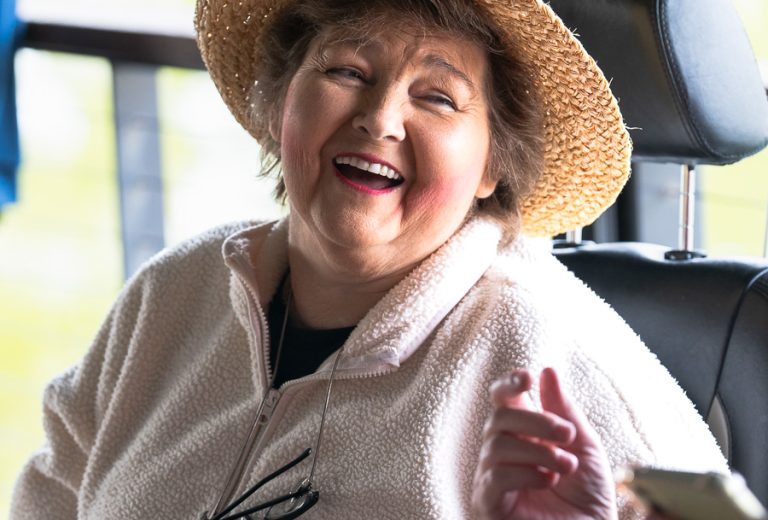
ID: A woman laughing wearing a broad brim straw hat.
Christine remembers the fear more than anything.
Not fear of the unknown – but fear of the everyday.
The simple, human moments most of us take for granted had become the hardest. Standing. Moving. Reaching. Even holding her grandchildren came with a quiet, constant worry in the back of her mind: What if I fall? What if I hurt them? What if I hurt my husband trying to manage on our own?
Before moving into Specialist Disability Accommodation (SDA), life had become a careful balancing act – one where the risks were growing and the support just wasn’t enough.
Her home, though filled with love and familiarity, wasn’t built for what she needed.
“My bathroom [was] very big,” Christine explains, “but it’s not big enough for my wheelchair or my lifter. My husband was able to help me, but not always. He’s getting older too… I had to come here so that I could get the help that I needed so that I didn’t hurt Tony.”
It’s a reality many people face quietly – where love and care alone can’t replace the right environment, the right design, and the right level of support.
Moving into SDA in Gawler changed things for Christine – but not in the way people sometimes assume.
It didn’t take away her independence.
It gave it back.
“I’m getting the help that I need and I’m so much more relaxed… I can concentrate on getting better and building my strength up.”
With the right supports in place, Christine’s focus shifted – from simply getting through the day, to actually living it.
There’s something powerful about feeling safe in your own home. It creates space for everything else – healing, confidence, connection.
And for Christine, something else returned too: hope.
“Oh definitely… I used to be frightened to pick up my grandchildren… but now I’m quite confident in having them come visit me and sit on my lap… I can cuddle them and I can do the things that I need to do to be a great granny.”
That confidence – the ability to be present with the people you love without fear – is what real support looks like.
One of the biggest misconceptions about SDA is that it feels clinical or restrictive.
Christine’s experience tells a very different story.
“It doesn’t stop you from living your life, it helps you.”
Her home isn’t defined by limitations – it’s shaped around possibility.
She bakes. She uses her computer. She hosts friends. She celebrates milestones.
“We had Christmas here and my friends came… we had the best day.”
And when she needs support, it’s there – without hesitation.
“There’s nothing they won’t do for you… If I get stuck… they’re right there.”
This is what person-centred support looks like in action: an environment designed not just for access, but for living well.
For anyone unsure about SDA, Christine doesn’t hesitate.
“Do it, do it. It’s a must. If you’re not sure, if you’re stumbling, if you’re falling – you have to come here and get help, because this is the place to be.”
It’s simple. Honest. And grounded in lived experience.
Christine’s story is just one example of what’s possible when the right environment meets the right support.
And now, more opportunities are becoming available.
Three brand-new SDA homes are being developed in Tanunda, with vacancies expected from July 2026. Designed with accessibility, comfort, and independence in mind, these homes offer:
It’s important to note that while these homes are delivered in partnership with SDA provider, Metcalf Group (SA), My Ability Pathway provides the Supported Independent Living (SIL) supports – ensuring participants receive consistent, person-centred care aligned with their goals.
SDA isn’t just about accessible housing.
It’s about reducing risk.
It’s about restoring confidence.
It’s about creating the conditions where people can reconnect with what matters most.
For Christine, that meant holding her grandchildren again without fear.
For others, it might mean cooking independently, pursuing hobbies, or simply feeling safe enough to relax.
Whatever the goal – the right environment makes it possible.
If you or someone you support could benefit from SDA, now is the time to explore your options.
Secure your future home – complete an Expression of Interest.
Conditions apply.
Our team is here to guide you through the process, answer your questions, and help you determine whether SDA is the right fit. Let us know if you would like one of our complimentary SDA Information Packs to be sent to you.
Because everyone deserves a home that supports not just their needs – but their life.
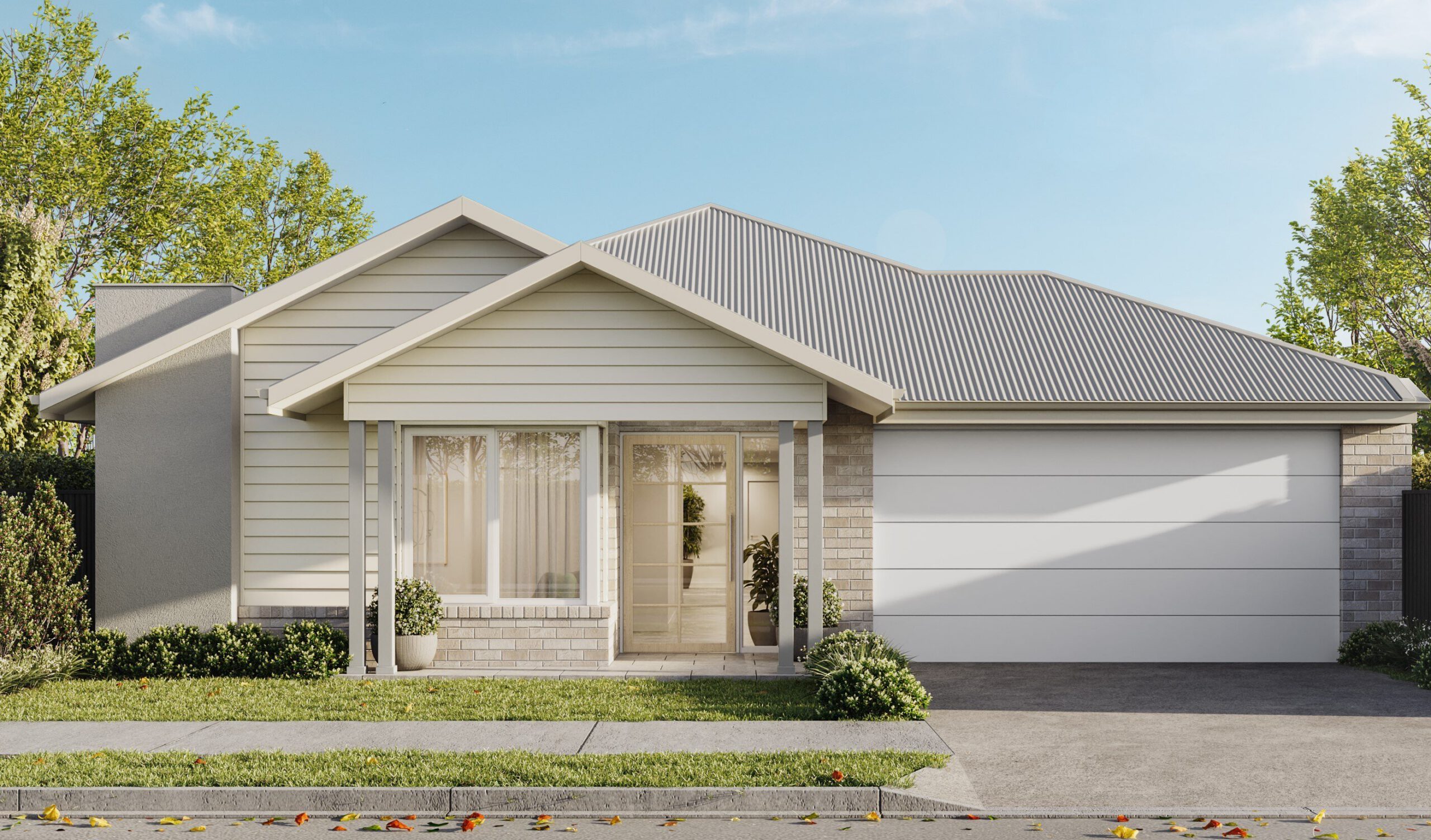
ID: Render of a modern SDA home
My Ability Pathway’s goal to establish Specialist Disability Accommodation (SDA) properties in the Barossa Valley has been years in the making – a goal that was achieved in May this year. The process of supporting the builds, seeking new clients and ultimately moving everyone into their new homes was much like a swan on a river – calm and smooth on the surface, wild and furious kicking underneath.
Calm and smooth was exactly the approach needed to support our clients with the move. The upheaval anyone may experience when moving home cannot be underestimated. MAP’s team did the wild kicking so our clients could have as stable a move as possible.
In reality, wild kicking at MAP looked like many months of structured meetings, meticulous planning and continuous adjustments as things beyond our control cropped up, such as delays with the build completion. Flexibility and adaptability were vital parts of the process for everyone involved. With information being updated daily as we approached the move dates, our entire Disability Services team handled the uncertainty masterfully.
All the planning in the world cannot account for the human element however, and while some of our clients have adapted well to this considerable change, others have faced some struggles.
The stresses of moving can be amplified for people living with disabilities. The loss of familiarity and changes to supports can lead to intense feelings of being unsafe in the new environment, and the impacts of some disabilities make it difficult for support people to explain the changes and offer reassurance. For some people with disabilities, the disruption caused by a significant change like moving home can contribute to an increase in symptoms – this is especially true for people living with dementia.
Of the six clients involved in our SDA move, two are living with dementia. Their responses to moving have been vastly different. One adjusted to the changes with unexpected ease, while the other has shown signs of distress, expressed as changes in behaviour. Rallying the support network to help with navigating changes is essential.
All of us can speak to the rise of emotions that come from being faced with change, however big or small. These emotions can be difficult, such as fear and resistance, or they can be exciting as we dive towards something we want. Sometimes we experience these at the same time.
Despite MAP’s the extensive preparation, in collaboration with our clients, the change of moving has been a space requiring adaptive and ongoing navigation. Expectations and realistic limits needed managing for everyone involved, while also ensuring safety and comfort for our clients.
Throughout the moving process, MAP has supported our clients to exercise their choice and control. Having a sense of ownership over the changes we face can help with maintaining a sense of calm and confidence, both vital for navigating transitions.
It’s also important to keep talking about the difficulties of a change, for people facing changes to have opportunities to express themselves in a safe space while having their thoughts and concerns validated. It’s natural for many of us to enter “problem-solving” mode when faced with change and challenges, however simply feeling heard can often be far more supportive for people than attempting to fix things – especially with a permanent change like moving.
Moving doesn’t completely end once the keys have been handed over and the removalists are gone. Transforming a house into a home is a process, while adapting to, and accepting change often takes a bit of time.
Coming back to our goals and purpose has been important during the weeks since the move happened, not just for the team at MAP but also for our clients. Re-establishing a sense of security after a big change is vital to wellbeing. Ensuring our clients, both new and existing, have been able to maintain their choice and control has been a priority within MAP’s team.
Our frontline team members have been remarkable throughout the move, staying flexible, understanding and supportive through all the hurdles. Offering care to our clients goes beyond supporting with personal care and daily activities – it’s also about nurturing their environment, creating a home filled with hope and happiness. Safety, warmth and comfort are our next focus to ensure the SDA builds are more than just a needs-based building – they’re a true home.

ID: Photo of the back of a SDA house
*some details are changed to respect the wishes of the client and her family.
Chloe is bubbly, social, engaging, confident and adored by all who meet her. She has had an exciting life, having lived abroad and interstate, and travelled extensively around Australia with her parents, she has seen more than most.
Chloe settled into Malalla where she spent the last 20 years surrounded by the love and warmth of her family, which included her mum, dad, sisters, and brother. Known for her outgoing nature, Chloe became a cherished part of her church and local community. She frequently travelled to nearby towns like Gawler and Elizabeth, embracing social activities and making the most of every opportunity to connect with others.
Life Changing Events
As time passed, changes in her family dynamic and evolving care needs led Chloe and her loved ones to explore new living arrangements. Her mother’s passing was a challenging time, but Chloe’s proximity to her during the final months ensured their bond remained strong until the end.
First Steps Toward Independent Living
Recognising the need for a secure, supportive environment, Chloe and her family took the first steps toward independent living by moving her to My Ability Pathway’s MTA property in the Barossa. This transition allowed her to form new connections with neighbours and the community while staying close to her roots in Kapunda. Chloe’s dad has remained an integral part of her life, and their relationship continues to flourish.
Securing Specialist Disability Accommodation (SDA)
Chloe’s journey toward independence culminated with the successful application for Specialist Disability Accommodation (SDA) funding, supported by her family and her dedicated Support Coordinator, Karen Healey. This funding paved the way for Chloe to move into a beautiful, purpose-built SDA home in Gawler. Designed to meet her needs, the home provides Chloe with a safe, supportive environment and a committed team that respects her preferences and choices.
Settling In To A New Way Of Life
Now settled into her new home, Chloe is thriving. Her connection to Gawler, a town she has known and loved since her younger days, has deepened as she engages with her community. Chloe enjoys hosting her dad for special moments like high tea in her living room, a testament to her growing independence and the strong relationships she nurtures.
The move has empowered Chloe to direct her care and build meaningful relationships with her support team. She is confident in expressing her preferences, ensuring her voice is heard. The stability and security provided by her SDA home means Chloe can focus on living a fulfilling life, surrounded by the community and family connections that have always been at the heart of her story.
Barbara Lightburn


ID: Photos of new SDA home and surrounds
In conjunction with New Dawn Housing and as part of our ongoing commitment to providing high-quality housing solutions for individuals with significant disability, we’re excited to share the latest updates on the Specialist Disability Accommodation (SDA) builds in the Barossa Valley. These state-of-the-art developments are designed to empower residents by meeting their complex support needs while creating welcoming and accessible living spaces.
The construction phase of the two homes in Nuriootpa has made significant strides over the past few months. With careful planning and collaboration between architects, builders, investors and New Dawn Housing it is ensured that each build adheres to the SDA design standards of accessibility, comfort, and design.
Completion Milestones: Both homes are nearing the final stages of construction, with anticipated completion in March. Each site has been tailored to the specific needs of future tenants, including modifications for mobility access, inbuilt structures for hoist equipment, sensory-friendly design, and cutting-edge assistive technology integration.
Looking ahead, we’re entering a critical phase of tenant consultation and finalising support partnerships. Here’s what’s on the horizon:
Tenant Engagement: SDA eligible tenants have now secured their places in both houses. We are liaising with the future tenants and their families to ensure that individual needs are reflected in the final fit-outs. Feedback from these sessions is invaluable in customising the environments further, from furniture layouts to sensory aids to garden design.
Support Coordination: Our team is actively liaising with NDIS providers to align SDA housing with residents’ broader NDIS support plans. This includes finalising arrangements for on-site visits, ensuring seamless integration of housing and support services.
Support Worker Recruitment: As we prepare to welcome the new residents into these homes, we are building dedicated support teams to provide the highest level of services. We are currently recruiting for several key roles, including:
To learn more about these opportunities head to our Careers Page
These homes aren’t just functional, they’re beautiful too. Located in a quite cul-de-sac and across from a nature reserve the designs balance practicality with modern aesthetics, creating spaces that residents can be proud to call home. Expect light-filled rooms, private outdoor areas, and accessible features that make all the difference, such as:
Stay Connected
As these builds progress, we’ll be sharing regular updates, including resident stories and insights into how these homes are transforming lives. Be sure to visit our Barossa SDA webpage and follow our social media channels for the latest news.
Together, we’re building more than just homes, we’re creating opportunities, independence and brighter futures.

ID: Photo of a Nuriootpa SDA in construction
At My Ability Pathway (MAP), we are delighted to see the progress of two new Specialist Disability Accommodation (SDA) buildings in Nuriootpa, which are on track to welcome residents in March 2025.
These homes, managed by New Dawn Housing and supported by MAP and Barossa SDA, represent a significant step forward in providing accessible, high-quality housing for people with disability in the Barossa Valley.
First SDA properties in the Barossa
Our team are watching the construction of these properties come together with great excitement, not just for the people who will soon call them home but for their positive impact on the entire Barossa community. These are the first SDA properties in our region, and they show that the Barossa Valley is an ideal location for future investments in SDA.
Our CEO, Barbara Lightburn, is particularly excited about the opportunities these homes represent. “These builds offer stable, affordable, and life-changing accommodation where people with significant disabilities can thrive and experience greater independence,” Barbara said. “This is the start of a brighter future, not just for the individuals living in them but for our entire community as we work toward a more inclusive and supportive society.”
We’ve already received a fantastic response, with many Expressions of Interest (EOIs) submitted and more coming in as the completion date approaches. If SDA housing is part of your (or your client’s) goal, we encourage you to submit an EOI via our website (or the form below). From there, we’ll connect you with the experts who can help guide you through the process.
Our General Manager, Charlotte Williams, shared our vision for the future: “These SDA homes are just the beginning. We’re already planning future projects to meet the growing demand for accessible housing in the Barossa Valley. It’s exciting to see this vision coming to life.”
MAP and Barossa SDA, leading accessible housing in Barossa.
As we get closer to the completion of these first SDA builds, we’re proud to see the Barossa Valley becoming a leader in accessible housing. This project is a testament to what can be achieved when we work together to create opportunities for independence, inclusion, and community connection.
If you’d like more information or to submit an Expression of Interest, complete the form here or call Barbara on 0417 653 336. We can’t wait to see what the future holds!

We are excited to continue our SDA Blog series with our next topic: “How to Apply for SDA Funding.” In this blog, we will provide valuable information to help you navigate the application process for Specialist Disability Accommodation (SDA) funding. Learn about eligibility requirements, essential documentation, and tips for a successful application. Our aim is to equip you with the knowledge and resources you need to secure the funding necessary for suitable housing solutions. Stay tuned for comprehensive insights and practical advice.
All NDIS supports need to meet the reasonable and necessary criteria, this includes SDA.
A quick review of the Reasonable and Necessary criteria and how this may fit within an application for SDA funding.
The NDIS will only fund specialist disability accommodation if it’s a better option for the person’s disability support needs than other supports alone. You will need to have a home and living goal in your Plan. The NDIS will ask the following questions.
Let’s dig deeper into these questions.
The NDIS will determine an extreme functional impairment if an individual experiences significant difficulty performing daily tasks independently or is sometimes unable to perform them at all. This assessment includes considering the necessity for substantial support from another person beyond the use of assistive technology or home modifications. The daily tasks evaluated include:
Mobility: Activities such as walking, climbing stairs, getting in and out of bed or a chair, carrying or moving items, and leaving the house.
Self-care: Tasks such as personal hygiene, using the toilet, dressing, eating, drinking, speaking, and taking medication.
Self-management: Responsibilities such as housework, following routines, forming and maintaining relationships, setting boundaries, and managing behavior.
The NDIS reviews various information to determine if a person has an extreme functional impairment or very high support needs. This evaluation helps the NDIS understand the person’s current circumstances, strengths, barriers, and daily support requirements. You are not expected to have all the information immediately, the NDIS will assist in gathering the necessary details.
Additional assessments may be requested if more information is needed for the NDIS to make a decision. These can include:
The NDIS will also include funding in the individual’s Plan to assess their home and living situation.
The NDIS needs to confirm specialist disability accommodation combined with other supports will lead to better outcomes. For example, whether it will:
The NDIS requires evidence that a person has very high support needs for a significant part of the day. This support must be readily available or quickly accessible when needed. Additionally, it is necessary to demonstrate that:
The NDIS will also need to ensure that the funding for specialist disability accommodation and other supports meets the funding criteria better than other options.
In particular, the NDIS will need to know if specialist disability accommodation:
SDA Services have created an eligibility tool that is accessible and easy to navigate. It will walk you through a series of questions and prompt answers to assist in collating information for an application with the NDIS. if you would like to check your eligibility for SDA funding follow the link here
If you have a home and living goal in your NDIS Plan, the NDIS will help you explore your options to pursue this goal, which can include SDA Funding. Speak with your Support Coordinator or the LAC/ NDIS (if you don’t have Support Coordination). It is essential to start thinking about your future housing options and ensure your home and living goals are in your NDIS plan. If you’re turning 18 in the next year or two, the NDIS suggest it is never too early to start thinking about whether you want to move and what this might look like for you in the future.
The NDIS generally funds specialist disability accommodation based on where a person tells them they would like to live. They will consider whether the location works with other required supports and meets the NDIS funding criteria.
To decide what specialist disability accommodation location to include in your Plan, the NDIS will look at the following:
It can be a very long process. It can take years to gain SDA into an NDIS plan. Therefore, we recommend that you and your informal supports consider what you want the future to look like and start planning!
SDA funding is paid directly to SDA providers to cover the building and maintenance costs of the home. You will be responsible for other day-to-day living costs such as rent., electricity bills, food and personal phones. The maximum reasonable rent contribution is 25% of the Commonwealth Disability Support Pension, as well as 100% of any Commonwealth Rent Assistance you get. You will negotiate this with the SDA provider and have it put into a Service Agreement.
The SDA Funding does not include the services or support you might need in your home related to your disability support needs.
When the NDIS decides to include specialist disability accommodation in your Plan, you won’t need to prove that you still meet the criteria at every plan reassessment.
Your Support Coordinator, a Local Area Coordinator (LAC) SDA Services and Barossa SDA
Resources
How do you get SDA in your plan.
Does the support meet the reasonable and necessary criteria?
