We value your privacy
This website uses technical, functional and analytical cookies that do not infringe on your privacy.
General purpose platform session cookies are usually used to maintain an anonymised user session by the server.


ID: Photo of a group of people outdoors having a picnic and playing games.
Have you ever come home from an activity and thought, “That filled the afternoon, but it was not really for me”? A busy calendar can look positive from the outside. Yet attending activities and feeling connected are not necessarily the same thing. Meaningful community participation begins with what you enjoy, who you want to spend time with and how you want to take part. A good starting question is not “How many outings did we organise?” but “Was this worth doing for you?”
Community might mean a local club, an art class, a library, a familiar café or time with neighbours. It might involve a disability-specific group, a mainstream activity, an online interest group or a combination. No single setting is automatically the most inclusive for everyone. The important questions are whether you want to be there, can participate in a way that suits you and have opportunities for the kind of connection you value. Enjoyment is a valid reason to take part. You do not need to turn every interest into a lesson or a measurable achievement.
Consider a hypothetical person who enjoys plants and wants to try a community gardening group. Getting there matters, but so does what happens after arrival. Can they reach the work area? Are instructions accessible? Is there a task they actually enjoy? Does someone speak directly with them rather than only with their support worker? These details can determine whether an outing becomes a valued part of the week. Meaningful participation is not about making someone more sociable. It is about making room for the involvement they want.
Start with an interest, not a vacant place on a program. Ask what you would like more of: time outdoors, creative expression, familiar conversation or a chance to learn. Being unsure is fine. Looking at a few options can be part of finding out.
Check the details that matter to you, including transport, accessible toilets, noise, seating, communication and breaks. In regional areas, consider the whole journey, including getting home. A venue’s general claim that it is accessible may not answer your particular questions. With your permission, a supporter can help ask about adjustments without sharing unnecessary personal information.
Ask whether a short visit or introductory session is possible, and clarify any charges first. Agree what help you want during the visit. Some people prefer an introduction and then space; others want ongoing assistance to communicate or take part. Neither approach is a better form of independence.
Afterwards, ask: did I enjoy it, feel included and have enough say? What would I change? The answer might be a different time, a smaller group, more assistance or a different activity altogether. Choosing not to return is useful information, not a failure.
The NDIA’s social and recreation support guidance distinguishes disability-related assistance from ordinary activity expenses. Depending on individual circumstances and funding criteria, the NDIS may fund extra help needed because of disability. General costs that everyone pays, such as ordinary membership or entrance fees, remain the participant’s responsibility. Do not assume that an activity, transport arrangement or support charge is funded simply because it links to a goal. Check your plan and current guidance before committing. A support coordinator, where involved, can help clarify questions; they do not approve NDIA funding.
There can be pressure to fill every available hour or keep adding new experiences. A familiar weekly visit may be more valuable than several unfamiliar outings. Rest, time alone and changes of mind also deserve respect. Families and support teams can help by noticing barriers without deciding what a satisfying social life should look like. Community organisations have a part to play too: welcoming communication, workable adjustments and direct engagement should not depend entirely on a support worker’s presence. Paid support can assist participation, but it cannot guarantee friendship or belonging.
The most useful next step might be small: asking about a class, returning to a familiar place or finding a way to join a conversation. Success is not always a larger calendar. It might be greater choice, a comfortable routine or taking part in something you value. MAP’s published community approach emphasises individual interests and connection. To explore assistance in the Barossa, Gawler or Adelaide’s northern suburbs, read about MAP’s disability support services and social and community participation. Begin with what matters to you, then consider what support would make it possible.
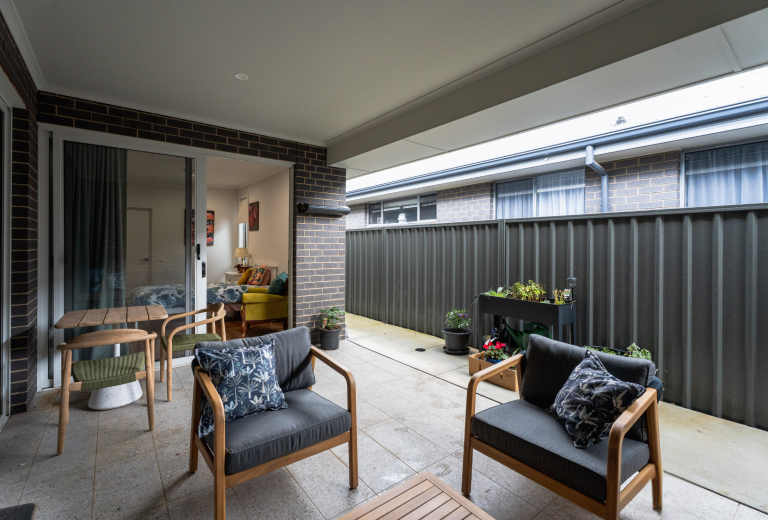
ID: Photo of an alfresco area that has been intentionally designed for a client who has dementia. Featuring sturdy seating areas and easy access to the bedroom.
Good design is about more than creating beautiful spaces. At its best, it helps people feel comfortable, safe and independent in their everyday lives.
When interior designer Steve Angel, from Décor Made Easy, looks at a room, he sees more than furniture, colours and floorplans. He sees opportunity: an opportunity to create a space where someone can continue doing the things they enjoy, feel connected to the people around them and maintain independence in a home that supports their needs.
Recently, Steve worked alongside My Ability Pathway to transform a small north-facing alfresco area into a practical outdoor retreat for a client living with dementia. The client loved gardening and wanted somewhere she could enjoy the sunshine, spend time with family and friends, and continue doing something she was passionate about.
What emerged was much more than an outdoor sitting area. It became a space that supported connection, routine and independence.
For Steve, successful design starts by understanding the individual.
“The client loves gardening, so what we looked to achieve was an extra space for her to have a little bit of autonomy,” Steve explains. “Somewhere where she could sit and have a cup of tea, enjoy the northern sun, have family and friends visit, and create a little bit of space for gardening because that’s what she loves.”
Positioned just outside the client’s bedroom, the outdoor area naturally extends her living space, making it easy to access throughout the day while offering a peaceful place to relax.
“It’s literally off the client’s bedroom… and it’s a great use of the space.” Steve says.
Inclusive design is often about details that many people may not immediately notice, but that can have a significant impact on someone’s confidence, comfort and safety.
For this project, furniture was carefully selected to provide stability and reassurance. Steve chose solid timber seating that would not move unexpectedly when someone sat down, while dining chairs were fitted with rubber stoppers to prevent them from sliding away.
“We wanted fairly generous seating, quite solid, so it’s not something too flimsy if someone isn’t too stable on their feet,” Steve says. “You can sort of flop into it and it won’t slide away.”
Rather than creating a space filled with busy patterns or overwhelming colours, the design remains calm and inviting. As Steve puts it, “It’s just simplistic, with a bit of colour in the cushions. Nothing too demanding or dramatic.”
Through previous work designing dementia-specific environments in aged care spaces, Steve has seen firsthand how thoughtful design can improve quality of life. One of the biggest lessons was understanding that people living with dementia may experience their surroundings differently.
Something as simple as a patterned floor can create confusion. Steve recalls learning that flooring with strong borders or contrasting lines could sometimes be perceived as an obstacle that residents felt they needed to step over.
“People thought patterned floors or border lines were something they had to step over, so we learned we couldn’t have those sorts of designs because they affected people’s confidence to move freely.”
Those observations also revealed creative ways to gently guide movement without using physical barriers. In one aged care setting, a wallpaper border placed at eye level helped guide a resident through a space where she had previously become stuck, preserving her freedom while reducing frustration and confusion.
“We discovered we could use visual cues to encourage people through spaces or away from certain areas without putting up barriers. It worked extremely well.”
Colour and contrast also play an important role, particularly for people experiencing vision changes. Steve learned that artwork, patterns and decorative elements work best when they feature clear edges and strong contrast.
“We learned that artwork needed nice sharp edges and good contrast. Anything blurry or soft could become difficult to interpret, so we were very mindful of choosing crisp patterns and images.”
For Steve, inclusive design is about helping people maintain control over their daily lives and continue doing the things that matter to them.
He recalls working with an older woman who had severe arthritis and struggled to use the chain-operated blinds installed in her room. The blinds may have looked modern, but they were not functional for the person using them.
“She used to have to call staff just to put the blind up or down.”
By replacing them with motorised blinds and an accessible wall-mounted remote, she was able to manage them independently and no longer needed to ask staff for help.
“She became so much more independent because she was in control of that.”
For Steve, this is what inclusive design is all about: thinking first, rather than simply following design trends.
“It’s a little bit more thinking first, and not just saying, ‘Well, that’s the fashion in design.’ Let’s think about whether that’s suitable.”
Inclusive design does not require creating clinical spaces or removing personality from a home. Instead, it means understanding how people experience their environment and making thoughtful choices that support safety, confidence and independence.
Whether it is selecting stable furniture, creating clearer visual cues, improving accessibility or enabling people to continue pursuing the hobbies they love, thoughtful design can have a lasting impact on quality of life.
As Steve’s work shows, the most successful spaces are not necessarily the most stylish or the most expensive. They are the spaces that help people keep doing what matters most.
“If design can help people become independent – whatever that means for them – that’s a fantastic thing.”
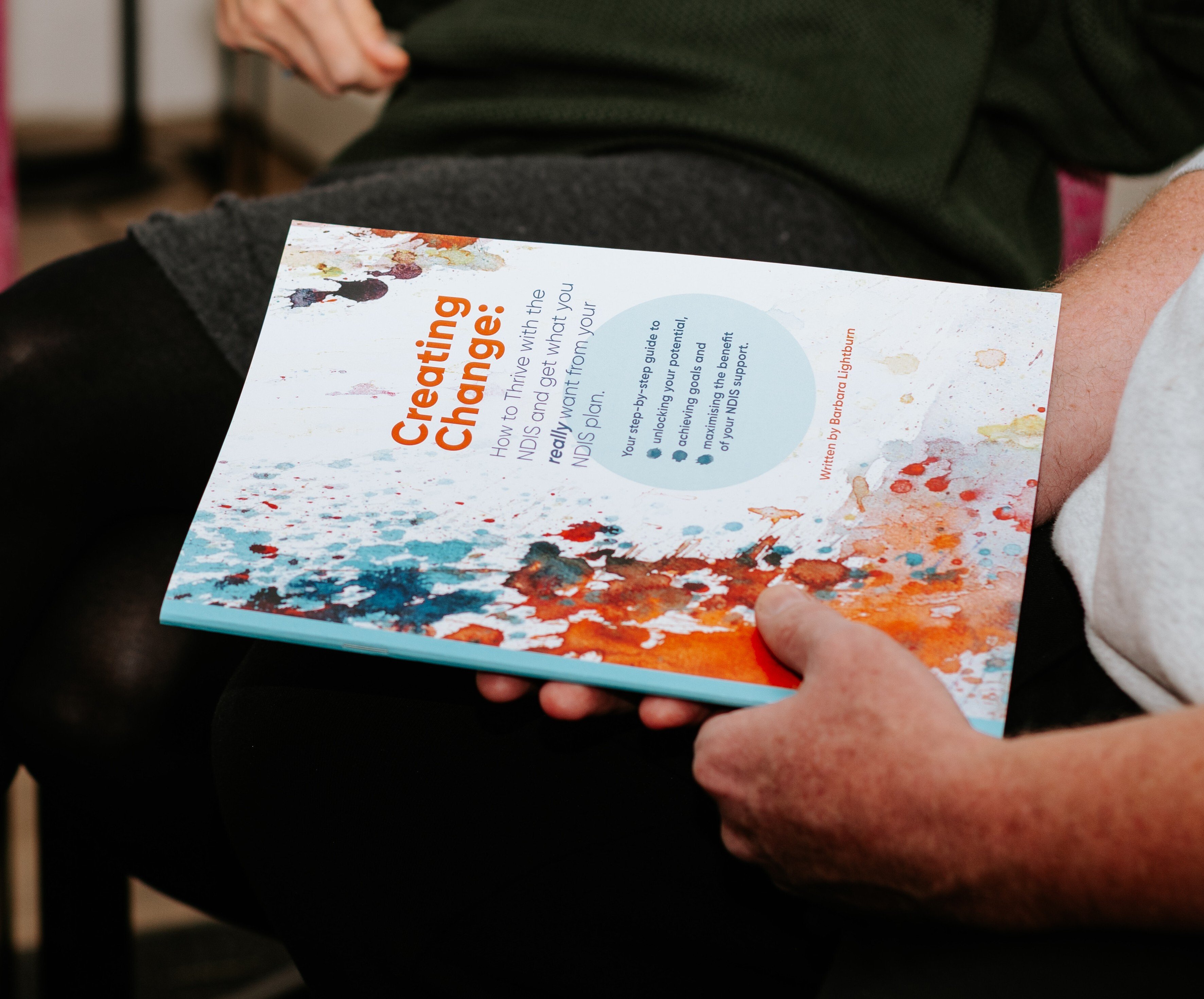
ID: A photo of a person holding the Creating Change book.

New year’s resolutions. A popular method of goal setting, but one that doesn’t tend to have the best success rate. Why?
Goals that fall by the wayside often have some things in common:
So, let’s explore creating goals.
Goal setting is something that gets talked about a lot in NDIS spaces. If you’re a participant, you’ll have been asked to set some goals for your NDIS plan. These can be anything you want, and sometimes it can be difficult to figure out what that might be.
If you work in the disability industry, or support a loved one with a disability, you’ll be looking to align outcomes with the goals of the participants you support – and you’ll have your own goals, whether they be work-based or personal.
Creating Change, written by Barbara Lightburn, is a resource to support anyone looking to hone their goal setting skills.
Top Tip – Write your goals down and monitor progress
Setting strong, personalised goals can be extremely beneficial in assisting you to achieve what you want to achieve. For many of us, having a written record and a way to track progress is very supportive. There are many ways to record your goals and monitor progress – from spreadsheets to apps to journalling, there is bound to be a method that will work for you.
At MAP, we’ve built a culture inspired by the importance of setting goals as a way to support all areas of life. Seeing our achievements gives us a sense of success, builds confidence, and empowers us to continue striving. No win is too small, and if you’re tracking your progress, you’ll get to see in real time just how far you’ve progressed, despite any setbacks or interruptions.
This is so important, because many of us notice shortcomings far more sharply than we recognise successes. Retraining your focus to be objective and positive helps you stay strong when times get tough.
Top Tip – Make your goals “SMART”
There are so many positives to learning to set goals – and beyond that, to adjust those goals when things change for you. Sometimes a goal no longer applies or may become unrealistic. Any number of things can change in the time we’re working to achieve the things we’re aiming for.
There’s a skill to strong goal setting, and it’s one that can be learned and honed. A popular method is “SMART” goals. SMART stands for:
Developed by George T. Doran, SMART goals help you be clear about what you want to do, support you to set a timeframe to keep you on track and accountable, ensuring it’s realistic and applicable to you, and assists with measuring your achievements.
On top of creating a SMART goal, you can break the goal down into manageable steps or actions. This will make it easier to monitor for those small wins and see your progress. Chapter 4 of Creating Change includes a helpful workbook section to guide you through this.
Check in and review your goals regularly – daily, weekly or monthly check ins work well for many goals, and allow you to adjust your focus, try new approaches and recognise what’s going well as you work towards your goals.
Top Tip – Develop a support network
Having support can help us towards our goals in a variety of ways. From encouragement to holding us accountable, a support network gives us people to rely on for help and perspective.
Different types of goals need different types of support. It’s important to consider who might be the best person, or group of people, to help out. From emotional support to professional guidance, there are options appropriate to every type of goal.
Online spaces are increasingly popular ways to connect with likeminded people, especially for those living rurally or regionally. Local clubs and groups might be an option too – for example, a book club or sports group could help with a goal around reading more, or learning a new fitness activity. Consider your budget and explore training or coaching options that may suit your needs.
Goals help us give our lives direction, supporting us to achieve and grow in the ways that we want. Consider your new year’s resolutions and think about how you might be able to refine and refocus them into strong, SMART goals. Have you made those small wins already? Celebrate them! Will you benefit from an accountability partner, or some guidance from someone with experience? Explore finding that support.
Most of all, remember your purpose. You set this goal for a reason. It’s yours to achieve.
Barbara Lightburn

ID: Team members sitting around a desk at a presentation.
Lately at MAP, I’ve noticed something quietly encouraging—people have started saying things like:
“I’m not having a whinge, but…”
“I’m not being negative—I just need to say this…”
To an untrained ear, it might sound defensive—a disclaimer before frustration. But to me, it’s a sign of something deeper and far more important.
It means our culture is shifting. People are catching themselves in the moment between reaction and reflection. They’re thinking about how they communicate before they speak. That’s emotional intelligence in action. It’s the early sign of a team learning how to express truth with care.
In most workplaces, the fear of being labelled negative silences more progress than any official policy ever could. When people start filtering every thought through “Will I sound like I’m complaining?”, the real problems stay buried.
But healthy cultures know the difference between negativity and honesty.
When we give people language, tools, and safety to make that distinction, something powerful happens: the energy that used to fuel gossip or resentment starts fuelling problem-solving instead.
At MAP, we talk often about “Pause • Reflect • Respond.”
That moment of pause—where you catch yourself and think, “How do I want to say this?”—is leadership maturity in real time.
When someone says, “I’m not having a whinge,” what they’re really saying is:
“I know how I sound matters.”
“I’m trying to express this in a way that builds, not breaks.”
That self-awareness, even if clumsy at first, is where real cultural transformation begins.
It’s the difference between reacting and responding—between emotional impulsivity and emotional intelligence.
Culture change never starts polished. It starts awkward. People experiment out loud. They try on new language and sometimes overcorrect.
That’s okay. That’s progress noise.
It’s the sound of people moving from avoidance (“I’ll just keep this to myself”) to engagement (“Let’s talk about it, but carefully”).
As leaders, our job isn’t to roll our eyes at the awkwardness. It’s to recognise the courage it takes to try something new—to speak truth differently, without defaulting to blame or frustration.
When someone says, “I’m not being negative, but…,” don’t correct them.
Coach them forward.
Say:
“I can hear you’re trying to keep this constructive—that’s the right instinct. Let’s look at what outcome you’d like instead.”
It’s not about tone-policing. It’s about teaching people how to turn emotion into action.
Leaders can do this by modelling four simple behaviours:
When leaders stay open, others learn that honest doesn’t mean hostile.
One of the most practical shifts in culture is how people frame their frustration.
Here’s what that evolution looks like in action:
|
Old Language |
MAP Language |
|
“This is ridiculous.” |
“This process isn’t working—can we explore why?” |
|
“No one ever listens.” |
“I’d like to share some feedback—can we review how we communicate updates?” |
|
“I’m not being negative, but…” |
“Here’s something I think could be improved—can I offer a suggestion?” |
That’s the heart of MAP’s Frank, Fearless, and Factual standard.
We don’t silence emotion—we channel it into clarity, care, and progress.
Frustration, tension, and awkward feedback moments are not threats, they’re information.
They tell us where a process, relationship, or system needs attention.
We say often at MAP:
“Discomfort is data, not danger.”
When you train yourself and your team to treat discomfort as insight, not insult, you start to uncover what’s really blocking progress. You learn faster. You recover quicker. And you lead stronger.
Here’s how to embed this mindset as a daily habit:
You’ll know this shift is working when:
That’s not theory—it’s what happens when emotional intelligence becomes habit instead of aspiration.
At MAP, we believe leadership isn’t a title—it’s a way of being.
It’s the ability to stay steady in discomfort, to stay kind in truth, and to choose clarity over avoidance.
So, the next time someone says, “I’m not being negative, but” … smile!
It means they’re catching themselves—and that’s the first step toward the kind of culture where everyone feels safe, seen, and supported.
That’s the MAP Way of Working—helpful, active, connected, adaptive, and supportive.
Sally Kennedy

ID: R U OK? Day logo on a yellow and black background
R U OK? Day is more than just a day on the calendar; it’s a reminder for us to check in with our colleagues, friends, and loved ones, creating a supportive and open environment where mental health is a priority. At My Ability Pathway (MAP), we believe in nurturing a workplace culture where everyone feels valued, heard and supported, the well being of all our team members is a priority.
One of the key resources we make available to our team is the Employee Assistance Program (EAP), provided by Acacia. This free and confidential service offers our team members access to professional mental health and well-being support, ensuring that help is always available when needed.
Our EAP, facilitated by Acacia, is designed to support the mental health and well-being of all team members, with a holistic approach. Available 24 hours a day, 365 days a year, the EAP ensures that all team members and their immediate family, have access to confidential and timely assistance that aligns with each person’s unique needs and circumstances. Extending theses services to immediate family members supports the ‘bigger picture’ of an individual’s own personal wellbeing. The team at Acacia understand the importance of mental health and commit to providing a safe space where people can seek the support they need without judgment.
The services offered by Acacia under the EAP framework address various aspects of mental health and well-being, including:
Seeking support through the EAP is a proactive step toward maintaining mental health and well-being. When team members utilise these services it is entirely confidential, the EAP is there to support our team members every step of the way. There is no shame in reaching out for help, taking care of your mental health is just as important as taking care of your physical health.
Accessing support through the EAP is straightforward. Our team members can contact Acacia directly, 24/7, to speak with a counsellor or arrange an appointment by clicking on the link here.
On this R U OK? Day, let’s commit to creating a culture where checking in on each other is a daily practice, not just an annual event. The EAP provided by Acacia is here to help our team members navigate life’s challenges, big or small.

ID: Photo of a women sitting at a desk with a laptop and paperwork in front of her
When you have been approved for the NDIS, you get to decide how to manage the funding for your support. There are three main ways to do this, you can even mix and match these methods if you want. Your choices are:
This means you’re in charge of your NDIS funding. Using the myplace portal (soon to be PACE) to manage payments and funding, you can choose what services you want, inline with your NDIS plan and pay for them yourself.
If you are good at record keeping, using technology such as computers or smart phones, understanding technical documents (guidelines) and have the time to research providers, negotiate services and prices then self-management may be for you.
If you find it difficult to understand budgeting, do research and deal with negotiations like discussing prices and service expectations then you might want to consider other options.
www.ndis.gov.au/participants/using-your-plan/self-management
With this option, the NDIS gives the funding to a Plan Manager that you choose. The Plan Manager then pays the invoices for your services, keeps track of your NDIS funding and does all the paperwork for you. The Plan Manager is responsible for paying for the support and services you access that are allocated in your NDIS Plan. They are also responsible for keeping you informed of how your budget is tracking, to ensure you don’t run out of funding before the end of one plan and beginning of another. There are many Plan Managers on the market and they must be a NDIS registered provider. It is worth taking your time to ask around about other people’s experiences and recommendations to find the right fit for you.
www.ndis.gov.au/participants/creating-your-plan/ways-manage-your-funding/plan-management
The NDIS takes care of paying for your services directly. You don’t have to worry about paperwork or payments, but you’ll still get to choose who provides your support.
During your planning meeting with the NDIS, someone will talk to you about these options. They’ll help you figure out which method (or mix of methods) might work best for you. Remember, no matter which way your plan is managed, you always have the power to choose what services you use and make sure they’re right for you.
Even if someone else is managing your funds, it’s good to check in on how your money is being spent. You can do this through the NDIS myplace portal. It’s a website where you can see your budget and make sure everything is going as planned.
Choosing how to manage your NDIS plan is a big decision, but it’s all about what makes you feel most comfortable and supported. Whether you like the idea of handling things yourself, having someone help you with the financial details, or letting the NDIS manage payments, you’ve got the power to decide.
Remember, the goal of the NDIS is to make sure you have the support you need to achieve your goals. By understanding your plan management options, you’re taking an important step towards making the most of what the NDIS offers.
*The NDIS registration process ensures providers are compliant with an extensive list of practise standards to ensure the safety of participants of the NDIS. The Australian Government NDIS Review has identified many issues with lack of regulation for unregistered providers.
Look for the logo to find registered providers.

ID: Photo of Team Mentor Carmen, smiling at another women
Here we provide an explanation of the role a Support Coordinator has in assisting you to understand your plan and implement the supports you need with your NDIS funding.
A Support Coordinators role could be described as a bit like a conductor. A conductor interprets the music then guides and directs the orchestra on how to play the music. The Support Coordinator does a similar task by interpreting the funding in your NDIS plan and then guiding and bridging the connection with the appropriate services for your needs. The Support Coordinators role changes and adapts to what your needs are during your NDIS experience.
This can be broken down into four steps.
Whether you are new to the NDIS or have a new plan, a Support Coordinator will work with you to identify and understand what supports are available in your NDIS plan. They will then discuss options with you of supports and services you can access to achieve your NDIS goals.
Example :Jane has capacity building in her NDIS Plan to help her with her communication. The Support Coordinator will identify suitable Speech Pathologist’s and provide options to Jane so she can build on her communication skills.
Support Coordinators provide information and connections to increase your understanding of the NDIS. This may be finding answers to questions or supporting you to understand how to self-manage your NDIS plan. Everybody receives their own individualised support.
Example: Bill has funding for Supported Independent Living (SIL) but does not know where to start. The Support Coordinator will find SIL providers that Bill can meet with, to look at different options for his housing needs.
Life changes, and your supports may need to change to best fit your new circumstances. Support Coordinators help you plan for changes and prepare for unexpected emergencies.
Example: Jenny’s mum is her main carer, she has become sick needing to spend time in hospital. Jenny’s Support Coordinator will inform the NDIS that Jenny’s circumstances have changed and she will need more support because her mum can’t care for her. The Support Coordinator will work alongside Jenny to secure her the support she needs to maintain her independence.
The Support Coordinator will gather information about the supports you have been receiving for your plan review, if your circumstances have changed they will access the expertise required to inform the NDIS of these changes, to support the need for additional funding in your next NDIS plan.
Example : Since Brian’s last plan review his circumstances have changed a lot. He now needs more help around the house because he is less mobile. The Support Coordinator will arrange for a Functional Assessment to be done by an Occupational Therapist (OT) so this can be presented at his plan review meeting to apply for more funding in his next NDIS Plan.
If you, a friend or family member are trying to understand your NDIS Plan it is worth making contact with provider to discuss your options. MAP is always there to answer your questions with no obligations.
For more information go to: www.ndis.gov.au/participants/using-your-plan/who-can-help-start-your-plan/support-coordination
Barbara Lightburn

ID: Photo of two girls looking at the camera eating fruit
As a mother of four and grandmother of seven, I have faced my share of challenges when trying to get kids to eat a healthy meal, or sometimes to eat anything!
This week, we took two of our granddaughters, Amelia 9 and Ivie 7, to the beach for a few days. It was a good reminder that dealing with a fussy eater in the family can be challenging, but there are effective strategies to encourage more varied eating habits in children. Here is how you can gently guide your child towards a more diverse palette:
Introduce New Foods Gradually : Add small portions of new foods alongside their favourites. This gradual introduction can reduce resistance.
Get Creative in the Kitchen : Sometimes, the presentation can make all the difference. Making food fun, like creating smiley faces with vegetables, can encourage children to try new things.
Involve Your Child in Food Preparation : Kids are often more interested in eating something they helped make. Simple tasks like washing vegetables or stirring can be exciting for them.
Avoid Pressure or Bribery : Forcing children to eat can create negative associations with food. Instead, encourage them gently without making a big deal if they refuse.
Be a Role Model : Children learn by example. Eating a variety of foods yourself can encourage them to do the same.
Regular Meal and Snack Times : Consistent meal and snack times create a routine that can help manage hunger and reduce fussiness.
Understand Their Preferences : Pay attention to the textures or flavours your child prefers. This understanding can guide you in preparing foods they are more likely to enjoy.
Patience is Key : Changing eating habits takes time. Be patient and celebrate small victories.
Remember, every child is unique, so what works for one may not work for another. It’s about finding the right balance for your child while ensuring they get the nutrition they need.
I based my tips on the study “A Family-Centered Positive Behavior Support Approach to the Amelioration of Food Refusal Behavior.” Lauren Binnendyk and Joseph M. Lucyshyn University of British Columbia, Vancouver, Canada.
Raising Children Network (raisingchildren.net.au ): Provides comprehensive, practical, expert child health and parenting information and activities covering children aged 0-15 years.
Healthy Kids Association (healthykids.nsw.gov.au) : Offers information on healthy eating for kids and families, including resources on fussy eating.
Better Health Channel (betterhealth.vic.gov.au ): Offers health and medical information that is quality assured, reliable, and trustworthy.
Eat For Health (eatforhealth.gov.au ): Provides advice about the amount and kinds of foods that we need to eat for health and wellbeing.
The Royal Children’s Hospital Melbourne (rch.org.au ): Offers health advice on various child health issues, including nutrition and fussy eating.

ID: A photo of two girls wearing backpacks, holding hands and walking away from the camera
Getting out of the house in the morning can be challenging for parents, child/ren and the whole family dynamic. It’s not easy to find the balance between everyone contributing to their own routine as well as staying on task, no matter what the makeup of your family is.
The following are a few suggestions that can help you and your family walk out the door with everything everyone needs and a smile on your face (hopefully).
Families can be complicated and diverse, encouraging open communication and addressing challenges or concerns as a family can help maintain a supportive, happy and healthy family environment.
Check out some of these great resources
