We value your privacy
This website uses technical, functional and analytical cookies that do not infringe on your privacy.
General purpose platform session cookies are usually used to maintain an anonymised user session by the server.

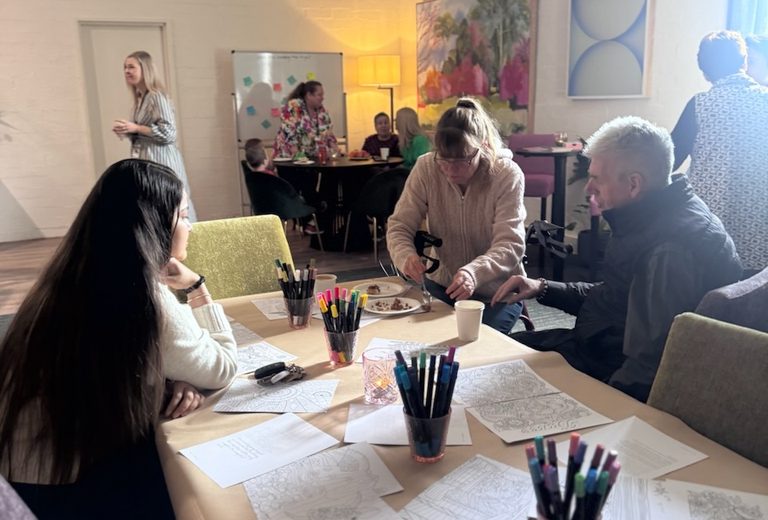
ID: Group of people sitting around a table with colouring in pages.
At My Ability Pathway, wellbeing is something we talk about often, but it is also something we need to make time for intentionally. In the disability sector, so much of the work is centred on supporting others – often through complex, emotional and physically demanding days. For frontline team members in particular, the rhythm of care can mean giving a lot of yourself, day after day.
Recently, we held our Wellbeing Together event at MAP HQ. It was planned around the time of R U OK? Day, but with a slightly different focus. While awareness days can be important reminders to check in, we wanted to create something that felt practical, gentle and ongoing – a space where people could pause, connect and be reminded that wellbeing is not a one-day conversation.
The morning itself was simple, but in many ways that was what made it meaningful. Around the room were small wellbeing stations designed to give people different ways to slow down. Some team members sat together colouring in, enjoying the quiet focus and conversation that can come from doing something with your hands. Others took time to reflect, sitting with prompts that invited them to notice what was happening in their internal world. There was also a massage chair for a much-needed neck and back massage, along with good food, drinks and time to talk.
Nothing about it was complicated. And perhaps that was the point. Sometimes wellbeing begins with permission – permission to step away from the pace of the day, to sit beside someone you may not usually work with, to take a breath, or to notice that you are carrying more than you realised.
Wellbeing Together was primarily created for our team, while also being open to clients. It gave us an opportunity to come together in a way that was relaxed and human, away from tasks, rosters, emails and routines. It was also a chance to bridge the perceived gap that can sometimes exist between frontline and administration teams.
In an organisation like MAP, every role contributes to the same purpose. Some people provide direct support in homes and communities. Others coordinate services, manage systems, communicate with families and stakeholders, or help keep the organisation moving behind the scenes. Events like this remind us that we are not separate groups doing separate work – we are one team, supporting people in different but connected ways.
For people working in the disability sector, wellbeing cannot be an afterthought. Supporting people with significant disabilities can be deeply rewarding, but it can also be exhausting. The emotional labour, the responsibility, the unpredictability and the physical demands can add up quietly over time.
That is why checking in matters – not just with the people around us, but with ourselves. Am I actually doing okay? What do I need right now? Who can I talk to if I am not coping? These questions are not signs of weakness. They are part of staying well enough to keep showing up with care, patience and compassion.
We also used the event as an opportunity to connect our team with local wellbeing resources. Lifeline has recently opened at the Barossa Community Centre on Second Street in Nuriootpa, making support more accessible within our community. While Lifeline is well known for suicide prevention, its services extend beyond crisis support. They offer free, confidential counselling, unlimited support sessions, mental health and emotional wellbeing support, and a safe space to talk through life’s challenges – big or small.
You do not need to be in crisis to reach out. Support can be for stress, anxiety, grief, relationship challenges, work pressures or the everyday weight of life. Knowing where to turn before things become overwhelming is an important part of looking after ourselves and each other.
We also encourage our male team members to explore Good Better Best Men, a volunteer-run organisation offering open men’s groups and workshops focused on connection, wellbeing and supporting one another. Sometimes the hardest step is starting the conversation, and community spaces like these can make that step feel a little easier.
Wellbeing Together was never about replacing formal supports or suggesting that one morning could meet every need. It was about reminding our team that support exists, that connection matters, and that caring for yourself is part of caring well for others.
Our hope is that events like this help create a culture where wellbeing is not only spoken about when things are difficult, but woven into the everyday. A culture where people feel safe to say they need a moment, where reaching out is encouraged, and where no one feels they have to carry things alone.
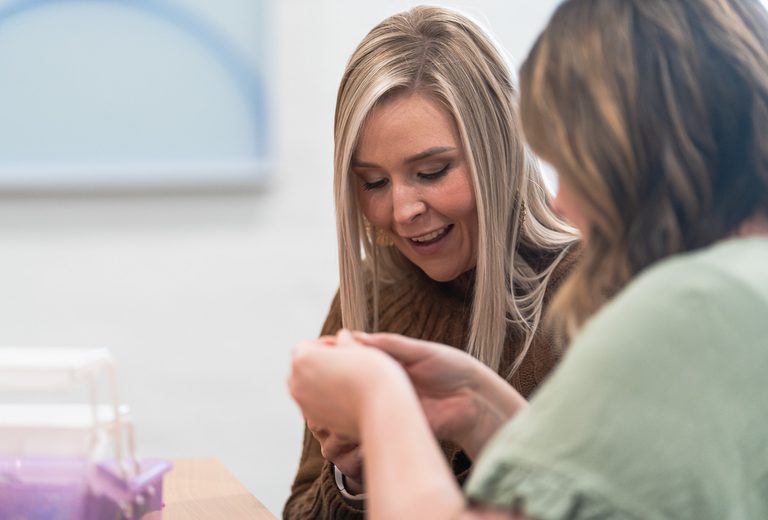
ID: Photo of two women making bracelets.
When Bianca joined My Ability Pathway as our new HR & Payroll Administrator, she stepped into more than a new workplace. She stepped into a new industry, a new role, and a team she says made her feel welcome from the very beginning.
“I’m brand new in the disability sector,” Bianca shared. “I have never worked in the disability sector…. I’m brand new to the role.”
But while there has been plenty to learn, Bianca says one thing stood out quickly: the support around her.
“Everyone is so supportive. It’s very inclusive,” she said. “From day one I’ve been part of the team, whether I’ve been part of the industry or not. I’ve felt very welcome.”
Outside of work, Bianca finds meaning and release through watercolour painting. What began around two years ago during a deeply difficult time has become an important part of how she expresses herself and makes sense of her experiences.
“I started about two years ago just after the passing of my dad,” Bianca explained. “I didn’t have the opportunity to go back home or to see him, or visit him in hospital. So I struggled with the grief process and I feel like art has given me the opportunity to deal with that grief.”
For Bianca, painting is not about perfection. It is about having somewhere safe to put feelings that can be hard to say out loud. It is a healthy coping mechanism, a creative outlet, and a reminder that expression can take many forms.
“It’s been really freeing in a sense,” she said. “I feel like that’s what art means for a lot of people. They use it as a coping mechanism, as a healthy coping mechanism.”
This year, Bianca took another brave step by submitting one of her artworks to the SALA Festival’s BE SEEN exhibition, presented by Barossa Village. The exhibition celebrates “bold journeys, fearless creativity, and the vibrancy of those souls often overlooked,” with the full collection on display at Barossa Village Lodge in Nuriootpa from 3–31 August.
Creative arts can offer people a way to communicate what words cannot always hold. Whether through painting, drawing, music, writing, movement or craft, creativity can help people explore emotion, identity, connection and healing in a way that feels personal and empowering.
For some, art is a quiet space to reflect. For others, it becomes a way to share a story, celebrate culture, process grief, or feel connected to community. Exhibitions like BE SEEN are important because they create space for those stories to be recognised, valued and celebrated.
Bianca’s artwork carries part of her own story, including why she began painting and why she believes art matters.
“I think it’s a really great tool for people to utilise when they need a way to express their feelings, to deal with their grief,” she said. “For me it was very hard, I didn’t have any family here to talk to and that was a way of expressing what I felt.”
We are proud to celebrate Bianca not only as part of the MAP team, but as someone willing to share her creativity and personal journey with the wider community. Her story is a beautiful reminder that creativity can help us process life’s hardest moments, connect with others, and be seen. You can visit the BE SEEN full collection at Barossa Village Lodge, 14 Scholz Avenue, Nuriootpa, from 3–31 August, Monday to Friday, 8:30am–4:30pm.
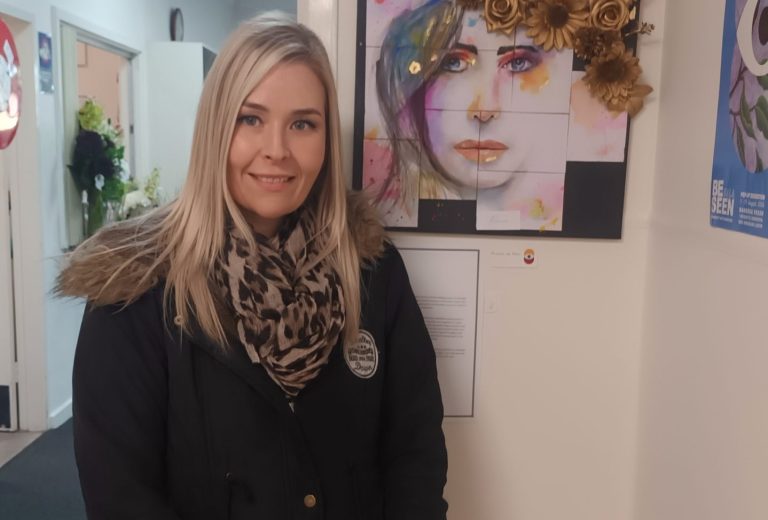
Bianca at the Barossa Village SALA Exhibition Opening on Monday 3 August 2026.
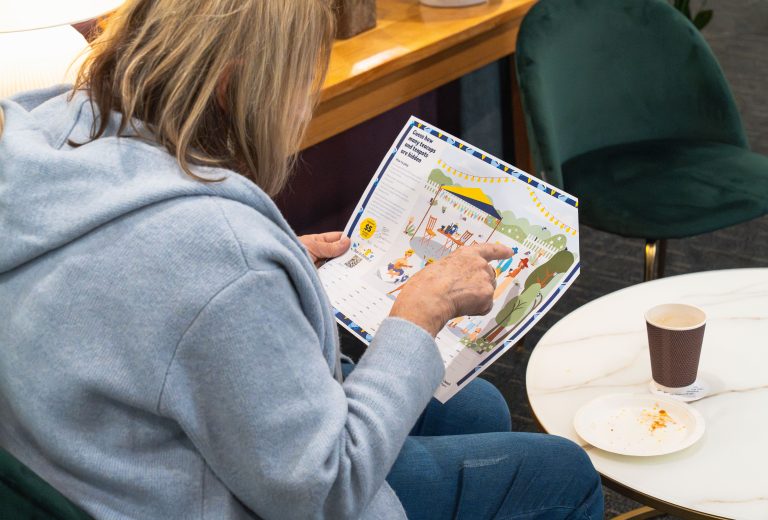
ID: A women playing the Biggest Morning Tea ‘Guess how many teacups’ game to raise funds for Cancer Council.
More than 30 people came together recently for My Ability Pathway’s third and final Australia’s Biggest Morning Tea, raising an incredible $1,108 for Cancer Council and surpassing our fundraising goal of $1,000.
It was lovely to see so many familiar faces, with clients, support workers, team members, families and local supporters gathering to enjoy good food, great company and the chance to support a cause that touches so many lives.
Like many Australians, we all know someone who has been affected by cancer. Over the past three years, these events have given us the opportunity to come together, show our support and give back in a meaningful way. Thanks to the generosity of everyone involved, we have now raised over $3,500 for Cancer Council since hosting our first Biggest Morning Tea.
This year’s event was particularly special. Not only did we exceed our fundraising target, but we were also heartened by the strong turnout and the sense of connection that filled the room. From delicious treats and coffee to raffle prizes and plenty of laughter, the morning was a reminder of what we can achieve when we come together.
As we close the chapter on our Biggest Morning Tea tradition, we do so with immense gratitude to everyone who has supported us over the past three years. While this marks the end of our involvement with this particular fundraiser, it certainly won’t be the end of our commitment to supporting meaningful causes.
We look forward to turning our attention to other worthwhile initiatives in the future and continuing to create opportunities for our community to make a difference.
Thank you to everyone who attended, donated, purchased raffle tickets, contributed prizes and helped make our final Biggest Morning Tea such a memorable success. Together, we have made a real difference.
Special thanks to the businesses and individuals who supported this event through donated goods:

ID: Photo of people sitting and listening to a women talk.
On Friday 1 May, My Ability Pathway was proud to host a Foundations Disability Inclusion Training at our HQ, bringing together more than 20 attendees from across the Barossa and surrounding regions.
Delivered by JFA Purple Orange, the session welcomed people from a diverse range of industries and backgrounds – including local businesses, community organisations, disability services, education, health, and hospitality.
While the training itself provided practical tools and insights around disability inclusion, what stood out most was the quality of the conversations happening throughout the day.
There was genuine curiosity, openness, and a shared willingness to learn. Attendees reflected on how inclusion shows up in everyday interactions, workplace culture, customer service, communication, and community participation. Just as importantly, there was space for people to ask questions, challenge assumptions, and connect with others who are equally passionate about creating more inclusive environments.
For My Ability Pathway Director Barbara Lightburn, the event reinforced the importance of bringing opportunities like this to regional communities.
“It’s not often this type of training is delivered locally in the Barossa, so it was fantastic to see such a strong cross-section of the community represented. Inclusion grows through conversations, shared learning, and people being willing to take that first step.”
A key focus of the session was helping attendees feel more confident in the language they use, the environments they create, and the everyday actions that contribute to inclusion.
Importantly, the event also created valuable networking opportunities, with attendees making new connections across industries and sectors – something that will continue to strengthen collaboration and inclusion across the region long after the session ended.
At My Ability Pathway, we believe inclusive communities are built collectively. Seeing so many local organisations and individuals investing their time into learning and connection was incredibly encouraging.
We’d like to sincerely thank JFA Purple Orange for delivering such an engaging and thought-provoking session, and thank everyone who attended and contributed so openly throughout the day.
Because meaningful change often starts with a conversation – and Friday proved just how powerful those conversations can be.
To find out more about JFA Purple Orange and the different trainings they offer, head to their website.

ID: Team and clients sitting and standing at outdoor benches.
Workplace culture. We’ve all heard of it. We all experience it. We all help shape it.
No matter what role we’re in or who we work with, every single one of us contributes to workplace culture.
Well, okay. But what is workplace culture?
It’s the environment created by share values, attitudes and behaviours within an organisation. Positive workplace cultures are recognisable by having:
Conversely, negative cultures blossom when these things are lacking – and can lead to toxic or even hostile workplaces. I could tell you some stories about that.
Gossiping in the workplace breaks trust. Micro-managing destroys autonomy. Passive-aggressive behaviour erodes the sense of belonging. We can all fall into these behaviours without even realising it – but when we allow or dismiss a behaviour that may have negative impacts, without calling it our or reframing it, that becomes the standard we accept.
And I get it – calling someone out or attempting to reframe our own comments is not easy. It’s uncomfortable. It might even feel unsafe. Sometimes we just don’t know what to say. I still don’t know how to respond to the colleague who repeatedly told me, “I’m not going to change.”
Working in the NDIS space, “positive behaviour” is a term we hear frequently. We all have an idea of what this means to us, but it’s generally accepted as acting in a constructive, helpful way within social norms. Being respectful and displaying emotional intelligence are other key points.
I’m not going to attempt to break down the complexity of human behaviour in a single blog post. The contributing factors and underlying science are far too vast and complex. Instead, I encourage you to think about your own behaviour or actions, and consider this: How much of it do you think is a choice?
Emotions and thoughts influence our behaviours, but they don’t have to control them. Learning to put space between our emotional responses and our reactive behaviours gives us a lot of power. It can stave off panic attacks, stop us acting in ways we later regret, keep us safe from an unexpected response and most of all, it lets us decide how to show up – for ourselves, for our workplace, for our loved ones.
I don’t want to downplay how difficult this sort of awareness can be, especially when there are other factors at play, like psychosocial health impacts and some disabilities. Personality, personal history and environment all contribute as well – it’s generally easier to speak up in a productive way in a place we feel supported than it is in a space where we feel threatened.
Imagine for a few minutes what life would look like for you if you were actively living as your “best self” – define this however you want.
How would you feel every day?
What would your goals be?
What would you be striving for?
Who would you be?
Sit with your best self for a while. Revisit them often. Then consider if your behaviours and actions support you to become your best self or if they move you away from that person. Some of us are familiar with “values” work, and this is a similar concept. Live according to your values and you’ll be much happier and healthier than if you live against them. But first you need to know what your values are.
Identify who your best self is. Break down what you need to do in your daily life to become or maintain being that person. This is different for each of us and includes seeking help from others.
I live my life by a profound and simple quote (that amazingly comes from a sit-com):
“Every decision you make from here on out should be in service of that.”
Whatever your “that” is, you’ll flourish when you live aligned with it.
So, let’s put it all together!
It’s unlikely that your best self is an angry, unfulfilled person going out of their way to cause harm to others. It’s unlikely you want to work for an organisation that encourages passive-aggression, whining or gossiping. These are things that drag us down and leave lingering feelings of unhappiness even after we’ve walked away from them.
How do you feel when you leave work? If it’s great, then recognise the good things and celebrate them with your team to continue nurturing that positive culture. If it’s not so great, think about ways things can improve and share that with those who can help you make a difference. If those people aren’t helping, find others who will.
We all contribute to the workplace culture.
What will your contribution be?
 ID: Behind the desk at MAP HQ.
Something I love about working with My Ability Pathway is how every person on the team is included, respected and valued. Every contribution has merit, and the intrinsic knowledge brought by each team member is celebrated.
And as an organisation, MAP is driven to develop that knowledge, build skills and empower team members. This is exciting yet can also be daunting. People may feel lost and overwhelmed when taking on new positions or accepting promotions. Change can be confronting, even when it’s positive and offering opportunities to those involved.
It’s vital to offer support through any type of change – and equally vital to ask for it when needed.
Sometimes it’s difficult to know where or who to ask for that support. Channels of communication can be complicated, people’s availability varies and for a lot of us, we just want to grin and bear it.
Something we’ve identified at MAP is the extensive knowledge held by our administrative team, knowledge that has grown from grassroots work in the disability sector. Several members of our HQ squad started their careers as support workers, studying, learning and supporting clients. Over the years – and in some cases, decades – they have progressed to different roles, including client management, team leadership and executive support.
So, what happens to all the knowledge they’ve developed on the frontline?
It sits behind a desk.
As MAP expands and builds our teams, I’ve been asking myself the same question on repeat: How do we spread that knowledge to the people that could really use it?
Let’s get personal:
My role at MAP is to provide executive support to Barb and Charlotte, our Director and General Manager respectively. Before this, I worked as a Support Coordinator for six years across MAP and another company. Prior to that, I worked in SIL settings, first as a support worker then as the equivalent of a Key Worker. I spent nearly a decade in Aged Care across residential and community, and before that I was a support worker in day options for a disability support provider.
Next year will be my 20th anniversary working in the care sector.
I’ve worked extensively with autism, dementia and managing behaviours of concern. Documentation, medication, manual handling … they’re all second nature to me. From personal care to SIL applications, I’ve done it, with the NDIS and before the NDIS.
Now I spend my time providing Support Coordination to a coupe of complex clients while otherwise supporting MAP with executive functions, communication and project work.
My knowledge sits behind a desk.
I’m not the only one.
So how do we spread that knowledge to the teams? How can we make sure the experience and learning – not just mine, but everyone across MAP – is shared with those who may benefit from it?
Answering this question is a journey we take together. With communication shared across our platforms, our monthly MAP Chats podcast and with MAP’s commitment to ongoing learning through Go1 and the Pathway to Success program. As an organisation, we prioritise information sharing in every direction. To safely and effectively support our clients, we need the valuable insights only frontline team members can provide. Never be afraid to speak up. What you know and see could be vitally important.
Every single person on the team has irreplaceable knowledge. The tiniest of details and small observations we make every day when interacting with clients, loved ones and providers adds up to a network of information that everyone can use. Never undervalue the information you bring to the team. It all combines to create a network of support.
There’s a quote I adore, from a book series I read about fifteen years ago. It has always stuck with me: “All knowledge is worth having”.
Interpret that how you will. I only encourage you to consider … who can help you? Who might know something you want to learn? It may be a person you wouldn’t have thought to ask.
Barbara Lightburn
 ID: MAP Director Barbara Lightburn, with MacKenzie
There’s a woman we know—let’s call her Kristy. She’s worked in disability support for years and is the kind of person who brings calm to the room just by walking into it. She doesn’t need to raise her voice. People trust her because she listens, not because she’s loud.
One Tuesday afternoon, she was supporting a young man named Liam. Usually gentle. Loves trains. But that day, he was off kilter. Agitated. Something had rattled him, and he couldn’t find the words to say what.
What came next was hard. A bowl thrown. A shout. A line crossed.
Kristy stayed steady. Gave him space. Spoke gently. Didn’t escalate. She used every tool she’d learned, not just from training, but from years of knowing people, of knowing what fear looks like when it wears someone else’s face.
And when it was over, she didn’t shrug and carry on. She wrote it down. Reported it. Asked for support. Not just for herself—but for Liam too.
Because care goes both ways.
At My Ability Pathway (MAP), we believe everyone deserves to be safe. Not just the people we support, but the people who support them.
We know that work-related violence—whether it’s verbal, physical, emotional, or even subtle forms of intimidation—is a very real risk in the disability support sector. But MAP refuses to treat it as “just part of the job.” That kind of thinking doesn’t protect anyone.
What protects people is honesty. Training. Systems that work. Leaders who listen. And a culture where speaking up is seen as strength, not weakness.
We’ve seen too many stories like Kristy’s. That’s why we’ve introduced the MAP Violence Prevention Policy—a new, organisation-wide commitment to safety, respect, and accountability.
This policy makes it clear: violence and aggression are never acceptable, no matter the circumstances. It sets out how we prevent it, how we respond when it happens, and how we support both our team and the individuals we serve to move forward in a way that’s safe, ethical, and informed.
For families, this means knowing that your loved one is being supported by people who are calm, well-trained, and respected in their work.
For external providers, this means working alongside a team that takes risk management seriously—without losing the humanity at the heart of what we do.
For our broader community, it means MAP is not just a service provider. We are an organisation committed to deep care—for everyone in the room.
Our policy is not just words on paper. It’s embedded in how we train, how we debrief, how we make decisions. It reflects our belief that a truly supportive environment lifts everyone—not just the client, not just the carer—but the whole community.
Because when care works both ways, everyone stands a little taller.
If you’d like to read the full policy or speak with someone about how we manage safety at MAP, please don’t hesitate to get in touch. We welcome your questions, your partnership, and your trust.
Together, we can keep building the kind of world we all want to live in—safe, respectful, and deeply human.

ID: National Volunteer Week Promotional Image with coloured text on a grey background and the #NVW2025
With National Volunteer Week currently being held, it’s a perfect opportunity to reflect on the vital contributions volunteers make to our community.
From first responders providing life-saving services to the unsung supports at community events, volunteers keep our society functioning. And for those who provide volunteer services, the rewards are wide reaching.
For some, volunteering is a stepping-stone to employment. It offers the opportunity to learn new skills and try out a job, getting a feel for what is needed and gaining valuable knowledge. Volunteering also offers a fantastic opportunity to develop skills and try new things based on your interests, unrelated to seeking paid work.
For many others, volunteering is a way to give back to the communities they love, offering support to those in need. Often, we think of our local CFS, SES or SA Ambulance service for these types of roles, however they also exist in our sports clubs, op shops, local museums and other community services.
People who regularly volunteer highlight the great joy it brings them, as well as the increased sense of connection they get from being a part of something, whatever that looks like. Some people enjoy the social elements of volunteering, while others take pleasure in working alone as they offer their contributions.
Volunteering isn’t always an easy thing to undertake. Some people have no interest in it, and for others a simple lack of time to commit can be a barrier.
However, a lack of confidence or understanding surrounding volunteering can also prevent people from getting involved. Having support when you first start out can make an immense difference. A nurturing environment with good supports helps people develop confidence in themselves and their abilities as they learn their role, while also supporting their personal development.
Living with disability is highlighted as being a major constraint on people being able to get involved with volunteering. Finding an option that suits you, matches with your interests and challenges you without being overwhelming can be a challenge. However, there are many volunteer options available to people with a variety of disabilities.
Some volunteering roles can be done online or from your own home, which offers flexibility. Accessible options also exist, allowing people with physical or sensory needs to join in. Many places value inclusivity and welcome people with diverse needs into their teams, celebrating the unique benefits each person offers and taking pride in the mutual support of these relationships.
The very first “State of Volunteering Report” in 2023 highlighted the vast numbers of South Australians volunteering their time, with over 60% of the state population aged 15 and over engaged in volunteer activity — more than 950,000 people.
This enormous contribution was estimated to have an approximate labour replacement cost of $9 billion, with 223 million hours spent volunteering across the year. Nearly 30% of volunteers indicated an intention to increase their volunteer hours over the next three years.
If you’re seeking a local volunteer opportunity, the Barossa Council website maintains a catalogue of current vacancies, also allowing you to submit an expression of interest application designed to help link you to the best possible options.
Join us in offering a heartfelt thank you to all the volunteers that keep our community safe, supported and successful.
We value you.

ID: Photo of The Barossa Council and Library Entrance in Nuriootpa
“Libraries are all about access.”
If you haven’t been to your local library in a while, it may be a surprise to what you remember. Gone are the days of silent book browsing. Libraries in our region are all about access.
Access can be a broader term than many of us imagine. We may think of doorways wide enough for a wheelchair, or ramps as an alternative to stairs. Libraries are hubs of information, and their very purpose is to make that information as accessible to as many people as they can.
To support this, all South Australian libraries offer free WiFi and computer access. In the Barossa, each library also has an accessible computer, with specialised keyboards, screens set up for ease of viewing and headphones available.
In the Barossa, our libraries are continuously growing to meet community needs and create greater access for everyone, supporting social inclusion, learning and skills development along with access to stories and information.
Collections
Collections are the range of items available to borrow from the library. In the Barossa, this naturally includes books, however there is also an extensive collection of DVDs available, along with as large-print books and audiobooks (which are available on CDs or via the “Libby” app on phone or computer). Beyond these, there are also selections of dyslexia-friendly books, graphic novels for all ages and magazines, amongst other items.
Available free of cost, these collections make stories and learning more accessible and available to those who may have difficulty with reading a traditional book.
Activities and Programming
Libraries frequently offer programs to the public, ranging from offering a space to local groups and clubs, to structured library-run programs at scheduled times. Popular programs in the Barossa include a monthly boardgame night and a collection of weekly children’s activities, which can be viewed here.
Nuriootpa library works with an Occupational Therapist and Speech Pathologist to develop children’s programs. There are also sensory toys available during groups, as well as tents for children to withdraw to if they’re becoming overwhelmed; this is an ever evolving and adapting space.
Reaching out to the library for a chat about what they can offer children with specialised needs is a great option for families in our region.
Individual technology and computer sessions are also available by appointment at Nuriootpa library twice a week, and at Mount Pleasant library one Thursday a month, supporting people to develop skills and understanding of technology.
Volunteering
A popular place for volunteering, libraries welcome diverse people into their teams and offer an array of tasks to suit the needs and interests of their people. For those with disability-related needs, libraries can be an accommodating space to volunteer, offering a wide range of tasks and options, including supporting with behind-the-scenes for those who find social elements challenging or overwhelming.
Volunteering for those with disabilities is a developing space at our Barossa libraries.
Access and Home Services
All South Australian state libraries are a part of the “OneCard network”. This provides access to any library in South Australia with a single card, offering enormous access and flexibility in borrowing and returning items.
If you are unable to get a copy of an item at your local library, they can order it through the network, so you can borrow and return it without having to visit a different library. OneCard is unique to South Australia.
For some people, though, attending any library can be difficult. In these cases, Nuriootpa library offers a Home Library service. With drop off and pick up once per month, a selection of items based on your interests can be made by the library team, or you can pick the specific items you would like. More information on home library can be found here.
Meeting Community Needs
Our Barossa libraries are continuously evolving and adapting as they become aware of the community needs, striving to create a deeper level of access. In support of this goal, the Barossa libraries are collaborating with Dementia Australia to become a dementia-friendly space, and with Disability Access Inclusion Group to develop access maps. These in-progress efforts show the dedication of our local libraries to providing for everyone in the community.
Barbara Lightburn

ID: Photo of Barb and her dog Miss Darcie
Lately, I’ve been thinking a lot about what it means to grow—and not just in the achievement sense. Growth that feels sustainable, honest and aligned. Growth that doesn’t demand we burn ourselves out or abandon ourselves to get there.
There’s this word—abundance—that gets thrown around a lot. Sometimes, it lands with meaning, but often, it feels like an empty promise. A placeholder for “more” without asking why or for whom. I’m interested in a deeper version of abundance. One that isn’t just about accumulation but about capacity. Capacity for clarity, for stillness, for better questions.
In seasons of real growth there’s usually a quiet kind of reckoning. We come face to face with what’s working and what’s not. It’s rarely glamorous. It’s often a letting go. Of expectations. Of identities we’ve outgrown. Of strategies that once served us but now feel hollow. That shedding can be painful. But it’s also where possibility lives.
Abundance, in its truest form, isn’t loud. It doesn’t need to be. It’s a deep, steady sense that there’s enough: time, space, energy, trust. That we don’t have to grip so tightly. That we can build from a place of presence instead of panic.
I’ve never been one who wanted to impress others, mostly because I am content with my space. For me, growth has looked like listening more closely. To my own instincts. To feedback. To the things that actually energise me.
To me, growth has looked like asking better questions—not just “How do I get ahead?” but “What does enough feel like?” and “What am I willing to protect even as I expand?”
We live in a culture that worships scale. But sometimes the most radical thing we can do is choose depth. Fewer things, done better. Quieter seasons, more rooted presence. Abundance isn’t the goal—it’s the result of moving from alignment.
“Abundance isn’t the goal—it’s the result of moving from alignment.”
What I mean is this:
Instead of chasing abundance as a standalone goal—more money, time, success, recognition— focus on aligning with what truly matters to you. That could be your values, your energy, your purpose, or even your capacity in a given season.
When you’re in alignment, your decisions become more intentional. You stop overextending in ways that drain you. You start investing in things that nourish you. And from that place, abundance naturally emerges—not as something forced, but as something sustained. Not just more, but more of the right things.
So, abundance isn’t the aim—it’s the outcome of living and working in integrity with yourself.
If you are in a season where things feel slow or uncertain, maybe you are in the part of growth that’s invisible. The internal rebalancing. The reorientation before the bloom.
This is a version of growth that doesn’t require us to abandon ourselves. It’s slower, but it’s real. And the abundance it brings? It’s the kind that actually sustains.
