We value your privacy
This website uses technical, functional and analytical cookies that do not infringe on your privacy.
General purpose platform session cookies are usually used to maintain an anonymised user session by the server.


ID: Photo of the front of a new Specialist Disability Accommodation house in Nuriootpa.
Looking for Specialist Disability Accommodation in Nuriootpa? Finding a suitable home involves more than checking whether a room is available. It means considering how the space works for you, what support you need and whether the location helps you stay connected to the people and places that matter. My Ability Pathway’s current vacancies page lists High Physical Support SDA in Nuriootpa, with housing provided by New Dawn Housing and Supported Independent Living supports delivered by MAP. If you are exploring your next move, here is a starting point for learning about the home and asking the questions that matter to you. Availability can change, so please contact MAP to confirm current vacancies and suitability.
Watch the Nuriootpa SDA video below as a starting point for exploring the home. As you watch, note what you would like to ask about or see during a visit. A video can help you prepare questions, but it cannot confirm whether a home will meet your individual accessibility, equipment or support needs.
MAP’s Nuriootpa vacancy listing describes a purpose-built High Physical Support home with modern accessible design, spacious shared living areas and a private bedroom with an ensuite. It also identifies proximity to local services and community facilities. These features are worth considering in relation to your own routines. How would you move between your bedroom, bathroom and shared spaces? Where would you spend time with visitors? What would help you take part in household activities in the way you prefer? The NDIS describes High Physical Support housing as including a high level of physical access for people who need very high levels of support. That category does not tell you every detail of an individual property. Ask which equipment and technologies are installed, which are provisions for future installation and what would need to be arranged for you.
New Dawn Housing is identified as the housing provider, while MAP provides the Supported Independent Living services. MAP’s listing describes 24/7 SIL support at the Nuriootpa home. Your individual assistance, overnight arrangements and any shared supports still need to be discussed; 24/7 support does not automatically mean continuous one-to-one assistance. SDA relates to the specialist home, while SIL relates to assistance or supervision with daily tasks. They are separate supports, and SDA funding does not include personal care or SIL. For an introduction, read MAP’s guide to SDA and SIL. Ask for clear information about the housing agreement, support agreement, charges and who to contact about each aspect.
For someone who wants to live in the Barossa, location may be an important part of the decision. Consider the people you want nearby, the appointments you attend and the places you enjoy visiting. Rather than relying on the phrase “close to services”, ask about the actual journey: transport, accessible routes, travel time and any assistance required. Your home should be considered alongside your wider life. Shared living also deserves discussion. Ask about the proposed household, privacy, visitors and how different routines can work together, while respecting other residents’ confidentiality.
SDA is for eligible NDIS participants with extreme functional impairment or very high support needs. A listed vacancy does not establish eligibility or guarantee that the property matches your approved funding and circumstances. Your support coordinator or chosen supporter can help you gather questions and understand the information provided. The NDIA explains that SDA residents pay a reasonable rent contribution and other day-to-day living costs, such as electricity. Request a clear breakdown of the costs for this particular home before deciding. There is no need to work through every question alone, but your preferences should remain central throughout.
If you would like to explore the Nuriootpa SDA vacancies, view the New Dawn Housing property listing on Housing Hub, check MAP’s current vacancies or contact MAP to ask about availability and a possible viewing. Call 08 8563 2569 or email ndis@myabilitypathway.org. Whether you are making an enquiry for yourself or supporting someone with their permission, the starting point is the same: what would make this a suitable home for the person who will live here?
Contact MAP to confirm Nuriootpa SDA availability, discuss your needs and ask about a viewing.

ID: Photo of a group of people outdoors having a picnic and playing games.
Have you ever come home from an activity and thought, “That filled the afternoon, but it was not really for me”? A busy calendar can look positive from the outside. Yet attending activities and feeling connected are not necessarily the same thing. Meaningful community participation begins with what you enjoy, who you want to spend time with and how you want to take part. A good starting question is not “How many outings did we organise?” but “Was this worth doing for you?”
Community might mean a local club, an art class, a library, a familiar café or time with neighbours. It might involve a disability-specific group, a mainstream activity, an online interest group or a combination. No single setting is automatically the most inclusive for everyone. The important questions are whether you want to be there, can participate in a way that suits you and have opportunities for the kind of connection you value. Enjoyment is a valid reason to take part. You do not need to turn every interest into a lesson or a measurable achievement.
Consider a hypothetical person who enjoys plants and wants to try a community gardening group. Getting there matters, but so does what happens after arrival. Can they reach the work area? Are instructions accessible? Is there a task they actually enjoy? Does someone speak directly with them rather than only with their support worker? These details can determine whether an outing becomes a valued part of the week. Meaningful participation is not about making someone more sociable. It is about making room for the involvement they want.
Start with an interest, not a vacant place on a program. Ask what you would like more of: time outdoors, creative expression, familiar conversation or a chance to learn. Being unsure is fine. Looking at a few options can be part of finding out.
Check the details that matter to you, including transport, accessible toilets, noise, seating, communication and breaks. In regional areas, consider the whole journey, including getting home. A venue’s general claim that it is accessible may not answer your particular questions. With your permission, a supporter can help ask about adjustments without sharing unnecessary personal information.
Ask whether a short visit or introductory session is possible, and clarify any charges first. Agree what help you want during the visit. Some people prefer an introduction and then space; others want ongoing assistance to communicate or take part. Neither approach is a better form of independence.
Afterwards, ask: did I enjoy it, feel included and have enough say? What would I change? The answer might be a different time, a smaller group, more assistance or a different activity altogether. Choosing not to return is useful information, not a failure.
The NDIA’s social and recreation support guidance distinguishes disability-related assistance from ordinary activity expenses. Depending on individual circumstances and funding criteria, the NDIS may fund extra help needed because of disability. General costs that everyone pays, such as ordinary membership or entrance fees, remain the participant’s responsibility. Do not assume that an activity, transport arrangement or support charge is funded simply because it links to a goal. Check your plan and current guidance before committing. A support coordinator, where involved, can help clarify questions; they do not approve NDIA funding.
There can be pressure to fill every available hour or keep adding new experiences. A familiar weekly visit may be more valuable than several unfamiliar outings. Rest, time alone and changes of mind also deserve respect. Families and support teams can help by noticing barriers without deciding what a satisfying social life should look like. Community organisations have a part to play too: welcoming communication, workable adjustments and direct engagement should not depend entirely on a support worker’s presence. Paid support can assist participation, but it cannot guarantee friendship or belonging.
The most useful next step might be small: asking about a class, returning to a familiar place or finding a way to join a conversation. Success is not always a larger calendar. It might be greater choice, a comfortable routine or taking part in something you value. MAP’s published community approach emphasises individual interests and connection. To explore assistance in the Barossa, Gawler or Adelaide’s northern suburbs, read about MAP’s disability support services and social and community participation. Begin with what matters to you, then consider what support would make it possible.

ID: photo of a client and support worker smiling at the camera.
A home can have wide doorways, a suitable bathroom and a bedroom you like, yet still leave an important question unanswered: what would living here actually be like? When you are exploring supported living, the building is only part of the decision. Daily routines, privacy, housemates, support arrangements and connection to familiar places all shape whether a home fits your life. A viewing is an opportunity to consider these things, not a test you have to pass or a decision you must make on the spot.
Supported living is a broad expression, not one NDIS funding category. Supported Independent Living (SIL) funds assistance or supervision with daily tasks at home for people with substantial support needs. Specialist Disability Accommodation (SDA) is specialist housing for eligible people with extreme functional impairment or very high support needs. Some people have both; they are not interchangeable. SIL does not pay ordinary expenses such as rent or groceries. You can read MAP’s guide to SDA and SIL for an introduction. Before considering a particular property, ask which home-and-living options may suit your circumstances and what your plan actually includes.
Think about a weekday morning rather than only the best features of the house. When do you like to wake up? How do you prefer meals to happen? What assistance do you need, and how do you communicate when something is not right? Ask how individual routines would work alongside shared support. Discuss what happens when two people need help at the same time, how overnight assistance is arranged and how changes are communicated. These questions help clarify the proposed arrangement; they do not assume that every request or staffing pattern can be accommodated.
Compatibility involves more than similar ages or support needs. Quiet evenings, visitors, pets, cooking, music and use of shared rooms can all matter. You do not need to become close friends with everyone you live with, but you do need space for your own preferences and privacy. Ask how potential housemates are introduced and how everyone’s views are considered. Any information shared should respect the other residents’ privacy. A hypothetical example: someone who enjoys a quiet breakfast may find a busy shared kitchen difficult. Discussing timing and access before a move is more useful than assuming everyone will adapt to one routine.
Ask who provides the housing, who delivers support and which agreement covers each responsibility. Request information you can understand about charges, notice periods, repairs, complaints and changing arrangements. The NDIS Commission’s SIL standard on tenancy, housing and support sets expectations for clear arrangements that distinguish housing from SIL supports and support informed decisions. It is not a substitute for advice about your particular tenancy. Ask what would happen to your housing if you wanted to change your support provider. If an answer is unclear, seek independent advice before signing rather than relying on a verbal assurance. A trusted supporter or independent advocate may help you prepare questions.
A nearby café is only useful if you can get there in a way that works for you. Consider the journey to friends, family, shops, health appointments and activities you already value. In the Barossa and Adelaide’s northern suburbs, compare actual travel arrangements rather than distance alone. Ask about accessible transport, timing, costs and the availability of support to make the trip. A home should be considered in the context of your wider life, not as a reason to start every relationship and routine again.
If exploring a move feels right, ask whether further visits or introductions can be arranged. They may not always be possible, and any costs or funding need to be clarified. With your consent, relevant information about communication, equipment and support needs can help the people involved prepare. Agree who will coordinate next steps and when you will discuss how things are going. Families and support coordinators can help organise information while keeping your preferences central. If people disagree, write down the different concerns rather than allowing the most confident voice to settle the decision.
You do not need all the answers at the first viewing. What matters is having enough clear information and appropriate assistance to make an informed decision. MAP provides SIL supports and works with housing providers in the Barossa. If you are beginning to explore local options, visit MAP’s Barossa SDA information page or contact MAP with your questions. Availability, suitability and funding need to be considered individually.
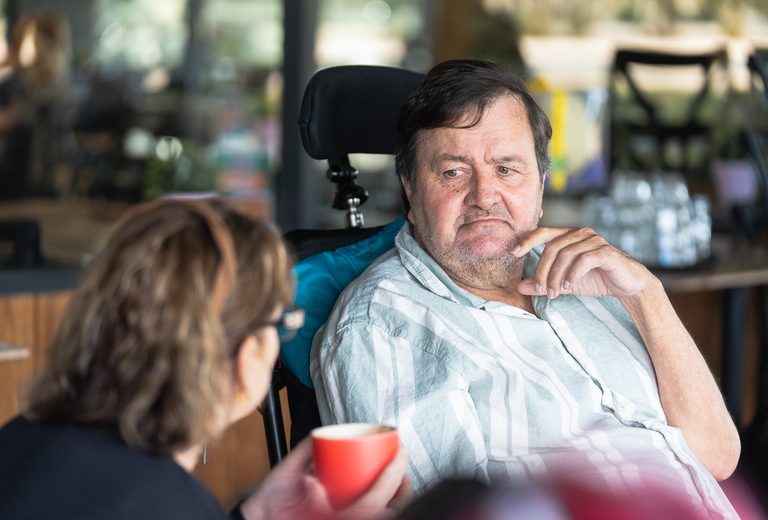
ID: Photo of Ian out at MAP’s Easter Morning Tea event.
For Ian and his family, moving into Specialist Disability Accommodation (SDA) in Nuriootpa has been about much more than finding an accessible house. It has been about creating a home that supports safety, independence, family connection and everyday choice.
After experiencing multiple strokes in 2023, Ian’s life changed significantly. Once a truck driver who had lived independently, Ian became wheelchair bound and needed a home designed around his physical support needs. His daughter, Regina, said the family knew that having access to an SDA home would be important for Ian’s future.
“Having access to an SDA house was what we were needing for his needs going forward,” Regina shared.
Specialist Disability Accommodation is purpose-built housing for NDIS participants with extreme functional impairment or very high support needs. For people like Ian, SDA can make daily routines safer, easier and more comfortable by removing barriers within the home and supporting greater independence.
For Ian, the difference is felt in the everyday details. Regina explained that his SDA home is “designed better” for him because it caters to his needs as a wheelchair user. Open spaces allow him to move through the home more freely, while accessible design features support the routines, interests and choices that continue to matter to him.
“He’s always enjoyed cooking,” Regina said, describing how adjustable kitchen benches allow Ian to remain involved in an activity he enjoys. “Having benches that can move up and down… cater for people who are in wheelchairs.”
Accessible housing is often spoken about in terms of equipment, floorplans and support ratios, but its real value is found in the way it helps people participate in their own lives. Ian’s Nuriootpa SDA home gives him room to move, space for safe transfers and the ability to do meaningful things for himself.
Regina shared that Ian can wheel himself to the front door and open it for her when she visits. It is a simple moment, but one that reflects the importance of independence, privacy and dignity within the home.
“He can wheel himself up,” Regina said. “The bathroom’s big enough so he can get in and out there… he’s got the big space to be able to be lifted to and from bed into wheelchair.”
One of the most important parts of Ian’s SDA journey has been location. Ian lives in the Barossa, close to Regina and his grandchildren. For their family, being near familiar places and people was an important part of finding the right long-term home.
Regina explained that Nuriootpa was a good fit because it kept Ian close to family routines and community connections. “It’s only 30 minutes away from where I live and my kids go to school here in the Barossa,” she said. “We’re always over here… the plan long term [was] to be able to have him as close to family as possible.”
This is why Specialist Disability Accommodation in regional communities like the Barossa matters. Purpose-built SDA homes can help people with disability remain connected to their families, local services, support networks and the communities they know, while receiving the daily support they need to live safely and well.
Ian’s story is a reminder that the right SDA home does more than meet physical access requirements. It supports confidence, comfort, connection and choice. It gives families reassurance that their loved one is living in a place designed around their needs, while also creating opportunities for the person to stay involved in everyday life.
At My Ability Pathway, we believe accessible housing should support people to live with dignity, independence and a strong sense of belonging. Through our Supported Independent Living services within SDA homes across the Barossa, we work alongside participants, families, support coordinators and housing providers to help people build a life that reflects their needs, preferences and goals.
We currently have a vacancy in a Nuriootpa Specialist Disability Accommodation home. If you are eligible for SDA, or know someone who may be looking for accessible housing in the Barossa, we encourage you to reach out to our team. More information about SDA can be found on our Barossa SDA page, and details about our current Nuriootpa vacancy are available on our Current Vacancies page.
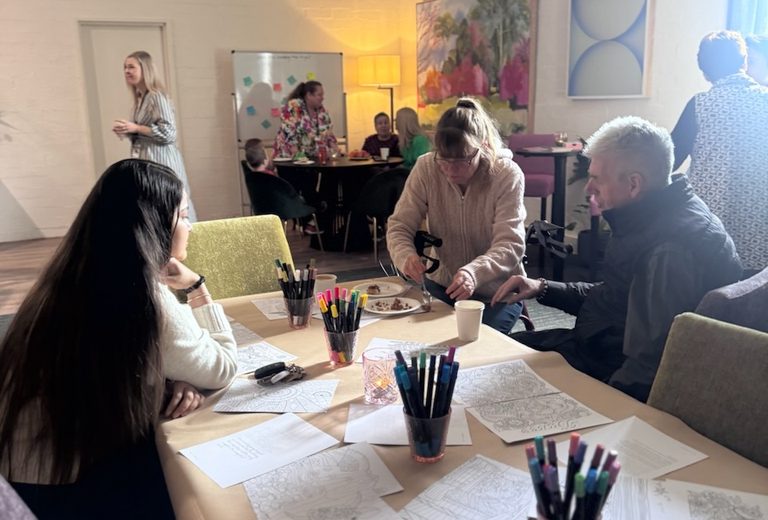
ID: Group of people sitting around a table with colouring in pages.
At My Ability Pathway, wellbeing is something we talk about often, but it is also something we need to make time for intentionally. In the disability sector, so much of the work is centred on supporting others – often through complex, emotional and physically demanding days. For frontline team members in particular, the rhythm of care can mean giving a lot of yourself, day after day.
Recently, we held our Wellbeing Together event at MAP HQ. It was planned around the time of R U OK? Day, but with a slightly different focus. While awareness days can be important reminders to check in, we wanted to create something that felt practical, gentle and ongoing – a space where people could pause, connect and be reminded that wellbeing is not a one-day conversation.
The morning itself was simple, but in many ways that was what made it meaningful. Around the room were small wellbeing stations designed to give people different ways to slow down. Some team members sat together colouring in, enjoying the quiet focus and conversation that can come from doing something with your hands. Others took time to reflect, sitting with prompts that invited them to notice what was happening in their internal world. There was also a massage chair for a much-needed neck and back massage, along with good food, drinks and time to talk.
Nothing about it was complicated. And perhaps that was the point. Sometimes wellbeing begins with permission – permission to step away from the pace of the day, to sit beside someone you may not usually work with, to take a breath, or to notice that you are carrying more than you realised.
Wellbeing Together was primarily created for our team, while also being open to clients. It gave us an opportunity to come together in a way that was relaxed and human, away from tasks, rosters, emails and routines. It was also a chance to bridge the perceived gap that can sometimes exist between frontline and administration teams.
In an organisation like MAP, every role contributes to the same purpose. Some people provide direct support in homes and communities. Others coordinate services, manage systems, communicate with families and stakeholders, or help keep the organisation moving behind the scenes. Events like this remind us that we are not separate groups doing separate work – we are one team, supporting people in different but connected ways.
For people working in the disability sector, wellbeing cannot be an afterthought. Supporting people with significant disabilities can be deeply rewarding, but it can also be exhausting. The emotional labour, the responsibility, the unpredictability and the physical demands can add up quietly over time.
That is why checking in matters – not just with the people around us, but with ourselves. Am I actually doing okay? What do I need right now? Who can I talk to if I am not coping? These questions are not signs of weakness. They are part of staying well enough to keep showing up with care, patience and compassion.
We also used the event as an opportunity to connect our team with local wellbeing resources. Lifeline has recently opened at the Barossa Community Centre on Second Street in Nuriootpa, making support more accessible within our community. While Lifeline is well known for suicide prevention, its services extend beyond crisis support. They offer free, confidential counselling, unlimited support sessions, mental health and emotional wellbeing support, and a safe space to talk through life’s challenges – big or small.
You do not need to be in crisis to reach out. Support can be for stress, anxiety, grief, relationship challenges, work pressures or the everyday weight of life. Knowing where to turn before things become overwhelming is an important part of looking after ourselves and each other.
We also encourage our male team members to explore Good Better Best Men, a volunteer-run organisation offering open men’s groups and workshops focused on connection, wellbeing and supporting one another. Sometimes the hardest step is starting the conversation, and community spaces like these can make that step feel a little easier.
Wellbeing Together was never about replacing formal supports or suggesting that one morning could meet every need. It was about reminding our team that support exists, that connection matters, and that caring for yourself is part of caring well for others.
Our hope is that events like this help create a culture where wellbeing is not only spoken about when things are difficult, but woven into the everyday. A culture where people feel safe to say they need a moment, where reaching out is encouraged, and where no one feels they have to carry things alone.
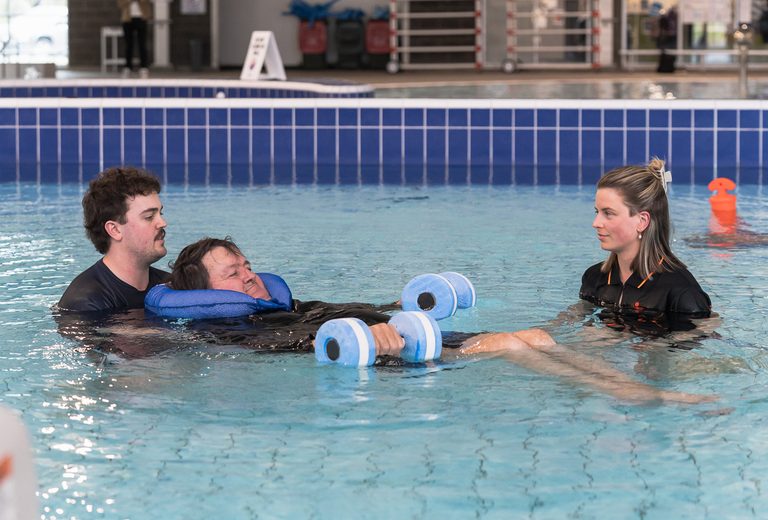
ID: A photo of Ian at The Rex Barossa Aquatic Fitness with Physiotherapist Aaron (left) and My Ability Pathway Service Delivery Lead Brooke (right).
For Ian, hydrotherapy is about more than exercise. It is time out of the house, time away from the routines of everyday life, and an opportunity to move in a way that feels more possible.
Supported by his My Ability Pathway team and guided by Aaron from Tanunda Physiotherapy, Ian has been attending hydrotherapy as part of his broader therapy routine. Together, they are working toward a goal that holds deep meaning for him: walking.
When asked what walking again would mean to him, Ian’s answer was simple: “A lot. I used to do a lot of it.”
Hydrotherapy uses the warmth, buoyancy and support of water to help people move with less pressure on their joints. For Ian, the water provides a space where exercise can feel more achievable than it does on land.
“When the water’s fairly warm it’s beautiful,” Ian said. While he is still working toward getting more movement and strength back in his legs, hydrotherapy has become an important part of that process.
Ian’s support worker Ryan has seen the difference that consistent therapy is making. “Since I’ve started working with you, you’ve definitely got more flexibility in your legs,” Ryan said. “You can straighten up a lot more than you used to.”
That progress matters. For many people, therapy is not about one big moment of change. It is about small improvements over time: a little more movement, a little more confidence, a little more comfort, and the support to keep going.
Ryan supports Ian to get to and from hydrotherapy, helping make the routine possible. For Ian, this practical support means he can continue accessing therapy, stay connected to his goals and take part in something he enjoys.
“It gets me out of the house,” Ian said. “It’s much easier to do the exercises in the water than it is on dry land.”
That sense of enjoyment is just as important as the exercises themselves. When supports are built around a person’s goals, interests and daily life, therapy can become something meaningful rather than just another appointment.
Aaron, Ian’s physiotherapist from Tanunda Physiotherapy, has been supporting Ian through a mix of hydrotherapy and land-based therapy. He has seen how the water can create opportunities that may not be available in other environments.
“The hydrotherapy is definitely fantastic for Ian,” Aaron said. “He’s allowed to do a lot more things in the water than he might not be able to do on land, and it’s an opportunity to just relax a little bit as well, just get out of the chair and move a little bit more freely in the water.”
For Ian, this combination of movement, relaxation and support is helping him continue working toward his goals. Each session is another step in building flexibility, confidence and capacity.
At My Ability Pathway, support looks different for every person. For some people, it might be building independence at home. For others, it might be reconnecting with community, learning new skills or working toward mobility goals. For Ian, hydrotherapy is one part of a bigger journey – one guided by patience, encouragement and the belief that every step forward matters.
And while Ian is clear that he is still working toward where he wants to be, he is also clear about what keeps him going: the chance to move, to get out, and to keep working toward walking again.
Progress can take time, but with the right team and the right supports around him, Ian is continuing to move forward – in the water, on land, and toward the goals that matter most to him.
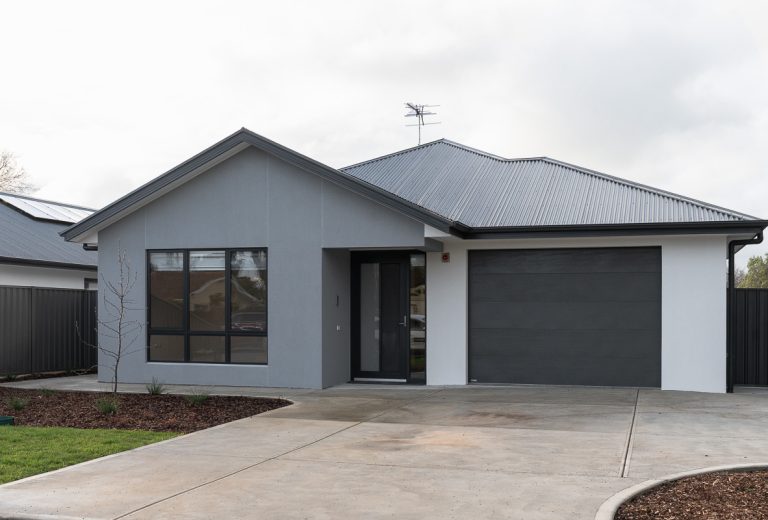
ID: Photo of the front of a modern SDA home in Tanunda.
Finding the right home can be life-changing. For people with disability, a home that is safe, accessible and designed around individual needs can create new opportunities for independence, confidence and connection.
In the heart of Tanunda, three new Specialist Disability Accommodation (SDA) dwellings are helping create that opportunity. Built by Metcalf Group (SA), with Metcalf Inclusive Living as the registered SDA Provider, these purpose-built homes have been thoughtfully designed to support people to live with greater comfort, choice and dignity.
My Ability Pathway provides the Supported Independent Living (SIL) supports within the homes, working alongside residents to build daily routines, develop skills, participate in their community and live as independently as possible.
Each Tanunda SDA dwelling has been created with accessibility at the centre of its design. The homes include large bedrooms with individually controlled heating and cooling, allowing each resident to enjoy their own level of comfort throughout the year. Every bedroom also includes a modern, fully accessible ensuite, supporting privacy, dignity and ease in everyday routines.
Shared living has also been carefully considered. With two separate living areas and a generous undercover alfresco, residents have space to spend time together, welcome family and friends, or enjoy quiet moments in a more private setting.
Accessibility continues throughout the entire property. From the kerb through to the alfresco area, clear and continuous pathways support safe and easy movement for wheelchair users. Practical features, such as an accessible front entry door with an integrated sliding screen, help make the homes welcoming, functional and easy to live in.
Built to the High Physical Support SDA Design Standard, the homes include provisions for future ceiling hoists, automated doors and blinds, and the installation of handrails. These features mean the environment can be adapted as a person’s support needs change over time, helping residents feel secure in a home that can continue to support them into the future.
Soft ambient hallway lighting has been installed to improve visibility in the evening while creating a warm, calm atmosphere. In the kitchen, accessible design features include an adjustable-height benchtop, provision for adjustable overhead cupboards and a side-opening oven, supporting residents to take part in daily living tasks with greater ease and confidence.
Located in Tanunda, the homes offer a balance of quiet residential living and connection to local services. Foodland, pharmacies, cafés and shopping are only a short drive away, while Tanunda Hospital is located nearby. For residents, this means everyday essentials, health services and community activities are within easy reach.
Safety and sustainability have also been considered throughout the design. A commercial fire sprinkler system, monitored by the Metropolitan Fire Service, provides added peace of mind for residents, families and support providers. Solar panels and battery storage support improved energy efficiency, while landscaped gardens with automatic irrigation create an attractive, low-maintenance outdoor environment to enjoy throughout the year.
SDA and SIL often work together, but they are different parts of a person’s NDIS support. SDA refers to the physical home – the purpose-built dwelling designed for people with significant functional impairment or very high support needs. SIL refers to the support a person receives to live as independently as possible, including help with daily routines, personal care, skill development and community participation.
In Tanunda, Metcalf Group (SA) has built the SDA dwellings, Metcalf Inclusive Living is the registered SDA Provider, and My Ability Pathway provides the Supported Independent Living supports. Together, these roles help create homes where residents can feel safe, supported and truly at home.
If you would like to learn more about Specialist Disability Accommodation, the difference between SDA and SIL, or the current vacancies, click here for more information and to submit an expression of interest or click the button below.
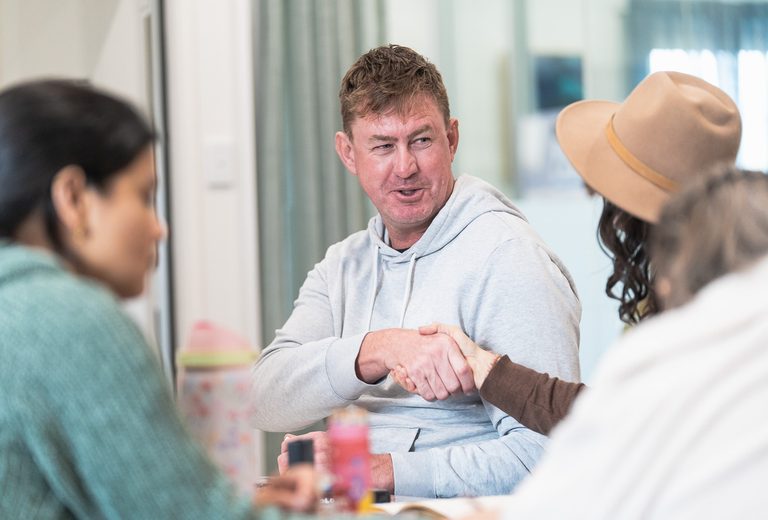
ID: Man sitting at a table and shaking hands with a women wearing a hat
When Ashley reflects on his journey, he doesn’t begin with what has been lost. He begins with gratitude, perspective and a steady belief that each day still holds the possibility of something good.
“It’s been a challenging journey, but I think it’s an exciting journey,” Ashley shares. “Every day I face my challenges, yet that is okay, my cup is half full. I’m thankful for what I have today and where I’ve come from if we looked at it from where I was to where I’m now.”
It is this sense of optimism that has carried Ashley through a period of enormous change. After becoming unwell, Ashley found himself in hospital in Adelaide, facing a future that suddenly looked very different from the life he had known. Independence, something he had once been able to rely on without much thought, was no longer guaranteed. Everyday tasks such as showering, getting dressed and moving through the day now required support.
“I no longer had independence anymore,” Ashley says. “I could no longer do what I used to be able to do and I needed help with my daily tasks.”
That adjustment was not only physical. For Ashley, coming to terms with the change also meant working through the emotional weight of uncertainty. He was trying to understand what life might look like, how he would manage, and how he could rebuild a sense of control. While the experience was difficult, Ashley was surrounded by family who helped him through those early stages.
At the time, Ashley and his family were living around two and a half hours from Adelaide. Being away from his wife and two boys during his hospital and rehabilitation journey was hard. As rehab continued, Ashley moved to the Barossa, where family support and local services helped make his recovery feel more possible.
A key part of that shift was discovering support close to home. Ashley was able to access hydrotherapy in Nuriootpa, continuing the rehabilitation he had begun in hospital. From there, more local supports became part of his life, including physiotherapy, occupational therapy, exercise physiology and community-based activities.
For Ashley, returning to the Barossa was more than a practical decision. It was a homecoming. A Barossa local, born and bred, he knew the area, the people and the sense of community that had shaped him. Moving back gave Ashley the chance to be closer to the supports, relationships and familiar places that could help him keep moving forward.
“The whole community piece is a huge part for me,” Ashley explains. Before becoming unwell, connection and supporting others had been a big part of his identity. When illness changed his daily life, that sense of involvement was something he deeply missed. Rebuilding those connections became an important part of his wellbeing.
Since moving back, Ashley has found strength not only in formal supports, but in the everyday power of community. He speaks about social outings, local groups and shared experiences with others who understand pain, fatigue and the challenges that are not always visible to the outside world.
“We’re all living through these similar things,” Ashley says. “Everyone has a very challenging journey and I think rolling this together, we need to support and be there for each other.”
That shared understanding matters. Ashley knows that not every disability, illness or ongoing health challenge is immediately visible. He has noticed that when people are not using a wheelchair or walking aid, others may assume they are okay. For Ashley, spaces where people can speak openly, feel understood and be met without judgement are essential.
Connection has also supported Ashley’s confidence, self-worth and passion for advocacy. His journey has helped him see how important it is for people to have someone to talk to, somewhere to belong, and access to the right supports in their own community. He believes there is value in more local opportunities where people can connect, share and support one another.
Acceptance has been a long process. Ashley is honest about that. There are days that are harder than others, and the journey has required him to get to know what he describes as “the new me”. But even within that reality, Ashley continues to choose hope.
“Some days are worse than others yet I’m thankful for every day,” he says. “There are good things to look forward to.”
Ashley’s story is a reminder that rehabilitation is not only about appointments, exercises or clinical progress. It is also about family, community, connection and having the right supports close enough to make daily life feel achievable. For Ashley, coming home to the Barossa has meant being surrounded by people and services that support his healing, independence and sense of purpose.
His cup-half-full outlook does not ignore the challenges he faces. Instead, it makes space for them while still recognising how far he has come. Ashley’s optimism, honesty and commitment to supporting others continue to shape his journey – one day, one connection and one step at a time.
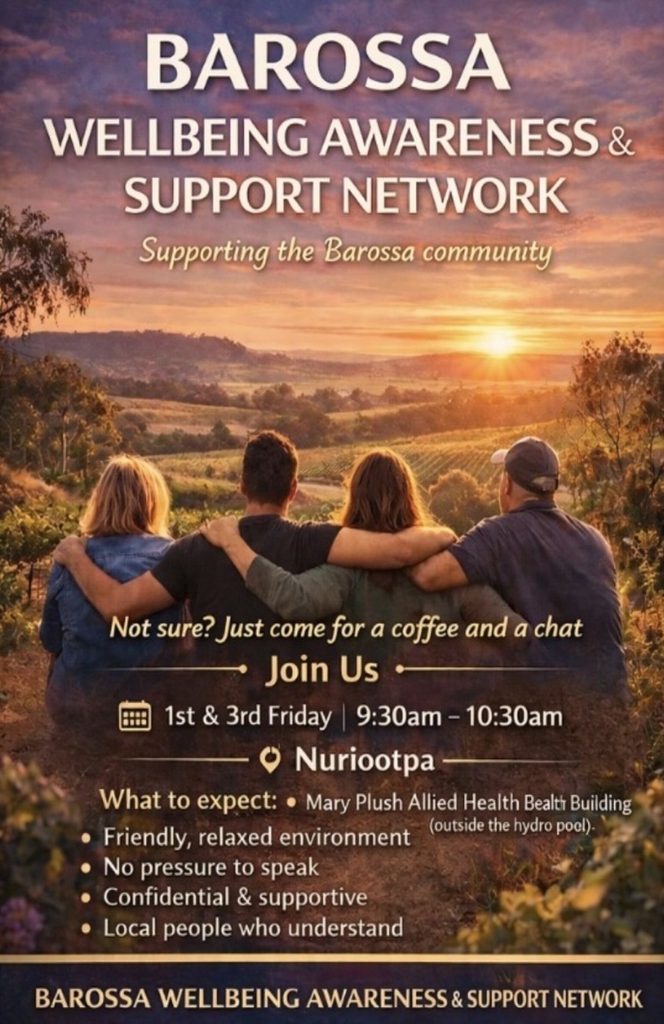
Ashley also helps run the Barossa Wellbeing Awareness & Support Network, held on the 1st and 3rd Friday of each month from 9:30am to 10:30am at the Mary Plush Allied Health Building. The group offers a friendly, relaxed and confidential space where there is no pressure to speak, just support from local people who understand. See the poster below for more information.
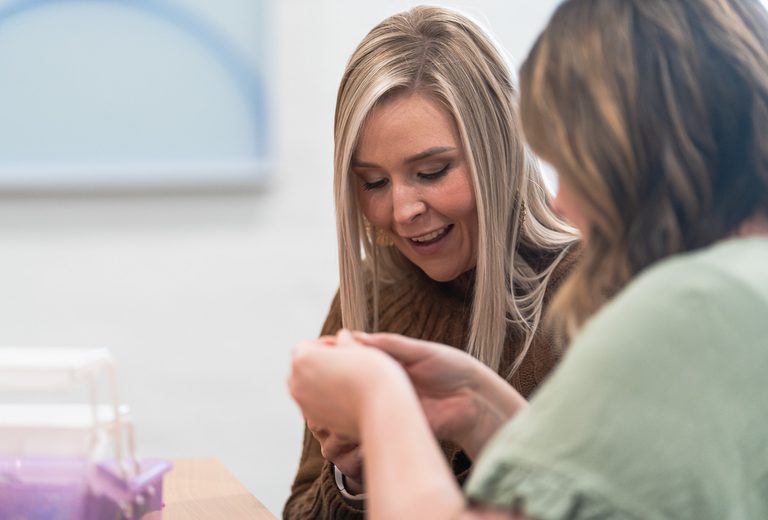
ID: Photo of two women making bracelets.
When Bianca joined My Ability Pathway as our new HR & Payroll Administrator, she stepped into more than a new workplace. She stepped into a new industry, a new role, and a team she says made her feel welcome from the very beginning.
“I’m brand new in the disability sector,” Bianca shared. “I have never worked in the disability sector…. I’m brand new to the role.”
But while there has been plenty to learn, Bianca says one thing stood out quickly: the support around her.
“Everyone is so supportive. It’s very inclusive,” she said. “From day one I’ve been part of the team, whether I’ve been part of the industry or not. I’ve felt very welcome.”
Outside of work, Bianca finds meaning and release through watercolour painting. What began around two years ago during a deeply difficult time has become an important part of how she expresses herself and makes sense of her experiences.
“I started about two years ago just after the passing of my dad,” Bianca explained. “I didn’t have the opportunity to go back home or to see him, or visit him in hospital. So I struggled with the grief process and I feel like art has given me the opportunity to deal with that grief.”
For Bianca, painting is not about perfection. It is about having somewhere safe to put feelings that can be hard to say out loud. It is a healthy coping mechanism, a creative outlet, and a reminder that expression can take many forms.
“It’s been really freeing in a sense,” she said. “I feel like that’s what art means for a lot of people. They use it as a coping mechanism, as a healthy coping mechanism.”
This year, Bianca took another brave step by submitting one of her artworks to the SALA Festival’s BE SEEN exhibition, presented by Barossa Village. The exhibition celebrates “bold journeys, fearless creativity, and the vibrancy of those souls often overlooked,” with the full collection on display at Barossa Village Lodge in Nuriootpa from 3–31 August.
Creative arts can offer people a way to communicate what words cannot always hold. Whether through painting, drawing, music, writing, movement or craft, creativity can help people explore emotion, identity, connection and healing in a way that feels personal and empowering.
For some, art is a quiet space to reflect. For others, it becomes a way to share a story, celebrate culture, process grief, or feel connected to community. Exhibitions like BE SEEN are important because they create space for those stories to be recognised, valued and celebrated.
Bianca’s artwork carries part of her own story, including why she began painting and why she believes art matters.
“I think it’s a really great tool for people to utilise when they need a way to express their feelings, to deal with their grief,” she said. “For me it was very hard, I didn’t have any family here to talk to and that was a way of expressing what I felt.”
We are proud to celebrate Bianca not only as part of the MAP team, but as someone willing to share her creativity and personal journey with the wider community. Her story is a beautiful reminder that creativity can help us process life’s hardest moments, connect with others, and be seen. You can visit the BE SEEN full collection at Barossa Village Lodge, 14 Scholz Avenue, Nuriootpa, from 3–31 August, Monday to Friday, 8:30am–4:30pm.
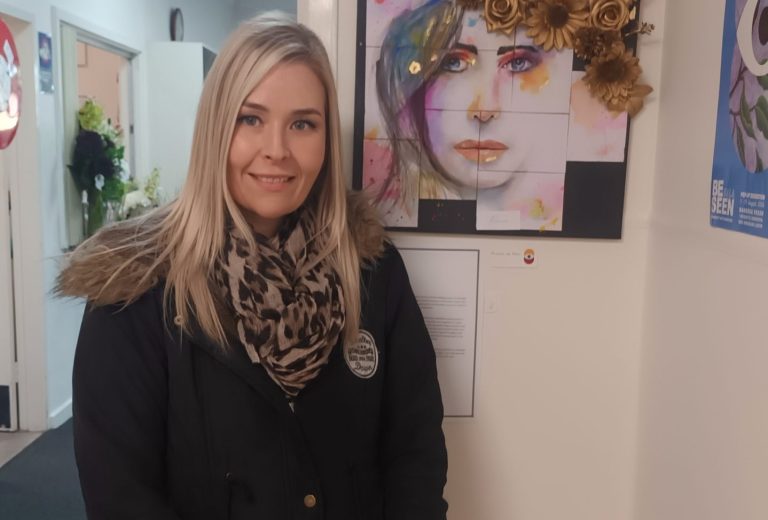
Bianca at the Barossa Village SALA Exhibition Opening on Monday 3 August 2026.
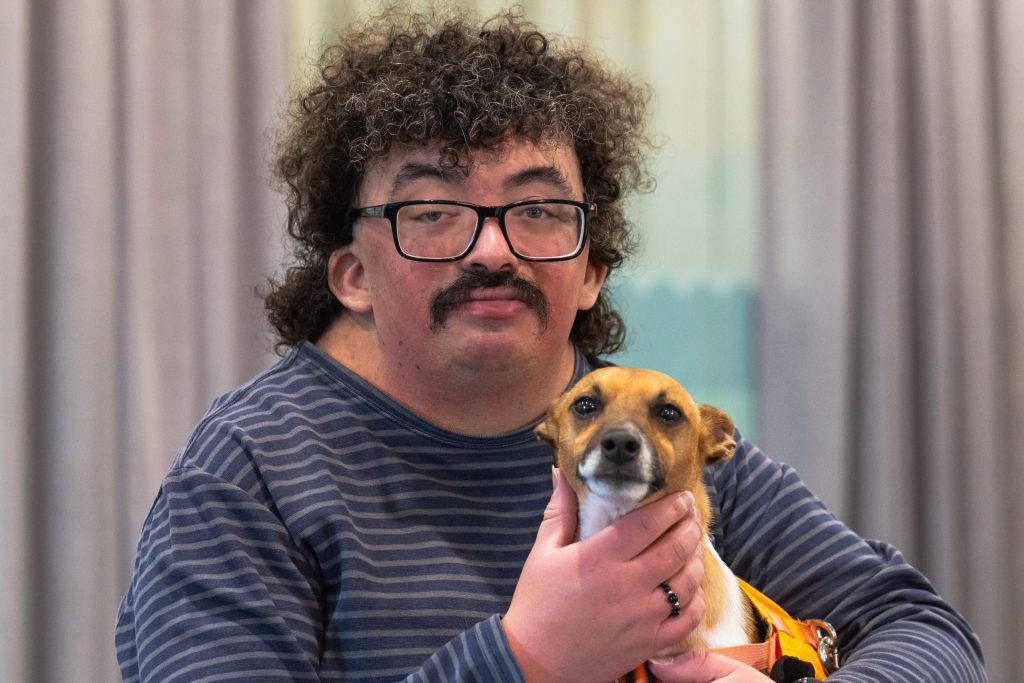
ID: Man sitting and facing the camera holding his pet dog.
For Malcolm Smith, independence doesn’t mean doing everything alone.
Instead, it means having the right support to live life on his own terms.
“There’s two types of independence,” Malcolm explains. ” Independence with help has been very much appreciated.”
Today, Malcolm lives independently with his dog, Bo, in a home that’s filled with routine, purpose and the confidence to enjoy everyday life. It’s a life that wasn’t possible before accessing support through the NDIS.
For Malcolm, support isn’t about someone taking over. It’s about having someone there when he needs it.
Whether it’s preparing healthy meals, attending medical appointments, getting out into the community or trying something new, having trusted support workers has helped Malcolm maintain his independence while building new skills and confidence.
“I’ve been able to cook better meals,” he says. “Just having someone with me when I need it to take me to doctor’s appointments and take me around if I want to go somewhere.”
His week is now full of activities that bring connection and enjoyment. Mondays are spent at an art group. Wednesdays are for cooking. Thursdays include water aerobics with one of his support workers, while Fridays are another opportunity to prepare a hearty meal. Monthly group dinners and social outings provide even more chances to connect with others, and weekends are often spent catching up with family.
These are things Malcolm says simply weren’t part of his life before.
“Yes,” he says. “I couldn’t do these things before.”
Before receiving NDIS supports, Malcolm spent many years living with chronic migraines that significantly impacted his daily life.
“For about 10 years I was mainly alone, very isolated,” he says. “Because of the pain… I wasn’t doing any of that. I wasn’t happy.”
The combination of physical health challenges and isolation meant everyday activities became difficult, and social connection was limited.
Today, life looks very different.
Support through the NDIS has helped Malcolm access community activities, maintain his home with the assistance of a cleaner, and receive equipment that has made a real difference to his independence.
A new mobility scooter has made shopping easier and given him the freedom to take Bo for walks.
“My new gopher has been extremely helpful with taking Bo on his walks,” Malcolm says. “And now I have something that helps me go to the shops better.”
It’s these practical supports that have opened the door to greater independence and a more connected life.
When asked what the right support means to him, Malcolm’s answer is simple.
“The right support is the ability to be yourself,” he says.
“To have someone help you be yourself and help you do your daily activities. And someone who pushes you – only a tiny little bit,” he says. “I don’t like to be pushed too much, only a tiny bit to do something different.”
That balance of encouragement and respect has helped Malcolm grow in confidence while remaining in control of his own life.
For Malcolm’s mum, Carolyn, watching her son’s confidence grow has been one of the greatest rewards.
“As a parent I am so relieved to have the supports in place through the NDIS because it has taken so much pressure off me,” she says.
After raising Malcolm and his sister on her own following the loss of Malcolm’s father when he was young, Carolyn spent many years as his primary support.
Today, she sees a very different Malcolm.
“It’s been fantastic as a parent to see Malcolm be able to grow through the NDIS and My Ability Pathway,” she says.
“The people who come in and support him are really caring and kind people, and I think that’s really important.”
Perhaps the biggest change has been Malcolm’s confidence.
“He was very scared in the beginning of having people coming into his home,” Carolyn recalls. “Now he’s really happy to have people come in. In the past he would never open the door, wouldn’t answer his telephone, and now to see his confidence grow… I’m just proud of the person he has become.”
Malcolm’s story is a reminder that independence looks different for everyone.
Sometimes, independence means asking for help. It means having people around who encourage you, respect your choices and provide the support you need to live the life you want.
With the right supports through the NDIS, Malcolm has gone from years of isolation to a life filled with connection, routine, confidence and choice.
And for Malcolm, that’s exactly what independence means.
