We value your privacy
This website uses technical, functional and analytical cookies that do not infringe on your privacy.
General purpose platform session cookies are usually used to maintain an anonymised user session by the server.

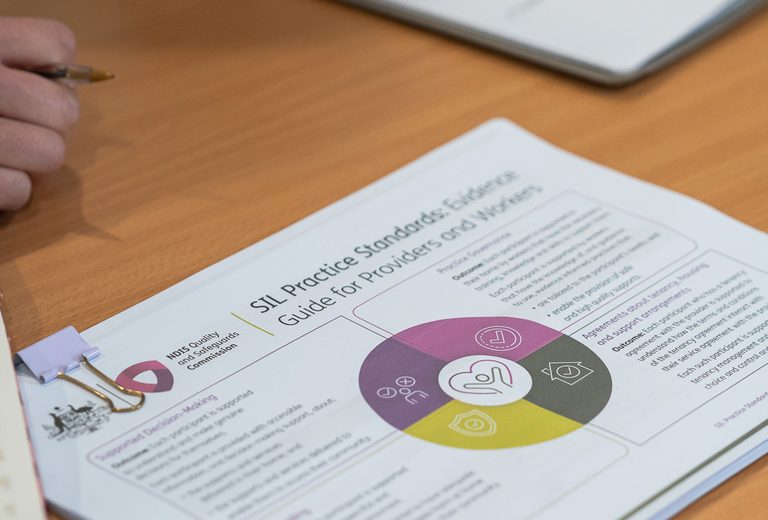
ID: Photo of a print out of the new SIL Practice Standards.
There has been a lot of conversation recently about the newly released Supported Independent Living (SIL) Practice Standards.
Introduced by the NDIS Quality and Safeguards Commission, the standards are designed to uphold the rights, safety and wellbeing of participants who receive SIL supports. People with SIL funding often receive support for most, or all, of the day, including overnight support.
The introduction of these standards also sits alongside new registration requirements for NDIS providers offering SIL supports. The standards came into effect on 1 July 2026, with providers needing to have mandatory NDIS registration in place, or have applied for it, by 1 October 2026.
The SIL Practice Standards are made up of four key areas: Supported Decision-making, Safeguarding, Practice Governance, and Agreements about Tenancy, Housing and Support Arrangements. Together, these areas are designed to support:
While there is a compliance element to the standards, and providers will be audited against them, these areas go deeper than meeting requirements. They are about strengthening quality, consistency and person-centred outcomes for participants.
Each area includes a dedicated intent, individualised quality indicators, and statements around expectations and outcomes. These can be viewed on the NDIS Commission website.
For participants, families and support networks, these benchmarks can also help build a clearer understanding of what quality supports should look like in a SIL setting.
Supported Decision-making: Ensures participants are supported, where needed, to make decisions about their own lives, rather than having decisions made for them.
Safeguarding: Outlines how SIL providers work to keep participants safe from harm, abuse, violence and neglect, while respecting choice, dignity of risk and individual decision-making. It also ensures SIL workers have the skills to identify and respond to signs of harm using a person-centred, trauma-informed approach.
Practice Governance: Sets out how providers are responsible for creating and maintaining safe living environments, supported by practice leadership, clear processes and good governance.
Agreements about Tenancy, Housing and Support Arrangements: Ensures providers have clear agreements in place that distinguish SIL supports from tenancy or housing arrangements. It also outlines how participants are supported to make decisions about who they live with, how support is delivered, and how changes can be made.
The quality indicators for each area map out the key, measurable criteria needed to demonstrate the outcomes of the SIL Practice Standards.
The NDIS Commission has shared resources to help participants, families, support people, providers and teams understand the SIL Practice Standards. These can be found here.
At MAP, we will continue to share updates and take a deeper look into each area of the SIL Practice Standards over the coming months, so keep an eye out.

ID: low angle photo of pink and orange balloons with sad and happy faces.
It can be hard to understand something we cannot see. Psychosocial disability is often hidden beneath the surface, which means its impacts can be overlooked, minimised or misunderstood. For people living with mental health conditions that affect daily life, relationships, work or study, that lack of understanding can lead to stigma, discrimination and sometimes, a painful absence of compassion.
Mental health conditions are, as the name indicates, health conditions. In Australia, they are treated by the healthcare system and supported by Medicare. Psychosocial disability exists when a person living with a mental health condition experiences functional difficulties or barriers directly related to the impacts of that condition.
Those impacts can show up in daily activities, social interactions, work, study and other parts of life. They don’t look the same for everyone. Some people may be able to work or study with support or clear boundaries, while others may go through periods where daily tasks, social connection or employment become very difficult – or even impossible – to manage, at least for a time.
One of the reasons psychosocial disability is so often misunderstood is that mental health conditions are not always visible. The disability impacts can be overlooked or misread. Someone might be labelled as lazy, difficult, messy, withdrawn or unwilling, when what’s really happening is that they are facing functional barriers connected to their mental health condition.
Comments like “be happy” or “run it off” don’t recognise how serious mental health conditions can be, or the very real disability impacts that can come with them. Those kinds of attitudes can add to stigma and make it harder for people to feel understood or supported.
The numbers show just how many people may be missing out on support. Figures from 2022–23 estimate that, across Australia, 230,500 people with severe psychosocial disability and 263,100 people with moderate psychosocial disability were not accessing either NDIS or mainstream support. That works out to more than 68% of people with severe psychosocial disability and more than 84% of people with moderate psychosocial disability not receiving support.
Those are significant numbers, especially when we think about the broader mental health picture. In any given year, an estimated one in five people will experience a mental illness. Not everyone who experiences mental health concerns will also experience psychosocial disability, but it does remind us that these conditions are common and widespread.
For some people, the cause of their psychosocial disability may be very treatable, and recovery from the functional impacts may be possible. For many others, mental health conditions can be chronic or episodic. This means they may flare up and then ease again with time or treatment. Relapses can happen, and treatments may need to be reviewed or adjusted along the way.
Recovery looks different for every person and every condition. It can depend on many things, including what recovery means to the person themselves. For some people, psychosocial disability may continue despite treatment. The NDIS calls this “permanence”. For others, treatment may resolve the functional impairments they experience because of their mental health condition.
Building skills to manage or overcome barriers can make a real difference, but it doesn’t always mean the underlying mental health condition has been “cured”. Many conditions are treatable but not curable, and depending on the person’s circumstances and goals, both mental health treatment and disability support may be needed.
Living with psychosocial disability can be incredibly difficult. It can affect things like housework, isolation, work, relationships, daily tasks, or even understanding what is happening. For some people, recovery is hard because they may not respond to traditional treatments, may be medication resistant, or may not be able to access treatment and therapies.
The good news is that support is available for both mental health conditions and the disability impacts that can come with them. In South Australia, Medicare may provide assistance, and the NDIS remains an option for people living with permanent psychosocial disability. Support phone lines, online chat options and walk-in support clinics are also available.
Progress in mental health is not always easy to see, and it is not always a straight line. Setbacks do not mean progress is not happening. When we understand psychosocial disability with compassion, accuracy and respect, we take an important step toward reducing stigma and helping people access the support they need.
Photo by Madison Oren on Unsplash

ID: Three girls walking with their backs to the camera.
Home life is busy. For a family of six – Mum, Dad, three girls and their dog, Freckles – most days start like any other family: getting ready for school and preparing for what lies ahead. But woven into their daily routine are therapy sessions with occupational therapists, speech pathologists and psychologists.
This family is one of many living with autism.
And they thrive! With three children with ASD, they have found a rhythm and joy in the everyday. Their lives are built on understanding, resilience and celebrating wins.
For Emily*, the first signs came at age five. What initially seemed like childhood quirks gradually formed a clearer picture—particularly a moment at a friend’s house when she covered her ears after flushing the toilet. It prompted a deeper look at patterns: sensitivities to noise and fabrics, challenges with sleep, and a preference for order (like keeping foods separate on her plate).
“We had always attributed her quirky behaviours as just being due to being little,” Mum says. “But when we spoke to the doctor, it was the first time we looked at all those little quirks and saw the bigger picture.”
“Lucy* was a little easier to see, once we understood Emily,” she continues. “But she had some of her own special traits.” Lucy’s differences included toe walking, sensory-seeking behaviours, and a love of movement—like swinging high on the swings—as well as selective eating habits.
“The main barrier we faced was getting a referral for an assessment – and then there was the waiting list!” Mum recalls. “For our youngest daughter, we paid for her to be assessed privately. It was so much faster, but it was an expensive process.”
Despite the challenges, having a diagnosis proved to be a turning point. It opened doors to funding and support through the NDIS, along with access to therapies and resources that have helped the family better understand and meet each child’s needs.
Ask the girls what they’re most proud of, and their answers come quickly.
“My biggest strength is swimming,” Emily says. “And I’m really proud of my swimming. I’m working hard to become an Olympic swimmer.”
Lucy shares that love of the water – and also shines in the kitchen: “I am really proud of learning how to bake and being able to make things in the kitchen on my own, with mum or dad just supervising.”
They find great joy in their passions.
“Spending time in the kitchen and the pool makes me happy,” Lucy says.
Emily agrees. She takes great pleasure in “spending time in the pool with my swimming friends.”
For Mum and Dad, an evening reflection proves the perfect way to focus on joy and the everyday wins. “At dinner we share the best part of our day, to find something that made us happy, even on a tricky day.”
“The word spectrum can be confusing. It makes people think that autistic people are somewhere along a continuum, whereas it’s more complicated than that,” Mum says. “Every child is unique with their own set of skills and challenges. For our girls, we have heard quite a lot about how they make eye contact, so they can’t have autism. We have three autistic girls, and they are all so very different.”
What people don’t always see is the effort it takes.
“Something [our girls] do have in common is working very hard at school, to focus and do their best – and then the struggles at home to regulate after a long day,” Mum shares. “I think more people need to be aware of just how hard some autistic children work to stay regulated and focused all day.”
Emily’s advice is simple but powerful: “Don’t let being autistic make you give up on your dreams.”
For Mum and Dad, connection is key. Seeking out support, accessing available services, and finding other families who understand the journey has made a meaningful difference. “There is lots of help and support out there, so make the most of it. Finding other families who have autistic children has been helpful for us as they understand our girls.”
*Names have been changed to protect the privacy of the children.
Photo by Steve Lieman on Unsplash

ID: A photo of a women and a man smiling.
Across three very different journeys, a common thread emerges: sometimes the most meaningful careers begin in unexpected places. For three of the MAP team, the path into disability support didn’t start in healthcare or community services—it started in the fast-paced, high-pressure world of commercial kitchens.
As chefs, Subi, Lana and Chris mastered long hours, intense environments, and the art of staying calm when everything around them demanded urgency. Over time, each of them was pulled toward something more sustainable, more balanced, and ultimately, more purposeful.
Drawn to disability support by a deep motivation to connect, to care, and to make a tangible difference in people’s lives, the diversity of career experience amongst MAP’s team showcases how transferable skills like resilience, organisation, and empathy opens doors to an entirely new career.
As chefs, Subi, Lana and Chris were accustomed to long hours, and busy weeks. “I used to be working sixteen-hour shifts,” Subi says. “It was very intense.”
Transitioning into disability support offered not just a change of role, but a shift in lifestyle. “I used to be a chef for seven years,” Chris reflects. “But then three years ago I got married … and I couldn’t balance my work/life.” Being able to prioritise time with family, the transition to the disability industry offered increased flexibility and structure. This has led to a renewed sense of balance and wellbeing, Importantly, this balance didn’t come at the cost of fulfilment—quite the opposite.
“I decided to pursue opportunities that would provide a better work-life balance,” Lana says. “And I find the work highly rewarding. Seeing the smiles on the clients’ faces brings me daily joy and a real sense of fulfillment in my work.
Subi agrees. “To see people smiling, a smile on their face is all we want. That’s the most satisfying thing in this role.”
“Being a chef was a very demanding job,” Subi remembers. “Disability is not an easy industry either. But it’s a very fulfilling job. You can make a difference in people’s lives.”
Despite leaving the kitchen behind, none of our team started from scratch. In fact, their hospitality experience became a strong foundation for success in support work. Working under pressure is a critical strength, as Chris highlights: “It’s pretty demanding working in the kitchen. I moved to a pub in Melbourne; in the first weekend we did 4000 meals. But I was calm and focused. That’s one thing that I bring into this sphere. Then I started as a support worker. For the first time, I was greeted when I walked into a job. By the client. That felt different for me. It’s very rewarding.”
“I can handle pressure and be calm,” Subi agrees. “I’m very good at dealing with people.”
Organisational skills and time management are other key things our team attribute to their time in the kitchen. As Lana shares, “My strong organisational and time management abilities enable me to stay on task and ensure that all responsibilities are completed efficiently for my clients.”
For Subi, Lana and Chris, the move into disability support work initially seemed like natural stopping point. However, all three describe their experiences with MAP opening doors to leadership opportunities and career progression—an often overlooked avenue in support work.
“I never thought of being in a leadership role of being a Key Worker,” Chris says. “I took it because working with different clients changed my mind. I’m almost a year into the leadership role and now I believe that I’m the perfect fit.”
“I did not initially see myself progressing into more senior roles,” Lana agrees. “However, my commitment to my clients grew and I developed a strong desire to do more. As a result, stepping into a higher-level role became a natural progression in my career.”
Subi shared a similar experience, and adds, “If you have the right team around you, it gives you confidence, it helps you to see the things that you have not discovered by yourself.”
The strongest theme shared is the emotional impact of support work. These moments capture what makes disability support unique—the ability to see, feel, and be part of meaningful change in someone’s life.
While deeply fulfilling, all three acknowledged that the work comes with challenges and requires the right mindset. “If you’ve got … a good attitude and you feel empathy and you want to do something rewarding, I would definitely recommend disability support work,” Chris says.
“Stepping into disability support work is both a meaningful and rewarding journey,” Lana agrees, while Subi says, “If you do the right thing, it can make an impact on people. There was a client with us, we had a very hard beginning with him. The whole team could see the difference in his life, the positive impact our support had on him. That hit me hard.”
Chris, too, shares a highlight moment in his journey so far. “I have my client who doesn’t speak at all, speak for about two minutes. Twice! I just laughed and cried, I was so over the moon, it was very rewarding.”
For Lana, this experience comes often. “Since joining MAP, I have experienced this feeling many times. The growth I have seen in our clients—their increased confidence and capacity building—is truly remarkable.”
From the intensity of the kitchen to the impact of disability support, Subi, Lana and Chris’s stories celebrate change and finding meaningful work that supports not just their clients, but also themselves. They’re united by where they came from, as well as where they’ve arrived: roles grounded in empathy, purpose, and connection.
For anyone considering a similar move, their experiences offer a simple but powerful message—your skills are more transferable than you think, and the right opportunity can lead to professional growth and a deeper sense of fulfilment in both work and life.
If you have experience as a Support Worker in aged care or disability and are looking for the stability of a rostered line of 38+ hours per week, we’d love to hear from you. Explore current opportunities and apply via My Ability Pathway Careers.


ID: Image of a multicoloured brain.
Neurodiverse is a term that lends itself to a wide range of conditions. The word “neurodiversity” was coined in 1998 by Australian sociologist Judy Singer, later leading to the term neurodiverse.
As the word suggests, it relates to the diversity of human brain functions, typified by thinking, learning and behaving differently to ways considered “neurotypical”.
These differences are called “neurotypes”, which are characterised by common experiences among those with a particular neurotype.
Neurotypes include, but are not limited to:
A great resource to learn more about each neurotype is Genius Within.
Neurodivergent people have different strengths and challenges to neurotypical people. While members of each neurotype are likely to have similar experiences, these still vary widely from person to person. After all, no two people’s brains are the same.
While this means that there is no normal for human brain function, medical and social constructs often rely on categories or definitions for ‘normal’. This provides a framework for identifying the differences and diversity of the ways the human brain can function. Acknowledging and understanding these differences empowers people to work with their particular strengths and challenges, ensuring they are able to learn and recognise tools that will help them succeed.
The social model of disability is an important consideration when talking about the overlap of neurodivergence and disability. The social model, a phrase conceived by Mike Oliver in 1983, outlines that disability is an interaction between impairment and environment – specifically, that disability exists when social constructs do not allow for accommodations to be made. A common example used to illustrate the model is a building that has no ramp access. In this case, the barrier is the lack of accessibility rather than an individual who uses a wheelchair.
For some people, the impacts of their neurodivergence leads them to identify as living with a disability, while the same may not be true for another person with similar experiences. It’s highly individual. This Psychology Today article goes into greater detail.
The interaction between neurology and environment is a significant factor for neurodiverse individuals. Some settings align with their needs, while others can cause discomfort and distress. The disability exists when environmental demands and neurology are mismatched. Similarly, some people describe their neurodivergence as a ‘superpower’ – this occurs when the environment allows them to flourish.
Supporting people with neurodivergence comes in several forms. One of the most important is social change to make environments and systems more inclusive and accommodating. This supports people’s strengths and challenges, without forcing them to conform to standards that may be unrealistic.
Communication is another key element. Listening to people and truly hearing their experiences, along with communicating in a personalised, preferred way makes all the difference. For example, some people do better with written communication than verbal. Try to give people the tools they need.
And remember all individuals, neurodivergent or neurotypical are exactly that – individuals. No two people are the same, have the same experiences, capabilities or struggles, regardless of a shared neurotype. Respect, curiosity and support are key to helping anyone succeed.

ID: Photo of Shaun outside, on a sunny day.
As we step into a new year, it’s a wonderful time to reflect on Shaun’s ongoing journey toward independence and the goals that continue to guide him forward. Last year, we shared Shaun’s story—his determination to live in his own home with Supported Independent Living (SIL) services, and the optimism he brings to every step of that journey. Since then, Shaun has continued to build on those foundations with enthusiasm, resilience and a clear focus on what he is working towards.
Reflecting on the year behind
Over the past year, Shaun has navigated change with perseverance. After returning to live with his mother, Coral, Shaun remained committed to his long-term goal of independent living. What could have feltlike a setback instead became a period of growth, reflection and skill-building. Together, Shaun and Coral continued to keep his goals front and centre, using this time to strengthen the skills and confidence needed for the next stage of his journey.
Shaun’s weekly SIL stays have continued to play an important role in maintaining momentum. These supports allow Shaun to practise independence in a supported environment, helping him bridge the gap between family life and living on his own again. During his stays, Shaun takes pride insetting up his space, organising groceries and planning his days. From swimming and shopping to cooking meals and attending concerts, Shaun remains actively engaged and motivated, using his NDIS supports to access meaningful activities while working steadily toward his goals.
Growth through skill-building
Looking back, Shaun has made notable progress in developing everyday living skills. With prompting and support, he continues to manage many daily tasks and safely approaches more complex activities alongside his support team. Each new skill—whether using household appliances or keeping up with chores—represents another step closer to the independent life he envisions.
Shaun’s confidence in decision-making has also continued to grow. Over the past year, he has become increasingly comfortable expressing his preferences and following through on his choices, from selecting clothes to planning outings. This growing self-confidence has been a key part of his progress and supports his ability to take ownership of his goals.
Shaun’s commitment to learning and self-improvement reminds us that progress is ongoing and goals are built one step at a time.
Looking ahead to the year to come
As the new year begins, Shaun continues to balance his love of family life with his desire for independence. Time spent at home with Coral and the comforting presence of his dog, Casper, remains important to him, while supported living continues to offer opportunities for growth and autonomy.
Looking forward, Shaun’s goals may continue to evolve, but his determination remains unchanged. With a positive outlook, strong support network and clear goals in mind, Shaun enters the new year ready to keep building toward a future where he can live independently, confidently and on his own terms.
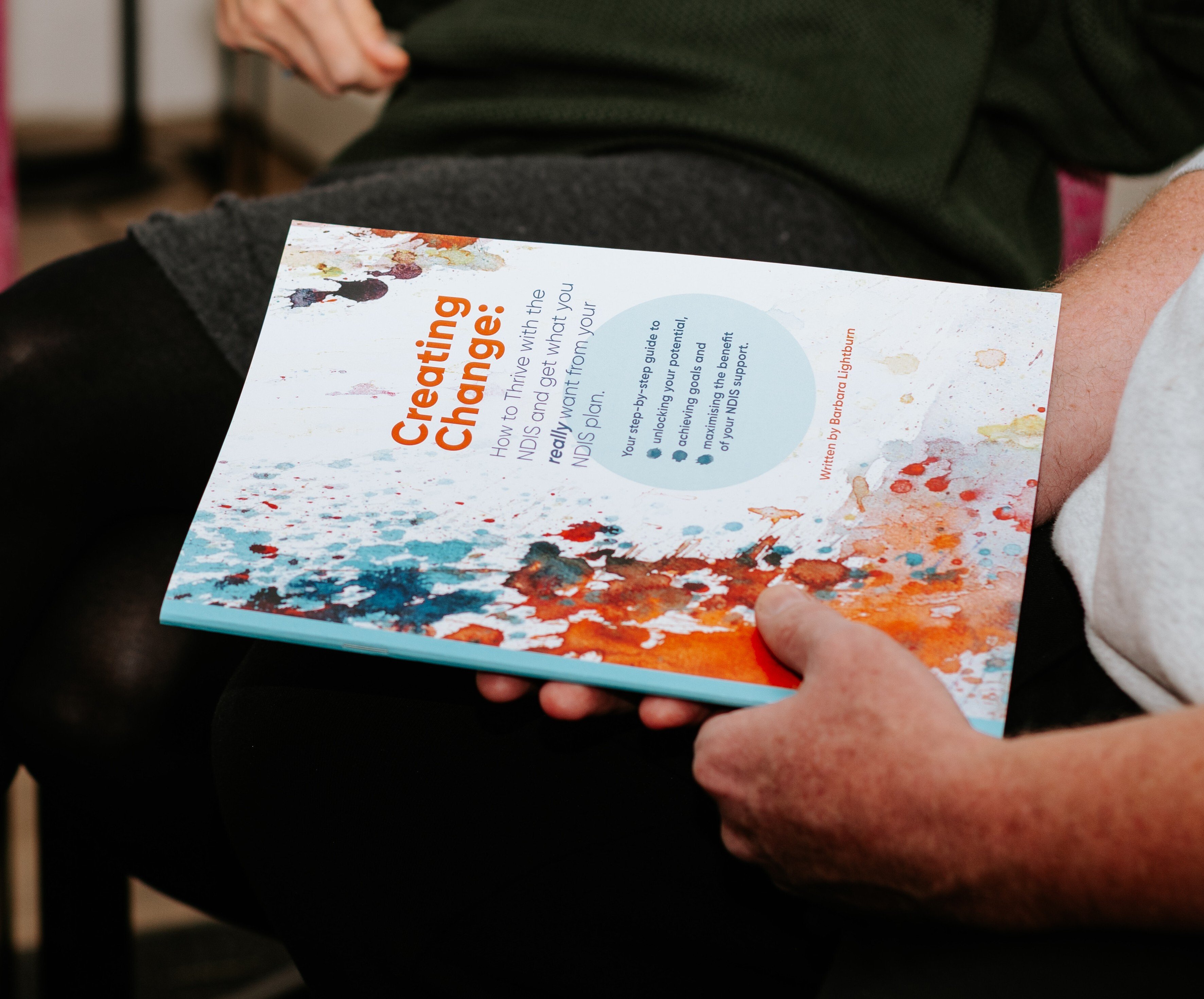
ID: A photo of a person holding the Creating Change book.

New year’s resolutions. A popular method of goal setting, but one that doesn’t tend to have the best success rate. Why?
Goals that fall by the wayside often have some things in common:
So, let’s explore creating goals.
Goal setting is something that gets talked about a lot in NDIS spaces. If you’re a participant, you’ll have been asked to set some goals for your NDIS plan. These can be anything you want, and sometimes it can be difficult to figure out what that might be.
If you work in the disability industry, or support a loved one with a disability, you’ll be looking to align outcomes with the goals of the participants you support – and you’ll have your own goals, whether they be work-based or personal.
Creating Change, written by Barbara Lightburn, is a resource to support anyone looking to hone their goal setting skills.
Top Tip – Write your goals down and monitor progress
Setting strong, personalised goals can be extremely beneficial in assisting you to achieve what you want to achieve. For many of us, having a written record and a way to track progress is very supportive. There are many ways to record your goals and monitor progress – from spreadsheets to apps to journalling, there is bound to be a method that will work for you.
At MAP, we’ve built a culture inspired by the importance of setting goals as a way to support all areas of life. Seeing our achievements gives us a sense of success, builds confidence, and empowers us to continue striving. No win is too small, and if you’re tracking your progress, you’ll get to see in real time just how far you’ve progressed, despite any setbacks or interruptions.
This is so important, because many of us notice shortcomings far more sharply than we recognise successes. Retraining your focus to be objective and positive helps you stay strong when times get tough.
Top Tip – Make your goals “SMART”
There are so many positives to learning to set goals – and beyond that, to adjust those goals when things change for you. Sometimes a goal no longer applies or may become unrealistic. Any number of things can change in the time we’re working to achieve the things we’re aiming for.
There’s a skill to strong goal setting, and it’s one that can be learned and honed. A popular method is “SMART” goals. SMART stands for:
Developed by George T. Doran, SMART goals help you be clear about what you want to do, support you to set a timeframe to keep you on track and accountable, ensuring it’s realistic and applicable to you, and assists with measuring your achievements.
On top of creating a SMART goal, you can break the goal down into manageable steps or actions. This will make it easier to monitor for those small wins and see your progress. Chapter 4 of Creating Change includes a helpful workbook section to guide you through this.
Check in and review your goals regularly – daily, weekly or monthly check ins work well for many goals, and allow you to adjust your focus, try new approaches and recognise what’s going well as you work towards your goals.
Top Tip – Develop a support network
Having support can help us towards our goals in a variety of ways. From encouragement to holding us accountable, a support network gives us people to rely on for help and perspective.
Different types of goals need different types of support. It’s important to consider who might be the best person, or group of people, to help out. From emotional support to professional guidance, there are options appropriate to every type of goal.
Online spaces are increasingly popular ways to connect with likeminded people, especially for those living rurally or regionally. Local clubs and groups might be an option too – for example, a book club or sports group could help with a goal around reading more, or learning a new fitness activity. Consider your budget and explore training or coaching options that may suit your needs.
Goals help us give our lives direction, supporting us to achieve and grow in the ways that we want. Consider your new year’s resolutions and think about how you might be able to refine and refocus them into strong, SMART goals. Have you made those small wins already? Celebrate them! Will you benefit from an accountability partner, or some guidance from someone with experience? Explore finding that support.
Most of all, remember your purpose. You set this goal for a reason. It’s yours to achieve.
 ID: Rosie at Barossa SDA Open Day, August 2025
Rosie’s not used to talking about herself, but once she starts her warmth shines through. Approaching her 65th birthday, she describes herself simply: someone who enjoys life where she can, who keeps going even when things get complicated, and who appreciates the people around her.
In 2017, Rosie was diagnosed with Neuromyelitis Optica, a condition that affects the central nervous system. That same year, she also learned she had Lupus. Both brought challenges—changes to her vision, ongoing pain, and swelling in her legs—but she adapted, bit by bit. In 2018 she experienced a TIA, and later that year a stroke, which left lasting effects. Tasks like reaching overhead cupboards or hanging clothes are difficult now, but Rosie has found her own ways of managing. She focuses on what she can do and stays connected through conversation, visits, and small things she enjoys—like planning her Christmas baking.
Though she doesn’t have family nearby, she has meaningful connections: her close friend Lisa lends a hand when needed, and there’s a long-time friend in Japan whom she hopes to visit one day. Rosie has always been a hard worker, too. She once ran a chicken farm, sold eggs, and later worked in a poultry factory—work she remembers with pride.
In 2025, when her home in Tanunda was demolished to make way for a new build, Rosie needed to find somewhere new to live. Rental options were limited, and she felt caught between services—too young for aged care, but unsure about living alone in the city. A friend’s mother offered her a place to stay, and Rosie describes this time with gratitude: she had company, support, and a chance to regroup.
With help from MAP, Rosie learned about Specialist Disability Accommodation (SDA). Exploring this option has involved talking openly about what she finds difficult and what would make daily life easier … conversations that aren’t always comfortable, but that are ultimately empowering. Having a report based on her needs has helped her discover SDA as a potential opportunity to regain independence in a way that works for her.
When Rosie imagines her ideal home, she pictures practical changes that would make a big difference: a bathroom large enough for her walker and shower chair, kitchen benches that adjust to her height so she can cook more easily, and a layout that supports her mobility. These aren’t luxuries—they’re tools to help her take part in her own life as fully as possible.
She also acknowledges, with honesty, that accepting support has been a journey. The idea of shared housing took time to get used to, but Rosie recognises that it doesn’t take away her independence.
Rosie hasn’t walked this path alone. With support, she’s now in a temporary home that’s close to her services and visited by her support team each day.
Looking ahead, Rosie is excited about settling somewhere long-term. She dreams of the day she can unpack her belongings—still stored in a shipping container on a friend’s farm—and see her things around her again. A place of her own, set up for her needs.
Rosie’s story speaks gently and clearly: a journey of adapting, reconnecting, and moving forward with quiet determination. Each step brings her closer to a home—and a life—that truly fits.
 ID: Jeneen sitting in a recliner.
I’m in my sixties. I enjoy trucking and used to be very active in the industry. I also used to train racing Greyhounds. Before my disability, I was a social butterfly, with a great network of friends, often throwing parties and barbecues. I love having company.
My two children are adults now, both very successful in their own rights! My son lives in New South Wales still, and my daughter is in Nuriootpa. My grandkids come to visit often now that I have also moved to the Barossa.
I love Human Nature! What a great band.
I lived with my husband on a property about 20 kilometres outside Binnaway, which is a small rural town in western New South Wales. Because of the impacts of my disability, I found it really difficult to leave the house and was almost never able to leave the farm. For 17 years, I only left for doctor’s appointments or hospital visits. Living so remotely, it was hard to get supports and my husband was my carer for all those years.
A big reason I moved to the Barossa was to be close to my daughter and her family. It was a really stressful process for them to support me with such a massive thing, but my Specialist Support Coordinator and My Ability Pathway really came through to help support them, and me, with everything involved.
I was helped with my move by a Specialist Support Coordinator (SSC). Before I moved, I spent some time in hospital with a broken leg. The hospital told me that I needed more support than I could get at home, so we started looking at NDIS Home and Living support options.
Huge amounts of work went on behind the scenes. My daughter helped a lot, meeting with local support providers to find me a new home. Once the house was found, the SSC juggled a lot of the logistics to help me move interstate.
I ended up flying across in an air ambulance and got to arrive in the Barossa in a limo! A nurse accompanied me from the NSW hospital. For my daughter, the whole process was very stressful and not something she wants to do again anytime soon!
Coming from a hot place, I was also in for a shock when I arrived in the cool Barossa – I didn’t even have winter clothes with me!
I love the house and am getting to know my new support team. It can actually be a little overwhelming at times to have so many people care about me.
I’ve been working with a new Occupational Therapist who is helping me stay safe and build capacity to access the local community. I’ve been working on developing new skills in my new home, which is very different to the house I used to live in. I’m also enjoying getting out and about a bit more, like going for coffee, which I couldn’t do before.
I feel like I have a lot more choice over some things now that I’m living in a town and less isolated. I get to choose when to go out, where before I wasn’t really able to leave the house with the supports I had access to. My Key Worker is helping me to get out and about, which I’m enjoying. I even got a new pair of walking shoes so I can be more active.
I’d like to keep building connection with the Barossa community and look at increasing what I’m able to do. It’s nice to reconnect with my social side.
There’s a dog next door that barks a lot! I struggle with that.
I’m currently staying in my home under Medium Term Accommodation – an NDIS support – while SDA Services assist me with exploring how to get Specialist Disability Accommodation funding in my NDIS plan.
Generally, I’m feeling so much happier since the move.

ID: Team and clients sitting and standing at outdoor benches.
Workplace culture. We’ve all heard of it. We all experience it. We all help shape it.
No matter what role we’re in or who we work with, every single one of us contributes to workplace culture.
Well, okay. But what is workplace culture?
It’s the environment created by share values, attitudes and behaviours within an organisation. Positive workplace cultures are recognisable by having:
Conversely, negative cultures blossom when these things are lacking – and can lead to toxic or even hostile workplaces. I could tell you some stories about that.
Gossiping in the workplace breaks trust. Micro-managing destroys autonomy. Passive-aggressive behaviour erodes the sense of belonging. We can all fall into these behaviours without even realising it – but when we allow or dismiss a behaviour that may have negative impacts, without calling it our or reframing it, that becomes the standard we accept.
And I get it – calling someone out or attempting to reframe our own comments is not easy. It’s uncomfortable. It might even feel unsafe. Sometimes we just don’t know what to say. I still don’t know how to respond to the colleague who repeatedly told me, “I’m not going to change.”
Working in the NDIS space, “positive behaviour” is a term we hear frequently. We all have an idea of what this means to us, but it’s generally accepted as acting in a constructive, helpful way within social norms. Being respectful and displaying emotional intelligence are other key points.
I’m not going to attempt to break down the complexity of human behaviour in a single blog post. The contributing factors and underlying science are far too vast and complex. Instead, I encourage you to think about your own behaviour or actions, and consider this: How much of it do you think is a choice?
Emotions and thoughts influence our behaviours, but they don’t have to control them. Learning to put space between our emotional responses and our reactive behaviours gives us a lot of power. It can stave off panic attacks, stop us acting in ways we later regret, keep us safe from an unexpected response and most of all, it lets us decide how to show up – for ourselves, for our workplace, for our loved ones.
I don’t want to downplay how difficult this sort of awareness can be, especially when there are other factors at play, like psychosocial health impacts and some disabilities. Personality, personal history and environment all contribute as well – it’s generally easier to speak up in a productive way in a place we feel supported than it is in a space where we feel threatened.
Imagine for a few minutes what life would look like for you if you were actively living as your “best self” – define this however you want.
How would you feel every day?
What would your goals be?
What would you be striving for?
Who would you be?
Sit with your best self for a while. Revisit them often. Then consider if your behaviours and actions support you to become your best self or if they move you away from that person. Some of us are familiar with “values” work, and this is a similar concept. Live according to your values and you’ll be much happier and healthier than if you live against them. But first you need to know what your values are.
Identify who your best self is. Break down what you need to do in your daily life to become or maintain being that person. This is different for each of us and includes seeking help from others.
I live my life by a profound and simple quote (that amazingly comes from a sit-com):
“Every decision you make from here on out should be in service of that.”
Whatever your “that” is, you’ll flourish when you live aligned with it.
So, let’s put it all together!
It’s unlikely that your best self is an angry, unfulfilled person going out of their way to cause harm to others. It’s unlikely you want to work for an organisation that encourages passive-aggression, whining or gossiping. These are things that drag us down and leave lingering feelings of unhappiness even after we’ve walked away from them.
How do you feel when you leave work? If it’s great, then recognise the good things and celebrate them with your team to continue nurturing that positive culture. If it’s not so great, think about ways things can improve and share that with those who can help you make a difference. If those people aren’t helping, find others who will.
We all contribute to the workplace culture.
What will your contribution be?
